
Catalogue Search | MBRL


Are you sure you want to remove the book from the shelf?

{{itemTitle}}
11
result(s) for
"Roberta Malee Bassett"
Sort by:
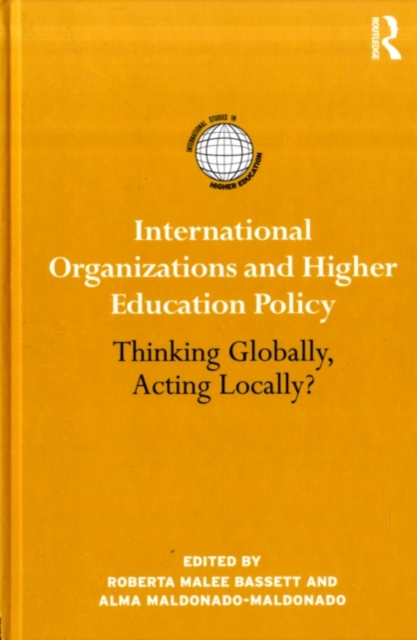
International Organizations and Higher Education Policy
Higher Education operates in an increasingly global context, and yet the examination of what drives and moves the field has remained largely focused on domestic campus leaders, national governments and institutional actors. International Organizations and Higher Education Policy expands the analysis to include the global drivers behind higher education policy, including a full array of influential organizations such as the World Bank, UNESCO, OECD, WTO, bilateral aid agencies and major private foundations. The significance of these organizations is especially pronounced in the developing world, where the expansion of higher education is happening in conjunction with the broadening influence of globalization.
International Organizations and Higher Education Policy critically analyses the impact that these influential organizations have at different levels of policy development and implementation around the world. It examines their role in higher education institutions, examines the strength of these relationships, and exposes both the positive and negative implications.
This edited volume is composed of scholars and members of these organizations from around the world. They address:
How international organizations represent the interests of the developed world and subsequently have an impact on the developing world.
How these organizations drive and shape the global agenda for higher education
How higher education as an international industry is subject to a myriad of influences, from the international to the regional level
What ethical issues emerge when international organizations intervene in national policy-making processes.
Section 1: Introduction: The history and influence of multinational/regional organizations and regimes (all terms will be explained and defined) on higher education
Section 2: Multilateral Organizations/Regimes:
Chapter 1: UNESCO: Worldwide and regional scopes
(Potential author: Stamenka Uvalic-Trumbic, UNESCO)
Chapter 2: UNESCO: A critical revision on its influence in higher education (potential author Alma Maldonado-Maldonado, Univ. of Arizona)
Chapter 3: OECD: Programmes, Centres, and other bodies investigating issues related to higher education
(potential author Stephan Vincent-Lancrin, OECD)
Chapter 4: OECD: Mechanisms of influence and critical analysis of its impact in higher education
(Potential author: Miriam Henry, Queensland University of Technology, Red Hill, Australia)
Chapter 5: The World Bank: Its role in higher education since 1944
(Likely authors: Jamil Salmi & Rick Hopper, The World Bank)
Chapter 6 The World Bank and its higher education initiatives: A critical view
(Potential author: Joel Samoff, Stanford University)
Chapter 7: The WTO: Higher education possibilities
(Potential author: Jane Knight, OISE, Toronto)
Chapter 8: The GATS: Current debate and situation
(Likely author: Roberta Malee Bassett)
Chapter 9: International organizations and bilateral aid: National interests and transnational agendas (Likely authors: Brendan Cantwell and Alma Maldonado-Maldonado, University of Arizona,)
Section 3: Regional Actors:
Chapter 10: Asia/Oceana
(Potential author: Simon Marginson, University of Melbourne)
Chapter 11: Europe
(Potential author: Pedro Lourtie, Instituto Superior—Lisbon)
Chapter 12: Latin America
(Potential author: Carmen García-Guadilla, Center for Development Studies, Central University of Venezuela)
Chapter 13: Africa
(Likely author: Damtew Teferra, The Ford Foundation and The Journal of Higher Education in Africa)
Chapter 14: Inter-American/Asian/African Development Bank
(Potential author: Suganya Hutaserani, Asian Development Bank)
Chapter 15: Regional Banks in the shadow of the World Bank: A critical examination
Chapter 16: Regional initiatives: Balancing local priorities or legitimizing global influences?
Section 4: Internationally/Regionally Active Foundations:
Chapter 17: Foundations sponsoring higher education initiatives and individuals
(Potential author, Daniel Levy, SUNY Albany)
Chapter 18: Altruism, interventionism or cooperation? Analytical discussion on Foundations supporting higher education
Section 5: Conclusions: Between the NGO’s, international organizations and corporations, where are the Nation-States?
Roberta Malee Bassett is currently serving as a higher education specialist with the World Bank, in Washington, DC.
Alma Maldonado-Maldonado is assistant professor at the Center for the Study of Higher Education at the University of Arizona.
\"The editors of this volume have given the international higher education community a valuable resource as we enter the second decade of the 21st century. This book has the potential to serve as a tool for nation states, regional consortiums, and international organizations as they consider their roles in the regulation, direction, and funding of higher education. I highly recommend it as a text in graduate-level courses in higher education and international education and could make the case that international organizations use the book as a resource to better navigate the sometimes difficult landscape of working with and understanding higher education on the national, regional, and global levels.\"-- The Review of Higher Education , Volume 33, Number 4, Summer 2010, pp. 604-606
eBook

The equity imperative in tertiary education: Promoting fairness and efficiency
While the share of the tertiary education age cohort (19–25) which is being given the opportunity to study has increased worldwide over the past two decades, this does not in fact translate into reduced inequality. For many young people, especially in the developing world, major obstacles such as disparities in terms of gender, minority population membership or disabilities as well as academic and financial barriers are still standing in their way. The authors of this article propose a conceptual framework to analyse equity issues in tertiary education and document the scope, significance and consequences of disparities in tertiary education opportunities. They throw some light on the main determinants of these inequalities and offer suggestions about effective equity promotion policies directed towards widening participation and improving the chances of success of underprivileged youths in order to create societies which uphold humanistic values. Si la proportion de la population immatriculée dans l'enseignement supérieur (groupe d'âge 19–25 ans), qui bénéficie de la possibilité de suivre des études, a augmenté à l'échelle mondiale au cours des deux dernières décennies, cette avancée ne se traduit pas dans les faits par une réduction des inégalités. De nombreux jeunes gens, notamment dans le monde en développement, se heurtent à des obstacles majeurs tels que les disparités dues au sexe, à l'appartenance à un groupe minoritaire ou à un handicap, ainsi qu'à des barrières d'ordre scolaire et financier. Les auteurs présentent un cadre conceptuel permettant d'analyser les questions d'équité dans l'enseignement supérieur et documentent l'ampleur, la portée et les conséquences des inégalités dans le secteur. Ils éclairent quelque peu les principaux déterminants de ces disparités et proposent des politiques de promotion efficace de l'équité, qui visent à élargir la participation et à améliorer les chances de réussite des jeunes défavorisés, dans la perspective de créer des sociétés porteuses de valeurs humanistes.
Journal Article

Nix the BRICs—At Least for Higher Education Scholarship
Although the “BRIC” moniker for the group of emerging economic powers—Brazil, Russia, India, and China—has become ubiquitous among financial analysts, it was actually coined by former Goldman Sachs economist Jim O’Neill as much for its clear imagery as for any actual commonalities amongst the countries (O’Neill, 2001). The bloc is even less relevant in understanding the complex higher education environments in these or other emerging economic powers such as Mexico, Indonesia, Nigeria, and Turkey (for which O’Neill has coined another clever acronym: the MINTs).
Magazine Article

Reconstructing the University: Worldwide Shifts in Academia in the 20th Century (review)
Focusing on the most basic purposes of the university-teaching and research-along with the cultural significance of individual nations' higher education systems, Frank and Gabler convincingly establish their thesis for the book: that universities in the 20th century began increasingly to move away from a domestic-or even a campus-level organizational model-toward a more universal, globally uniform structure, regardless of locale. In particular, Frank and Gabler set out to offer an alternative to two major explanations for structural changes in the university: (a) the idea of the academic pursuit being one of seeking enlightenment-progress made in the search for an absolute truth, and (b) the pervasive functionalist explanation for the \"reshuffling of university priorities\" (p. 3), which holds that the changes are purposeful adaptive responses to the student/faculty market for higher education services.
Journal Article

Measures matter
Rankings are here to stay-- the challenge is to make them more accurate and useful, argue Jamil Salmi and Roberta Malee Bassett
Journal Article

The Brain Trade
The landscape of international higher education is changing. The September 11, 2001, attacks led the United States, the top recipient of international students, to raise entry barriers. Yet there is no holding back the flow of students seeking education beyond their borders. A recent Australian study estimates that the total number of international students will increase to 8 million by 2025. It is safe to predict that most of these students will come from Asia and end up in rich Western countries, but an increasing number are looking to new options in the developing world.
Magazine Article
World University Rankings 2009
Two innovations have propelled the power of rankings into household concepts and, indeed, tools for decision-making: the 1983 debut of the US News & World Report Best Colleges ranking; and the 2003 launch of the Shanghai Jiao Tong University (SJTU) Academic Ranking of World Universities. Shared characteristics of rankings and league tables include the use of a set of weighted indicators; a rank order that implies hierarchical differences; the identification of a specific unit of comparison (institution or programme, for example); and the proliferation of reputational inputs based on stakeholder surveys, adding subjectivity to a seemingly objective exercise.
Trade Publication Article

University Expansion in a Changing Global Economy: Triumph of the BRICs?
Bassett reviews University Expansion in a Changing Global Economy: Triumph of the BRICs? by Martin Carnoy, Prashant Loyalka, Maria Dobryakova, Rafiq Dossani, Isak Froumin, Katherine Kuhns, Jandhyala B.G. Tilak, & Rong Wang.
Book Review