
Catalogue Search | MBRL


Are you sure you want to remove the book from the shelf?

{{itemTitle}}
5
result(s) for
"Robinson, Forrest G. (Forrest Glen), 1940-"
Sort by:


The jester and the sages : Mark Twain in conversation with Nietzsche, Freud, and Marx
The Jester and the Sages approaches the life and work of Mark Twain by placing him in conversation with three eminent philosophers of his time—Friedrich Nietzsche, Sigmund Freud, and Karl Marx. Unprecedented in Twain scholarship, this interdisciplinary analysis by Forrest G. Robinson, Gabriel Noah Brahm Jr., and Catherine Carlstroem rescues the American genius from his role as funny-man by exploring how his reflections on religion, politics, philosophy, morality, and social issues overlap the philosophers' developed thoughts on these subjects. Remarkably, they had much in common. During their lifetimes, Twain, Nietzsche, Freud, and Marx witnessed massive upheavals in Western constructions of religion, morality, history, political economy, and human nature. The foundations of reality had been shaken, and one did not need to be a philosopher—nor did one even need to read philosophy—to weigh in on what this all might mean. Drawing on a wide range of primary and secondary materials, the authors show that Twain was well attuned to debates of the time. Unlike his Continental contemporaries, however, he was not as systematic in developing his views. Brahm and Robinson's chapter on Nietzsche and Twain reveals their subjects' common defiance of the moral and religious truisms of their time. Both desired freedom, resented the constraints of Christian civilization, and saw punishing guilt as the disease of modern man. Pervasive moral evasion and bland conformity were the principal end result, they believed. In addition to a continuing focus on guilt, Robinson discovers in his chapter on Freud and Twain that the two men shared a lifelong fascination with the mysteries of the human mind. From the formative influence of childhood and repression, to dreams and the unconscious, the mind could free people or keep them in perpetual chains. The realm of the unconscious was of special interest to both men as it pertained to the creation of art. In the final chapter, Carlstroem and Robinson explain that, despite significant differences in their views of human nature, history, and progress, Twain and Marx were both profoundly disturbed by economic and social injustice in the world. Of particular concern was the gulf that industrial capitalism opened between the privileged elite property owners and the vast class of property-less workers. Moralists impatient with conventional morality, Twain and Marx wanted to free ordinary people from the illusions that enslaved them. Twain did not know the work's of Nietzsche, Freud, and Marx well, yet many of his thoughts cross those of his philosophical contemporaries. By focusing on the deeper aspects of Twain's intellectual makeup, Robinson, Brahm, and Carlstroem supplement the traditional appreciation of the forces that drove Twain's creativity and the dynamics of his humor.
eBook

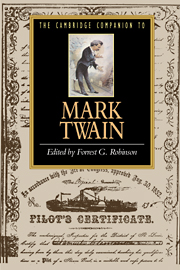
The Cambridge Companion to Mark Twain
The Cambridge Companion to Mark Twain offers new and thought provoking essays on an author of enduring pre-eminence in the American canon. The book is a collaborative project, assembled by scholars who have played crucial roles in the recent explosion of Twain criticism. Accessible enough to interest both experienced specialists and students new to Twain criticism, the essays examine Twain from a wide variety of critical perspectives, and include timely reflections by major critics on the hotly debated dynamics of race and slavery perceptible throughout his writing.
The volume includes a chronology of Twain's life and a list of suggestions for further reading, to provide the students or general reader with sources for background as well as additional information.
eBook

The Author-Cat
At the end of his long life, Samuel Clemens felt driven to write a truthful account of what he regarded as the flaws in his character and the errors of his ways. His attempt to tell the unvarnished truth about himself is preserved in nearly 250 autobiographical dictations. In order to encourage complete veracity, he decided from the outset that these would be published only posthumously.Nevertheless, Clemens's autobiography is singularly unrevealing. Forrest G. Robinson argues that, by contrast, it is in his fiction that Clemens most fully-if often inadvertently-reveals himself. He was, he confessed, like a cat who labors in vain to bury the waste that he has left behind. Robinson argues that he wrote out of an enduring need to come to terms with his remembered experiences-not to memorialize the past, but to transform it.By all accounts-including his own-Clemens's special curse was guilt. He was unable to forgive himself for the deaths of those closest to him-from his siblings' death in childhood to the deaths of his own children. Nor could he reconcile himself to his role in the Civil War, his part in the duel that prompted his departure from Virginia City in 1864, and-worst of all-his sense of moral complicity in the crimes of slavery.Tracing the theme of bad faith in all of Clemens's major writing, but with special attention to the late work, Robinson sheds new light on a tormented moral life. His book challenges conventional assumptions about the humorist's personality and creativity, directing attention to what William Dean Howells describes as the depths of a nature whose tragical seriousness broke in the laughter which the unwise took for the whole of him.
eBook