
Catalogue Search | MBRL


Are you sure you want to remove the book from the shelf?

{{itemTitle}}
43
result(s) for
"Roffe, Jon"
Sort by:

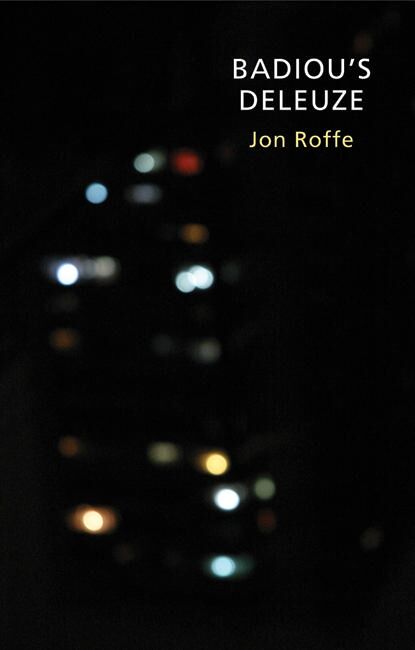
Badiou's Deleuze
Badiou's Deleuze presents the first thorough analysis of one of the most significant encounters in contemporary thought: Alain Badiou's interpretation and rejection of the philosophy of Gilles Deleuze.Badiou's reading of Deleuze is largely laid out in his provocative book, Deleuze: The Clamor of Being. Badiou's Deleuze presents a detailed examination of Badiou's reading and argues that, while it fails to do justice to the Deleuzean project, it invites us to reconsider and reassess Deleuze's power to address the ultimate concerns of philosophy. Badiou's Deleuze analyses the differing metaphysics of two of the most influential recent continental philosophers, whose divergent views have helped shape much contemporary thought.
eBook


Badiou's Deleuze
Badiou's Deleuze presents the first thorough analysis of one of the most significant encounters in contemporary thought: Alain Badiou's summary interpretation and rejection of the philosophy of Gilles Deleuze. Badiou's reading of Deleuze is largely laid out in his provocative book, Deleuze: The Clamor of Being, a highly influential work of considerable power. Badiou's Deleuze presents a detailed examination of Badiou's reading and argues that, whilst it fails to do justice to the Deleuzean project, it invites us to reconsider what Deleuze's philosophy amounts to, to reassess Deleuze's power to address the ultimate concerns of philosophy. Badiou's Deleuze analyses the differing metaphysics of two of the most influential of recent continental philosophers, whose divergent views have helped to shape much contemporary thought.
eBook

Badiou's Deleuze
Badiou's Deleuze presents the first thorough analysis of one of the most significant encounters in contemporary thought: Alain Badiou's interpretation and rejection of the philosophy of Gilles Deleuze. Badiou's reading of Deleuze is largely laid out in his provocative book, Deleuze: The Clamor of Being. Badiou's Deleuze presents a detailed examination of Badiou's reading and argues that, while it fails to do justice to the Deleuzean project, it invites us to reconsider and reassess Deleuze's power to address the ultimate concerns of philosophy. Badiou's Deleuze analyses the differing metaphysics of two of the most influential recent continental philosophers, whose divergent views have helped shape much contemporary thought.
eBook
TRUTH AND TIME
Badiou’s discussion of the themes of time and truth constitutes the most peculiar moment in his study of Deleuze. This discussion, found in chapter five ofThe Clamor of Being, is structured around a surprising string of equations such that, by the end of the chapter, the following terms have all been posited as synonymous: time, truth, the virtual, atemporal eternity, Relation and the One. Here, my concern will be less to argue against this bold string of equations, but rather to deal with the central link: the equation of time and truth. We must then discover, at least schematically,
Book Chapter
THE VIRTUAL
The heart of Badiou’s reading of Deleuze is found in his reconstruction and critique of Deleuze’s virtual–actual distinction. Indeed, the assertion that “‘Virtual’ is without any doubt the principal name of Being in Deleuze’s work” (dcb 43/65) makes clear an important touchstone of Badiou’s reading, namely, that while he thinks that Deleuze’s philosophy unfolds by way of a series of hierarchical pairs, these pairs are organized hierarchically. As a result, it is no surprise to find numerous repetitions of the claims about the virtual–actual distinction throughoutThe Clamor of Being, even when it is not this distinction as
Book Chapter
METHOD
As we have seen briefly in the previous chapter, Badiou’s central claim regarding Deleuze – that his philosophy is oriented around the thesis that Being is One – deviates substantially from a number of important moments in the latter’s work. However, the strength of Badiou’s argument is that the elaboration of this thesis takes place across a range of key concepts in Deleuze. In fact, these concepts mirror the four key concepts in Badiou’sBeing and Event:being (the One, the virtual), the event, truth and subject (thought). In other words, Badiou’s claim is not simply that Deleuze’s philosophy is
Book Chapter
THOUGHT AND THE SUBJECT
In the methodological passages near the start ofThe Clamor of Being, Badiou argues that any familiarity with Deleuze’s thought will reveal that “one could draw up an endless list of the conceptual couples that are organized according to this paramount formal opposition of the active and the passive”, and claims that “this duality clearly runs throughout Deleuze’s entire work” (DCB 33/52). For Badiou, though, this level of organization of the Deleuzean text must, however, only be treated as rhetorical or preliminary in nature. Thus he adds that “The active/passive duality indisputably exercises a strong influence on Deleuze's philosophical language
Book Chapter
IS DELEUZE A PHILOSOPHER OF THE ONE?
The claim that orients Badiou’s entire reading of Deleuze is infamous: “This philosophy is organized around a metaphysics of the One” (DCB 17/30). As philosopher of the One, Badiou claims that Deleuze has for the most part been remarkably successful. We are dealing therefore not with a failed or impossible philosophical project, but one that Deleuze has more or less successfully executed on behalf of contemporary thought. The closing lines ofThe Clamor of Beinginvoke Deleuze as “truly a most eminent apostle” (DCB 102/150) of the Spinoza for whom Being is radically unary in nature. If, as I shall
Book Chapter