
Catalogue Search | MBRL


Are you sure you want to remove the book from the shelf?

{{itemTitle}}
830
result(s) for
"Rogers, Pat"
Sort by:

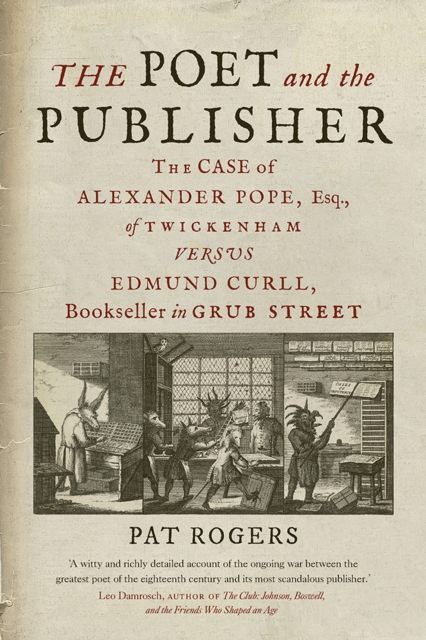
The Poet and the Publisher
\"Drawing on deep familiarity with the period and its personalities, Rogers has given us a witty and richly detailed account of the ongoing war between the greatest poet of the eighteenth century and its most scandalous publisher.\"—Leo Damrosch, author of The Club: Johnson, Boswell, and the Friends Who Shaped an Age \"What sets Rogers's history apart is his ability to combine fastidious research with lucid, unpretentious prose. History buffs and literary-minded readers alike are in for a punchy, drama-filled treat.\"— Publishers Weekly The quarrel between the poet Alexander Pope and the publisher Edmund Curll has long been a notorious episode in the history of the book, when two remarkable figures with a gift for comedy and an immoderate dislike of each other clashed publicly and without restraint. However, it has never, until now, been chronicled in full. Ripe with the sights and smells of Hanoverian London, The Poet and Publisher details their vitriolic exchanges, drawing on previously unearthed pamphlets, newspaper articles, and advertisements, court and government records, and personal letters. The story of their battles in and out of print includes a poisoning, the pillory, numerous instances of fraud, and a landmark case in the history of copyright. The book is a forensic account of events both momentous and farcical, and it is indecently entertaining.
eBook


An Essay concerning the Origine of Sciences and the Mode of Scriblerian Satire
A short satire, An Essay of the Learned Martinus Scriblerus concerning the Origine of Sciences, concerns the alleged role of an anthropoid race of pygmies in the evolution of human knowledge. It was first published in the Miscellanies of Alexander Pope and Jonathan Swift in 1732, and has been attributed to both of these authors. The aim of this article is to provide the first full account of the Essay in its context. This draws on information relating to the literary, biographical, and bibliographical circumstances in which members of the Scriblerian group produced the work. Among issues considered are relevant controversies engaged in by fellows of the Royal Society, notably Dr. John Woodward; the debt of the Essay to a pioneering work of physical anthropology, Edward Tyson’s Orang-Outang (1699), first explored by Richard Nash; and a survey of other sources, as revealed by citations and hidden allusions. The concluding argument seeks to establish the close filiation of the Essay with other Scriblerian satires and to suggest that it serves as a template for the subgenre that these came to embody. A case is made for the key role in composition taken along with Pope by Dr. John Arbuthnot, FRS, a polymath with special interests in comparative anatomy.
Journal Article
Daniel Defoe
First published in 1995. Routledge is an imprint of Taylor & Francis, an informa company.
eBook

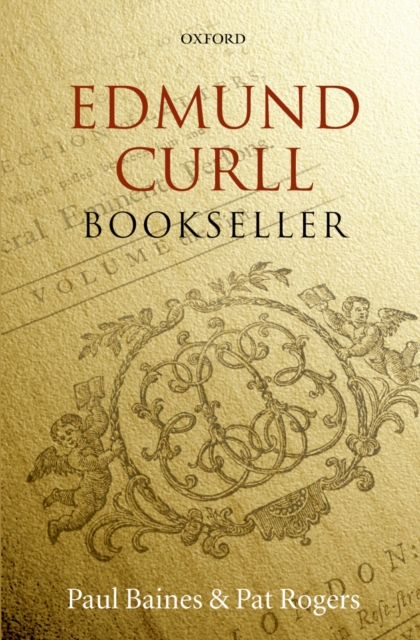
Edmund Curll, Bookseller
Edmund Curll was a notorious figure among the publishers of the early eighteenth century: for his boldness, his lack of scruple, his publication of work without authors' consent, and his taste for erotic and scandalous publications. He was in legal trouble on several occasions for piracy and copyright infringement, unauthorised publication of the works of peers, and for seditious, blasphemous, and obscene publications. He stood in the pillory in 1728 for seditious libel. Above all, he was the constant target of the greatest poet and satirist of his age, Alexander Pope, whose work he pirated whenever he could and who responded with direct physical revenge (an emetic slipped into a drink) and persistent malign caricature. The war between Pope and Curll typifies some of the main cultural battles being waged between creativity and business. The story has normally been told from the poet's point of view, though more recently Curll has been celebrated as a kind of literary freedom-fighter. This book seeks to give a balanced and thoroughly-researched account of Curll's career in publishing between 1706 and 1747, untangling the mistakes and misrepresentations that have accrued over the years and restoring a clear sense of perspective to Curll's dealings in the literary marketplace. It examines the full range of Curll's output, including his notable antiquarian series, and uses extensive archive material to detail Curll's legal and other troubles, telling what is known about this strange and awkward figure.
eBook


An Examination of Certain Abuses, Corruptions, and Enormities in the City of Dublin: Swift’s Anglo-Irish Tract
Jonathan Swift’s satirical pamphlet An Examination of Certain Abuses, Corruptions, and Enormities in the City of Dublin (published by George Faulkner in 1732) has been generally neglected. This may be in part because the main ‘abuses’ that it reviews are innocent looking street cries. However, its appearance in the volume of Irish Political Writings after 1725, in the Cambridge Edition of Swift’s works (2018), offers an opportunity for a complete reassessment. This article attempts to provide the first full analysis of the workings of the Examination. It situates the text within Swift’s writings as a whole and sets out its close relation to other satires by members of the Scriblerus group. In addition, it argues that the pamphlet, though centrally concerned with Dublin, relies heavily on matter drawn from the author’s earlier experience in London and his continuing interest in political affairs on both sides of the water. The narrator is an extreme Whig and Hanoverian with an almost paranoid obsession with Jacobites, whose seditious messages he detects underneath familiar street cries. He reverts constantly to the Oxford administration of 1710 to 1714, for whom Swift was the chief propagandist, and his principal target is its leader Robert Harley. The article concludes that Swift uses the British examples subliminally as a warning of the attitudes and intentions of the Hanoverian regime that extend to Ireland.
Journal Article