
Catalogue Search | MBRL


Are you sure you want to remove the book from the shelf?

{{itemTitle}}
7
result(s) for
"Rooney, David author"
Sort by:
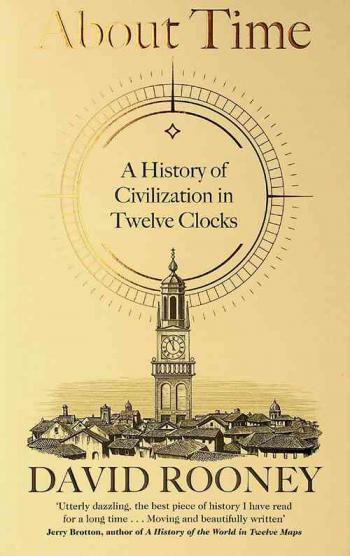
About time : a history of civilization in twelve clocks
\"A horological history of human civilisation, told through twelve world-changing clocks Since the dawn of civilization, we have kept time. But time has always been against us. From the city sundials of ancient Rome to the era of the smartwatch, clocks have been used throughout history to wield power, make money, govern citizens and keep control. In About Time, time expert David Rooney tells the story of timekeeping, and how it continues to shape our modern world. Over twelve chapters we discover how clocks have helped us navigate the world, build empires and even taken us to the brink of destruction. This is the story of time. And the story of time is the story of us\"--Publisher's description.

Kwame Nkrumah. Vision and Tragedy
The year-long celebration of Ghana's Golden Jubilee provides a fitting context for the republication of the book Kwame Nkrumah: Vision and Tragedy. In the lead-up to the celebration and over the course of the year, the life and times of Kwame Nkrumah will receive unprecedented public attention, official and unofficial. Kwame Nkrumah's very wide name-recognition is, paradoxically, accompanied by sketchy, often oversimplified knowledge about the events and processes of his life and times. For most of those born after independence in 1957, such knowledge does not extend much beyond who Kwame Nkrumah was and vague notions about he won us Independence. This book presents new material and new analysis, which helps to clarify aspects of the record, while advancing new perspectives. What comes across clearly throughout the book is the significant contribution of Nkrumah's vision and personality at a critical moment in the history of Africa and the Third World. He, perhaps more than any other, was able to identify, focus and catalyse the major factors and players driving the struggle for political independence in Ghana and liberation in other parts of Africa. In the process, he committed his life and work totally to a wide variety of activities and processes in Ghana, the continent and in the global Non-Aligned Movement.
eBook

Wisdom and Management in the Knowledge Economy
Today there are more technology, technologists, knowledge and experts than at any time in human history; but from a global perspective, it is difficult to argue that this accumulation of knowledge and technology has put the world in an unambiguously better position than it was in the past. Business is not getting any easier to do and major corporate collapses based on poor decisions, poor conduct, and poor judgement continue to occur. In public administration too, basic institutions and services (education, health, transport) seem to be continually undergoing “crises” of inadequate delivery and excessive pressure. Wisdom and Management in the Knowledge Economy explains why unwise managerial practice can happen in a world characterized by an excess of information and knowledge.
Drawing on Aristotle’s idea of practical wisdom, the book develops a theory of social practice wisdom that addresses important social psychological and sociological dynamics that underpin wise management and organizations. As well as providing a detailed theory of social practice wisdom, this book considers practical issues in organizational communication, behavior, culture, change and knowledge as well as in HRM, leadership, ethics, strategy, international business, business education, and wisdom research. By introducing the notion of social practice wisdom, aspects of social structure, organizational culture, and organizational communication needed for wisdom to flourish are for the first time rendered visible in a way that opens new possibilities for wiser management, wiser organizations, and wisdom research.
1. Wise Business in a Knowledge Society 2. What is Wisdom 3. Where did Talk of it Go? 4. Change, Ephemerality, and Fads 5. Knowledge, Innovation and Creativity 6. Human Resource Management 7. Public Administration 8. Strategy and Business Policy 9. International Business 10. Communication Management 11. Intellectual Leadership and the Wise Leader 12. Management Education 13. Wisdom Problematics and Limitations
David Rooney is a Senior Lecturer in Knowledge Management, UQ Business School. He has researched, taught and published widely in the areas of the knowledge-based economy, knowledge management, and wisdom. His books include Public Policy in the Knowledge-Based Economy, the Handbook on the Knowledge Economy, and Knowledge Policy: Challenges for the Twenty First Century. Rooney has published in many leading academic journals including The Leadership Quarterly, Public Administration Review, Human Relations, and Management Communication Quarterly.
Peter Liesch is a Professor of International Business and Chair of the Strategy Cluster in the UQ Business School at The University of Queensland, Australia. He has a textbook published by McGraw-Hill: Dowling, Liesch, Gray and Hill (2009) International Business, Asia-Pacific Edition. He has published many book chapters, and widely in academic journals including Journal of International Business Studies, Journal of Operations Management, Journal of World Business, and others. He is Editor of the Management & Entrepreneurship Department at the Journal of World Business.
Bernard McKenna is a Senior Lecturer in Communication, UQ Business School. He has won two large industry-funded ARC grants and has about 100 research outputs (including books, book chapters, journal articles, conference papers, and other publications). Academic journal publications include Applied Linguistics, Critical Discourse Studies, Leadership Quarterly , and others. He is on the Advisory Board of the Journal of Technical Writing and Communication, Critical Discourse Studies (also Book Review Editor), Communication Studies, and Critical Approaches to Discourse Analysis across Disciplines.
eBook


The big hop : the first non-stop flight across the Atlantic Ocean and into the future
Newfoundland, 1919. Buffeted by winds, an unwieldy aircraft - made mainly from wood and stiff linen - struggled to take off from the North American island's rocky slopes. Cramped side by side in its open cockpit were two men, freezing cold and barely able to move but resolute. They had a dream: to be the first in human history to fly, non-stop, across the Atlantic Ocean. But there were three other teams competing against them, and as the waves raged a few miles below, memories of wartime crashes resurfaced. Mining letters, diaries and evocative unpublished photographs, David Rooney's deeply researched account of the audacious contest shows how it was the airmen's thrilling wartime experiences that ultimately led them to the 'Big Hop', and brought old friends together for one more daring adventure.
BOOK

Mathematics : how it shaped our world
Mathematics is not just the product of lone geniuses dreaming up ideas remote from everyday life: real social, political and cultural problems drive developments in the subject, and the work of mathematical practitioners surrounds us everywhere we look. This lavishly illustrated book accompanies the Science Museum's landmark new Mathematics: The Winton Gallery. It includes an absorbing series of essays by world-leading experts in the history and modern practice of mathematics, alongside vivid accounts of mathematical work underpinning some of our most fundamental human concerns, from life and death to war and peace, money, trade, beauty and our attempts to control nature's most elemental forces. 'Mathematics' uses the world-class collections of the Science Museum to offer a vivid vision of the people behind 400 years of mathematical practice, driven by problems that affect us all.
Book