
Catalogue Search | MBRL


Are you sure you want to remove the book from the shelf?

{{itemTitle}}
105
result(s) for
"Rosato, Sebastian"
Sort by:


Europe's Troubles: Power Politics and the State of the European Project
The 1990s were years of great optimism in Europe. As the Europeans were putting the finishing touches on their economic community, observers predicted that political and military integration would soon follow. Optimism has turned to pessimism since the turn of the century, however. Most analysts believe that the economic community is in crisis, and hardly anyone predicts the creation of a political or military counterpart to it. Why has the European project run into trouble and what does the future hold? The answers to these questions are largely to be found in the distribution of power. It was the overwhelming power of the Soviet Union that drove the Western Europeans to consider a variety of integration initiatives and to build and maintain the European Community (EC) during the Cold War. In 1991 the collapse of the Soviet Union deprived them of a compelling geostrategic reason to pursue further integration or even to preserve their economic community. As a result, the Europeans have made no real effort to establish a political or military community over the past two decades, and the EC has slowly started to fray. As long as there are no significant changes in the balance of power going forward, worse times lie ahead.
Journal Article

Europe United
The construction of the European Community (EC) has widely been
understood as the product of either economic self-interest or
dissatisfaction with the nation-state system. In Europe United,
Sebastian Rosato challenges these conventional explanations,
arguing that the Community came into being because of balance of
power concerns. France and the Federal Republic of Germany-the two
key protagonists in the story-established the EC at the height of
the cold war as a means to balance against the Soviet Union and one
another.
More generally, Rosato argues that international institutions,
whether military or economic, largely reflect the balance of power.
In his view, states establish institutions in order to maintain or
increase their share of world power, and the shape of those
institutions reflects the wishes of their most powerful members.
Rosato applies this balance of power theory of cooperation to
several other cooperative ventures since 1789, including various
alliances and trade pacts, the unifications of Italy and Germany,
and the founding of the United States. Rosato concludes by arguing
that the demise of the Soviet Union has deprived the EC of its
fundamental purpose. As a result, further moves toward political
and military integration are improbable, and the economic community
is likely to unravel to the point where it becomes a shadow of its
former self.
The construction of the European Community (EC) has widely been
understood as the product of either economic self-interest or
dissatisfaction with the nation-state system. In Europe
United , Sebastian Rosato challenges these conventional
explanations, arguing that the Community came into being because of
balance of power concerns. France and the Federal Republic of
Germany-the two key protagonists in the story-established the EC at
the height of the cold war as a means to balance against the Soviet
Union and one another.
More generally, Rosato argues that international institutions,
whether military or economic, largely reflect the balance of power.
In his view, states establish institutions in order to maintain or
increase their share of world power, and the shape of those
institutions reflects the wishes of their most powerful members.
Rosato applies this balance of power theory of cooperation to
several other cooperative ventures since 1789, including various
alliances and trade pacts, the unifications of Italy and Germany,
and the founding of the United States. Rosato concludes by arguing
that the demise of the Soviet Union has deprived the EC of its
fundamental purpose. As a result, further moves toward political
and military integration are improbable, and the economic community
is likely to unravel to the point where it becomes a shadow of its
former self.
eBook

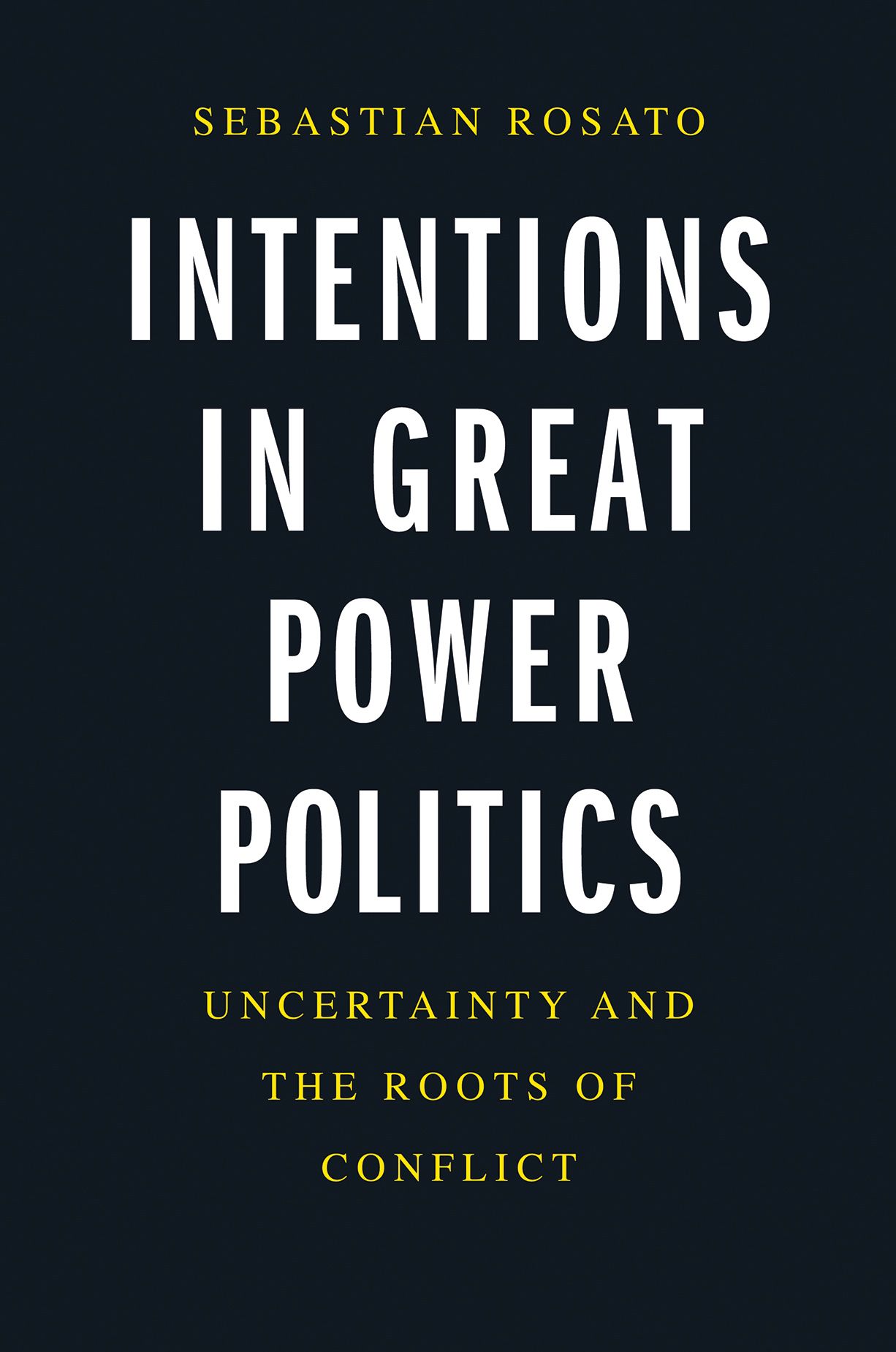
Intentions in Great Power Politics
Why the future of great power politics is likely to
resemble its dismal past Can great powers be confident
that their peers have benign intentions? States that trust each
other can live at peace; those that mistrust each other are doomed
to compete for arms and allies and may even go to war. Sebastian
Rosato explains that states routinely lack the kind of information
they need to be convinced that their rivals mean them no harm. Even
in cases that supposedly involved mutual trust-Germany and Russia
in the Bismarck era; Britain and the United States during the great
rapprochement; France and Germany, and Japan and the United States
in the early interwar period; and the Soviet Union and United
States at the end of the Cold War-the protagonists mistrusted each
other and struggled for advantage. Rosato argues that the
ramifications of his argument for U.S.-China relations are
profound: the future of great power politics is likely to resemble
its dismal past.
eBook
Balancing in Neorealism
Does neorealism offer a convincing account of great power balancing behavior? Many scholars argue that it does not. This conclusion rests on a misunderstanding of neorealist theory and an erroneous reading of the evidence. Properly specified, neorealism holds that great powers place an overriding emphasis on the need for self-help. This means that they rely relentlessly both on arming and on imitating the successful military practices of their peers to ensure their security. At the same time, they rarely resort to alliances and treat them with skepticism. There is abundant historical evidence to support these claims. Since 1816, great powers have routinely achieved an effective balance in military capabilities with their relevant competitors and promptly copied the major military innovations of the period. Case studies show that these outcomes are the product of states' efforts to ensure security against increasingly capable rivals. Meanwhile, the diplomatic record yields almost no examples of firm peacetime balancing coalitions over the past 200 years. When alliances have formed, great powers have generally doubted the reliability of their allies and of their opponents' allies. Thus neorealism provides a solid foundation for explaining great power balancing behavior.
Journal Article
Correspondence: Neoclassical Realism and Its Critics
Letter to the editor on Kevin Narizny, \"On Systemic Paradigms and Domestic Politics: A Critique of the Newest Realism,\" International Security, Vol. 42, No. 2 (Fall 2017), pp. 155-190
Journal Article
The Inscrutable Intentions of Great Powers
Can great powers reach confident conclusions about the intentions of their peers? Many scholars argue that they can. One set of arguments holds that states can deduce others' current intentions from certain domestic characteristics such as their foreign policy goals, ideology, or regime type. Another focuses on behavior and maintains that states can infer current intentions by examining their counterparts' arms policies, membership in international institutions, or past actions in the security realm. A final set of arguments explains why intentions are unlikely to change and thus why current designs are good predictors of future plans. On careful review, these optimistic claims are unpersuasive. Great powers cannot confidently assess the current intentions of others based on the latter's domestic characteristics or behavior, and they are even less sure when it comes to estimating their peers' future intentions. These findings have important implications for theory and policy. Theoretically, they strengthen structural realism against competing approaches. As for the real world, they suggest that the United States and China are on a collision course if the latter continues to rise and becomes a peer competitor.
Journal Article

The Flawed Logic of Democratic Peace Theory
Democratic peace theory is probably the most powerful liberal contribution to the debate on the causes of war and peace. In this paper I examine the causal logics that underpin the theory to determine whether they offer compelling explanations for the finding of mutual democratic pacifism. I find that they do not. Democracies do not reliably externalize their domestic norms of conflict resolution and do not trust or respect one another when their interests clash. Moreover, elected leaders are not especially accountable to peace loving publics or pacific interest groups, democracies are not particularly slow to mobilize or incapable of surprise attack, and open political competition does not guarantee that a democracy will reveal private information about its level of resolve thereby avoiding conflict. Since the evidence suggests that the logics do not operate as stipulated by the theory's proponents, there are good reasons to believe that while there is certainly peace among democracies, it may not be caused by the democratic nature of those states.
Journal Article
The inscrutable intentions of great powers
Can great powers reach confident conclusions about the intentions of their peers? The answer to this question has important implications for U.S. national security policy. According to one popular view, the United States and China are destined to compete unless they can figure out each other's designs. A recent Brookings Institution report warns that although \"Beijing and Washington seek to build a constructive partnership for the long run,\" they may be headed for trouble given their \"mutual distrust of [the other's] long-term intentions.\" Similarly, foreign policy experts James Steinberg and Michael O'Hanlon argue that \"trust in both capitals... remains scarce, and the possibility of an accidental or even intentional conflict between the United States and China seems to be growing.\" Reversing this logic, many analysts believe that U.S.-China relations may improve if the two sides clarify their intentions. Thus the Pentagon's latest strategic guidance document declares that if China wants to \"avoid causing friction\" in East Asia, then its military growth must be \"accompanied by greater clarity of its strategic intentions.\" Meanwhile China scholars Andrew Nathan and Andrew Scobell recommend that even as the United States builds up its capabilities and alliances, it should \"reassure Beijing that these moves are intended to create a balance of common interests rather than to threaten China.\"
Journal Article