
Catalogue Search | MBRL


Are you sure you want to remove the book from the shelf?

{{itemTitle}}
6
result(s) for
"Rosenbaum, Jonathan, author"
Sort by:


Abbas Kiarostami
Before his death in 2016, Abbas Kiarostami wrote or directed more than thirty films in a career that mirrored Iranian cinema's rise as an international force. His 1997 feature Taste of Cherry made him the first Iranian filmmaker to win the Palme d'Or at Cannes. Critics' polls continue to place Close-Up (1990) and Through the Olive Trees (1994) among the masterpieces of world cinema. Yet Kiarostami's naturalistic impulses and winding complexity made him one of the most divisive--if influential--filmmakers of his time. In this expanded second edition, award-winning Iranian filmmaker Mehrnaz Saeed-Vafa and film critic Jonathan Rosenbaum renew their illuminating cross-cultural dialogue on Kiarostami's work. The pair chart the filmmaker's late-in-life turn toward art galleries, museums, still photography, and installations. They also bring their distinct but complementary perspectives to a new conversation on the experimental film Shirin. Finally, Rosenbaum offers an essay on watching Kiarostami at home while Saeed-Vafa conducts a deeply personal interview with the director on his career and his final feature, Like Someone in Love.
eBook
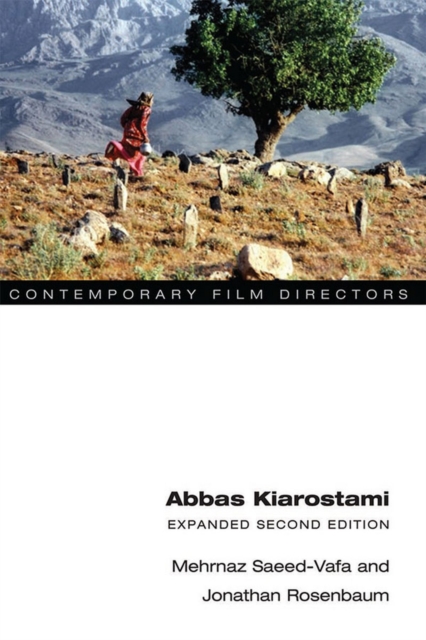
Abbas Kiarostami
Before his death in 2016, Abbas Kiarostami wrote or directed more than thirty films in a career that mirrored Iranian cinema's rise as an international force. His 1997 feature Taste of Cherry made him the first Iranian filmmaker to win the Palme d'Or at Cannes. Critics' polls continue to place Close-Up (1990) and Through the Olive Trees (1994) among the masterpieces of world cinema. Yet Kiarostami's naturalistic impulses and winding complexity made him one of the most divisive--if influential--filmmakers of his time. In this expanded second edition, award-winning Iranian filmmaker Mehrnaz Saeed-Vafa and film critic Jonathan Rosenbaum renew their illuminating cross-cultural dialogue on Kiarostami's work. The pair chart the filmmaker's late-in-life turn toward art galleries, museums, still photography, and installations. They also bring their distinct but complementary perspectives to a new conversation on the experimental film Shirin. Finally, Rosenbaum offers an essay on watching Kiarostami at home while Saeed-Vafa conducts a deeply personal interview with the director on his career and his final feature, Like Someone in Love.
eBook

Essential Cinema
In his astute and deeply informed film reviews and essays, Jonathan Rosenbaum regularly provides new and brilliant insights into the cinema as art, entertainment, and commerce. Guided by a personal canon of great films, Rosenbaum sees, in the ongoing hostility toward the idea of a canon shared by many within the field of film studies, a missed opportunity both to shape the discussion about cinema and to help inform and guide casual and serious filmgoers alike. In Essential Cinema, Rosenbaum forcefully argues that canons of great films are more necessary than ever, given that film culture today is dominated by advertising executives, sixty-second film reviewers, and other players in the Hollywood publicity machine who champion mediocre films at the expense of genuinely imaginative and challenging works. He proposes specific definitions of excellence in film art through the creation a personal canon of both well-known and obscure movies from around the world and suggests ways in which other canons might be similarly constructed. Essential Cinema offers in-depth assessments of an astonishing range of films: established classics such as Rear Window, M, and Greed; ambitious but flawed works like The Thin Red Line and Breaking the Waves; eccentric masterpieces from around the world, including Irma Vep and Archangel; and recent films that have bitterly divided critics and viewers, among them Eyes Wide Shut and A.I. He also explores the careers of such diverse filmmakers as Robert Altman, Raúl Ruiz, Frank Tashlin, Elaine May, Sam Fuller, Terrence Davies, Edward Yang, Hou Hsiao-hsien, and Orson Welles. In conclusion, Rosenbaum offers his own film canon of 1,000 key works from the beginning of cinema to the present day. A cogent and provocative argument about the art of film, Essential Cinema is also a fiercely independent reference book of must-see movies for film lovers everywhere.
eBook

Discovering Orson Welles
Of the dozens of books written about Orson Welles, most focus on the central enigma of Welles's career: why did someone so extravagantly talented neglect to finish so many projects? Film critic Jonathan Rosenbaum has long believed that to dwell on this aspect of the Welles canon is to overlook the wealth of information available by studying the unrealized works.Discovering Orson Wellescollects Rosenbaum's writings to date on Welles-some thirty-five years of them-and makes an irrefutable case for the seriousness of his work, illuminating both Welles the artist and Welles the man. The book is also a chronicle of Rosenbaum's highly personal writer's journey and his efforts to arrive at the truth. The essays, interviews, and reviews are arranged chronologically and are accompanied by commentary that updates the scholarship. Highlights include Rosenbaum's 1972 interview with Welles about his first Hollywood project,Heart of Darkness;Rosenbaum's rebuttal to Pauline Kael's famous essay \"Raising Kane\"; detailed essays and comprehensive discussions of Welles's major unfinished work, including two unrealized projects,The Big Brass RingandThe Cradle Will Rock;and an account of Rosenbaum's work as consultant on the 1998 re-editing ofTouch of Evil,based on a studio memo by Welles.
eBook
