
Catalogue Search | MBRL


Are you sure you want to remove the book from the shelf?

{{itemTitle}}
2,378
result(s) for
"Ross, Elizabeth"
Sort by:

Paula Danziger's Amber Brown is tickled pink
Nine-year-old Amber is nervous and excited about her mother's wedding to Max, but Amber's father makes things complicated.
Book

Picturing experience in the early printed book : Breydenbach's Peregrinatio from Venice to Jerusalem
Bernhard von Breydenbach's Peregrinatio in terram sanctam (Journey to the Holy Land), first published in 1486, is one of the seminal books of early printing and is especially renowned for the originality of its woodcuts. In Picturing Experience in the Early Printed Book, Elizabeth Ross considers the Peregrinatio from a variety of perspectives to explain its value for the cultural history of the period. Breydenbach, a high-ranking cleric in Mainz, recruited the painter Erhard Reuwich of Utrecht for a religious and artistic adventure in a political hot spot—a pilgrimage to research the peoples, places, plants, and animals of the Levant. The book they published after their return ambitiously engaged with the potential of the new print medium to give an account of their experience.
The Peregrinatio also aspired to rouse readers to a new crusade against Islam by depicting a contest in the Mediterranean between the Christian bastion of the city of Venice and the region's Muslim empires. This crusading rhetoric fit neatly with the state of the printing industry in Mainz, which largely subsisted as a tool for bishops' consolidation of authority, including selling the pope's plans to combat the Ottoman Empire.
Taking an artist on such an enterprise was unprecedented. Reuwich set a new benchmark for technical achievement with his woodcuts, notably a panorama of Venice that folds out to 1.62 meters in length and a foldout map that stretches from Damascus to Sudan around the first topographically accurate view of Jerusalem. The conception and execution of the Peregrinatio show how and why early printed books constructed new means of visual representation from existing ones—and how the form of a printed book emerged out of the interaction of eyewitness experience and medieval scholarship, real travel and spiritual pilgrimage, curiosity and fixed belief, texts and images.
eBook
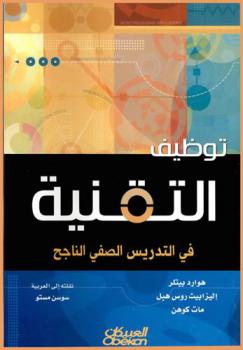
توظيف التقنية في التدريس الصفي الناجح
\"توظيف التقنية في التدريس الصفي الناجح\" للمؤلف \"هوارد بيتلر [ومجموعة آخرون]\" فى حوالى (293) صفحة من القطع المتوسط. وجاءت محتوياته كالتالى : -وضع أهداف محددة ومرنة. -وضع مخططات مسبقة وعروض غير لغوية. -مساعدة الطلاب على كتابة الملاحظات والتلخيص وإجراء المقارنات. -مشاركة الطلاب في التعلم التعاوني -مساعدة الطلاب على وضع الفرضيات واختبارها. -دعم الطلاب في ممارسة مهارات جديدة وحل الواجبات المنزلية. -تعزيز جهود الطلاب من خلال التقويم البنائي والتغذية الراجعة والتقدير. يركز كل فصل من فصول الكتاب على واحدة من هذه الإستراتيجيات، ويتضمن أمثلة من المستويات التعليمية والمقررات التدريسية مستمدة من خطط ومشروعات في دروس حقيقية لمدرسين يستخدمون التكنولوجيا داخل قاعة الدروس بطرق جذابة وملهمة للطلاب. ويوصي مؤلفو الكتاب أيضا بعشرات من تطبيقات معالجة النصوص وإنشاء برامج الجدولة والألعاب التعليمية وأدوات جمع البيانات والمصادر على شبكة الإنترنت التي يمكن أن تساعد على جعل الدروس أكثر تسلية وتحديا، والأهم أكثر فاعلية.
Book

A spatially resolved brain region- and cell type-specific isoform atlas of the postnatal mouse brain
Splicing varies across brain regions, but the single-cell resolution of regional variation is unclear. We present a single-cell investigation of differential isoform expression (DIE) between brain regions using single-cell long-read sequencing in mouse hippocampus and prefrontal cortex in 45 cell types at postnatal day 7 (
www.isoformAtlas.com
). Isoform tests for DIE show better performance than exon tests. We detect hundreds of DIE events traceable to cell types, often corresponding to functionally distinct protein isoforms. Mostly, one cell type is responsible for brain-region specific DIE. However, for fewer genes, multiple cell types influence DIE. Thus, regional identity can, although rarely, override cell-type specificity. Cell types indigenous to one anatomic structure display distinctive DIE, e.g. the choroid plexus epithelium manifests distinct transcription-start-site usage. Spatial transcriptomics and long-read sequencing yield a spatially resolved splicing map. Our methods quantify isoform expression with cell-type and spatial resolution and it contributes to further our understanding of how the brain integrates molecular and cellular complexity.
Alternative RNA splicing varies across the brain. Its mapping at single cell resolution is unclear. Here, the authors provide a spatial and single-cell splicing atlas reporting brain region- and cell type-specific expression of different isoforms in the postnatal mouse brain.
Journal Article

The Hunger Games
Set in a future where the Capitol selects a boy and girl from the twelve districts to fight to the death on live television. Katniss Everdeen volunteers to take her younger sister's place for the latest match.
DVD

Unlocking the genetic complexity of congenital hydrocephalus
Genome sequencing of patients with sporadic congenital hydrocephalus reveals mutations of large effect size indicative of a developmental origin for the disease.
Journal Article

Single-cell isoform RNA sequencing characterizes isoforms in thousands of cerebellar cells
Full-length spliced RNA isoforms are identified in thousands of single cerebellar cells.
Full-length RNA sequencing (RNA-Seq) has been applied to bulk tissue, cell lines and sorted cells to characterize transcriptomes
1
,
2
,
3
,
4
,
5
,
6
,
7
,
8
,
9
,
10
,
11
, but applying this technology to single cells has proven to be difficult, with less than ten single-cell transcriptomes having been analyzed thus far
12
,
13
. Although single splicing events have been described for ≤200 single cells with statistical confidence
14
,
15
, full-length mRNA analyses for hundreds of cells have not been reported. Single-cell short-read 3′ sequencing enables the identification of cellular subtypes
16
,
17
,
18
,
19
,
20
,
21
, but full-length mRNA isoforms for these cell types cannot be profiled. We developed a method that starts with bulk tissue and identifies single-cell types and their full-length RNA isoforms without fluorescence-activated cell sorting. Using single-cell isoform RNA-Seq (ScISOr-Seq), we identified RNA isoforms in neurons, astrocytes, microglia, and cell subtypes such as Purkinje and Granule cells, and cell-type-specific combination patterns of distant splice sites
6
,
7
,
8
,
9
,
22
,
23
. We used ScISOr-Seq to improve genome annotation in mouse Gencode version 10 by determining the cell-type-specific expression of 18,173 known and 16,872 novel isoforms.
Journal Article

Metagenomic Predictions: From Microbiome to Complex Health and Environmental Phenotypes in Humans and Cattle
Mammals have a large cohort of endo- and ecto- symbiotic microorganisms (the microbiome) that potentially influence host phenotypes. There have been numerous exploratory studies of these symbiotic organisms in humans and other animals, often with the aim of relating the microbiome to a complex phenotype such as body mass index (BMI) or disease state. Here, we describe an efficient methodology for predicting complex traits from quantitative microbiome profiles. The method was demonstrated by predicting inflammatory bowel disease (IBD) status and BMI from human microbiome data, and enteric greenhouse gas production from dairy cattle rumen microbiome profiles. The method uses unassembled massively parallel sequencing (MPS) data to form metagenomic relationship matrices (analogous to genomic relationship matrices used in genomic predictions) to predict IBD, BMI and methane production phenotypes with useful accuracies (r = 0.423, 0.422 and 0.466 respectively). Our results show that microbiome profiles derived from MPS can be used to predict complex phenotypes of the host. Although the number of biological replicates used here limits the accuracy that can be achieved, preliminary results suggest this approach may surpass current prediction accuracies that are based on the host genome. This is especially likely for traits that are largely influenced by the gut microbiota, for example digestive tract disorders or metabolic functions such as enteric methane production in cattle.
Journal Article
Single-nuclei isoform RNA sequencing unlocks barcoded exon connectivity in frozen brain tissue
Single-nuclei RNA sequencing characterizes cell types at the gene level. However, compared to single-cell approaches, many single-nuclei cDNAs are purely intronic, lack barcodes and hinder the study of isoforms. Here we present single-nuclei isoform RNA sequencing (SnISOr-Seq). Using microfluidics, PCR-based artifact removal, target enrichment and long-read sequencing, SnISOr-Seq increased barcoded, exon-spanning long reads 7.5-fold compared to naive long-read single-nuclei sequencing. We applied SnISOr-Seq to adult human frontal cortex and found that exons associated with autism exhibit coordinated and highly cell-type-specific inclusion. We found two distinct combination patterns: those distinguishing neural cell types, enriched in TSS-exon, exon-polyadenylation-site and non-adjacent exon pairs, and those with multiple configurations within one cell type, enriched in adjacent exon pairs. Finally, we observed that human-specific exons are almost as tightly coordinated as conserved exons, implying that coordination can be rapidly established during evolution. SnISOr-Seq enables cell-type-specific long-read isoform analysis in human brain and in any frozen or hard-to-dissociate sample.
Complete RNA isoforms are captured by a new single-nuclei sequencing method.
Journal Article
Genomic prediction using low-coverage portable Nanopore sequencing
Most traits in livestock, crops and humans are polygenic, that is, a large number of loci contribute to genetic variation. Effects at these loci lie along a continuum ranging from common low-effect to rare high-effect variants that cumulatively contribute to the overall phenotype. Statistical methods to calculate the effect of these loci have been developed and can be used to predict phenotypes in new individuals. In agriculture, these methods are used to select superior individuals using genomic breeding values; in humans these methods are used to quantitatively measure an individual’s disease risk, termed polygenic risk scores. Both fields typically use SNP array genotypes for the analysis. Recently, genotyping-by-sequencing has become popular, due to lower cost and greater genome coverage (including structural variants). Oxford Nanopore Technologies’ (ONT) portable sequencers have the potential to combine the benefits genotyping-by-sequencing with portability and decreased turn-around time. This introduces the potential for in-house clinical genetic disease risk screening in humans or calculating genomic breeding values on-farm in agriculture. Here we demonstrate the potential of the later by calculating genomic breeding values for four traits in cattle using low-coverage ONT sequence data and comparing these breeding values to breeding values calculated from SNP arrays. At sequencing coverages between 2X and 4X the correlation between ONT breeding values and SNP array-based breeding values was > 0.92 when imputation was used and > 0.88 when no imputation was used. With an average sequencing coverage of 0.5x the correlation between the two methods was between 0.85 and 0.92 using imputation, depending on the trait. This suggests that ONT sequencing has potential for in clinic or on-farm genomic prediction, however, further work to validate these findings in a larger population still remains.
Journal Article