
Catalogue Search | MBRL


Are you sure you want to remove the book from the shelf?

{{itemTitle}}
87
result(s) for
"Rowan, Steven W"
Sort by:


The Baron in the Grand Canyon
In The Baron in the Grand Canyon, Steven Rowan presents the first comprehensive look at the life of Baron Friedrich Wilhelm von Egloffstein, mapmaker, artist, explorer, and inventor. Utilizing new German and American sources, Rowan clarifies many mysteries about the life of this major artist and cartographer of the American West. This revealing account concentrates on Egloffstein's activity in the American mountain West from 1853 to 1858. The early chapters cover his roots as a member of an imperial baronial family in Franconia, his service in the Prussian army, his arrival in the United States in 1846, and his links to his scandalous gothic-novelist cousin, Baron Ludwig von Reizenstein. Egloffstein's work as a cartographer in St. Louis in the 1840s led to his participation in John C. Frémont's final expedition to the West in 1853 and 1854. He left Frémont for Salt Lake City where he joined the Gunnison Expedition under the leadership of Edward Beckwith. During this time, Egloffstein produced his most outstanding panoramas and views of the expedition, which were published in Pacific Railroad Reports. Egloffstein also served along with Heinrich Balduin Möllhusen as one of the artists and as the chief cartographer of Joseph Christmas Ives's expedition up the Colorado River. The two large maps produced by Egloffstein for the expedition report are regarded as classics of American art and cartography in the nineteenth century. While with the Ives expedition, Egloffstein performed his revolutionary experiments in printing photographic images. He developed a procedure for working from photographs of plaster models of terrain, and that led him to invent \"heliography,\" a method of creating printing plates directly from photographs. He later went on to launch a company to exploit his photographic printing process, which closed after only a few years of operation. Among the many images in this engaging narrative are photographs of the Egloffstein castle and of Egloffstein in 1865 and in his later years. Also include are illustrations that were published in the PRR, such as \"View Showing the Formation of the Cañon of Grand River [today called the Gunnison River] / near the Mouth of Lake Fork with Indications of the Formidable Side Cañons\" and Beckwith Map 1: \"From the Valley of Green River to the Great Salt Lake.\"
eBook

This idea is brilliant : lost, overlooked, and underappreciated scientific concepts everyone should know
Presents essays responding to a question about what scientific term or concept ought to be more widely known, written by such authors as Jared Diamond, Richard Thaler, Richard Dawkins, Lisa Randall, Steven Pinker, and Carlo Roveri.
BOOK
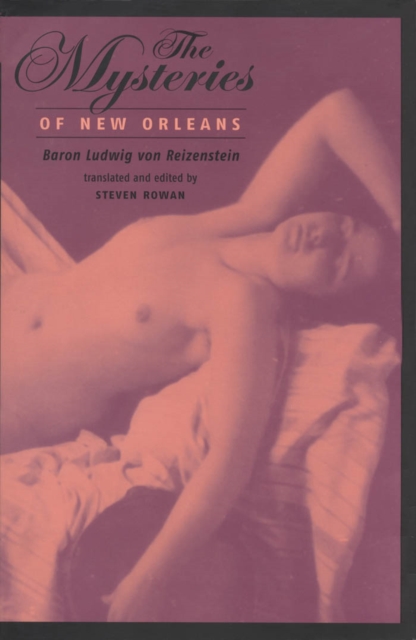
The Mysteries of New Orleans
One of the most scandalous books published in America at the time. \"Reizenstein's peculiar vision of New Orleans is worth resurrecting precisely because it crossed the boundaries of acceptable taste in nineteenth-century German America and squatted firmly on the other side . . . This work makes us realize how limited our notions were of what could be conceived by a fertile American imagination in the middle of the nineteenth century.\"—from the Introduction by Steven Rowan A lost classic of America's neglected German-language literary tradition, The Mysteries of New Orleans by Baron Ludwig von Reizenstein first appeared as a serial in the Louisiana Staats-Zeitung, a New Orleans German-language newspaper, between 1854 and 1855. Inspired by the gothic \"urban mysteries\" serialized in France and Germany during this period, Reizenstein crafted a daring occult novel that stages a frontal assault on the ethos of the antebellum South. His plot imagines the coming of a bloody, retributive justice at the hands of Hiram the Freemason—a nightmarish, 200-year-old, proto-Nietzschean superman—for the sin of slavery. Heralded by the birth of a black messiah, the son of a mulatto prostitute and a decadent German aristocrat, this coming revolution is depicted in frankly apocalyptic terms. Yet, Reizenstein was equally concerned with setting and characters, from the mundane to the fantastic. The book is saturated with the atmosphere of nineteenth-century New Orleans, the amorous exploits of its main characters uncannily resembling those of New Orleans' leading citizens. Also of note is the author's progressively matter-of-fact portrait of the lesbian romance between his novel's only sympathetic characters, Claudine and Orleana. This edition marks the first time that The Mysteries of New Orleans has been translated into English and proves that 150 years later, this vast, strange, and important novel remains as compelling as ever.
eBook


The Common Penny (1495–99) as a Source of German Social and Demographic History
The returns of a tax called the common penny (gemeiner Pfennig) survive in considerable number, and when they are fully exploited they will help to make pre-Reformation Germany much more intimately known than ever before. Registers of this levy are likely to turn up in archives where they might not be expected. It is important, as a result, to know how to recognize and use these materials, most of which still remain to be identified. I will briefly review the common penny and its collection, and then I will demonstrate its potential as a resource for the study of social and demographic history.
Journal Article


