
Catalogue Search | MBRL


Are you sure you want to remove the book from the shelf?

{{itemTitle}}
91
result(s) for
"Rowland, Nancy"
Sort by:
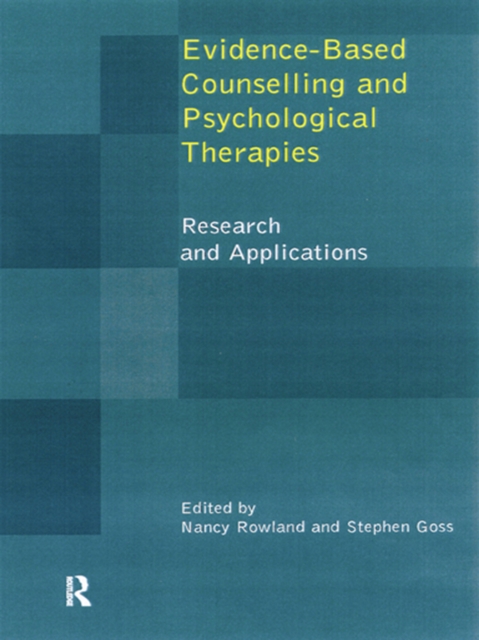
Evidence-Based Counselling and Psychological Therapies
Evidence-Based Counselling and Psychological Therapies assesses the impact of the international drive towards evidence-based health care on NHS policy and the provision of the psychological services in the NHS. An outstanding range of contributors provide an overview of evidence-based health care and the research methods that underpin it, demonstrating its effect on policy, provision, practitioners and patients. Their thought-provoking chapters look at a variety of relevant issues including: * generating and implementing evidence * cost-effectiveness issues * practical guidelines * practitioner research Evidence-Based Counselling and Psychological Therapies is essential for mental health professionals and trainees concerned with this movement which is having, and will continue to have a huge impact on the purchasing, provision and practice of health care.
eBook

Randomised controlled trial of school-based humanistic counselling for emotional distress in young people: Feasibility study and preliminary indications of efficacy
Aims
The purpose of this study was to test the feasibility of a randomised controlled trial comparing six weeks of humanistic school-based counselling versus waiting list in the reduction of emotional distress in young people, and to obtain initial indications of efficacy.
Methods
Following a screening procedure, young people (13 - 15 years old) who experienced emotional distress were randomised to either humanistic counselling or waiting list in this multi-site study. Outcomes were assessed using a range of self-report mental health measures, with the emotional symptoms subscale of the Strengths and Difficulties Questionnaire (SDQ) acting as the primary outcome indicator.
Results
Recruitment procedures were successful, with 32 young people consenting to participate in the trial and 27 completing endpoint measures. Trial procedures were acceptable to all involved in the research. No significant differences were found between the counselling and waiting list groups in reductions in levels of emotional symptoms (Hedges'
g
= 0.03), but clients allocated to counselling showed significantly greater improvement in prosocial behaviour (
g
= 0.89) with an average effect size (
g
) across the nine outcome measures of 0.25. Participants with higher levels of depressive symptoms showed significantly greater change.
Conclusion
This study suggested that a randomised controlled trial of counselling in schools is acceptable and feasible, although initial indications of efficacy are mixed.
Trial registration
Current Controlled Trials ISRCTN68290510.
Journal Article

Evidence-based counselling and psychology therapies: research and applications
Evidence-Based Counselling and Psychological Therapiesassesses the impact of the international drive towards evidence-based health care on NHS policy and the provision of the psychological services in the NHS.An outstanding range of contributors provide an overview of evidence-based health care and the research methods that underpin it, demonstrating its effect on policy, provision, practitioners and patients. Their thought-provoking chapters look at a variety of relevant issues including:* generating and implementing evidence* cost-effectiveness issues* practical guidelines* practitioner researchEvidence-Based Counselling and Psychological Therapiesis essential for mental health professionals and trainees concerned with this movement which is having, and will continue to have a huge impact on the purchasing, provision and practice of health care.
eBook

Circulating sex hormone binding globulin levels are modified with intensive lifestyle intervention, but their changes did not independently predict diabetes risk in the Diabetes Prevention Program
IntroductionSex hormone binding globulin (SHBG) levels are reported to be inversely associated with diabetes risk. It is unknown whether diabetes prevention interventions increase SHBG and whether resultant changes in SHBG affect diabetes risk. The purpose of this analysis was to determine whether intensive lifestyle intervention (ILS) or metformin changed circulating SHBG and if resultant changes influenced diabetes risk in the Diabetes Prevention Program (DPP).Research design and methodsThis is a secondary analysis from the DPP (1996–2001), a randomized trial of ILS or metformin versus placebo on diabetes risk over a mean follow-up of 3.2 years. The DPP was conducted across 27 academic study centers in the USA. Men, premenopausal and postmenopausal women without hormone use in the DPP were evaluated. The DPP included overweight/obese persons with elevated fasting glucose and impaired glucose tolerance. Main outcomes measures were changes in SHBG levels at 1 year and risk of diabetes over 3 years.ResultsILS resulted in significantly higher increases (postmenopausal women: p<0.01) or smaller decrements (men: p<0.05; premenopausal women: p<0.01) in SHBG compared with placebo or metformin. Changes in SHBG were primarily attributable to changes in adiposity. There were no consistent associations of change in SHBG with the risk of diabetes by treatment arm or participant group.ConclusionsLifestyle intervention may be associated with favorable changes in circulating SHBG, which is largely due to changes in adiposity. Changes in circulating SHBG do not independently predict reductions in diabetes incidence.
Journal Article

Rapid Rescue: Spatial Storage Effect Facilitates Evolutionary Rescue in Rapidly Changing Environments
AbstractThe storage effect is a plausible natural mechanism that generates balanced genetic polymorphism in varying environments. Balanced polymorphism may facilitate evolutionary rescue, promoting the persistence of populations otherwise destined for extinction. However, it is unknown whether the storage effect can be established in small populations whose size is allowed to vary, and if so, whether it will lead to evolutionary rescue. In this study, we investigate if the spatial storage effect emerges and facilitates evolutionary rescue across small populations of variable sizes that inhabit heterogeneous temporally varying environments and exchange migrants. We use an eco-evolutionary model to examine the phenomenon under a wide set of conditions, including the magnitudes and periods of temporal variation, habitat harshness, migration rates, the degrees of spatial heterogeneity, and increasing fitness oscillations over time, all within the framework of the logistic population growth model. We find that the storage effect emerges and that it increases the persistence of populations in harsh temporally varying habitats beyond levels driven by migration alone under source-sink dynamics. This mechanism, which we call “rapid rescue” broadens the known conditions for population persistence in the face of sudden environmental change.Competing Interest StatementThe authors have declared no competing interest.
Paper

Getting evidence into practice
In this final chapter we consider the challenge of getting evidence into practice and of producing evidence relevant to complex psychological therapies. Some of the barriers to change and strategies that may help practitioners integrate evidence into their work are considered. We outline a number of ways in which managers and practitioners can facilitate and extend evidence-based clinical practice. In considering the impact on psychological therapies of evidence-based commissioning and policy, a pluralist approach to generating evidence for psychological therapies is advocated. We conclude by noting the potential for shifting the balance of power created by EBHC in favour of its consumers because of the relative accessibility and immediate utility for all those with a stake in psychological therapy provision.
Book Chapter
Evidence-based psychological therapies
Those who work in the NHS need no reminding that health care reform is an international epidemic which shows no sign of abating (Klein, 1995). Keeping up with and managing the changes that come about as a result of health care reform is an all too familiar part of the job. Health care reforms spawn policies which invariably affect the pattern and provision of services, the professional practice of those who work in the NHS, and patient care. Much policy change is understood through the experience of implementing it. However, it is important to understand the origins of a particular health care reform, its aims, methodologies, the organisation and structures which support it, and the policies that it engenders.
Book Chapter

Counselling in primary care: A systematic review of the research evidence
Counselling in primary care in the UK is expanding rapidly, and its evidence base needs to be established. We present the rationale for conducting controlled trials of counselling in primary care, and suggest that a systematic review of controlled trials of counselling in primary care is timely. We describe the process of conducting the review in accordance with Cochrane Collaboration guidelines. The review aimed to assess the effectiveness and cost-effectiveness of counselling in primary care, by systematically reviewing cost and outcome data from randomised controlled trials and controlled patient preference trials of counselling interventions, for patients with psychological and psychosocial problems considered suitable for counselling. The search strategy, inclusion and exclusion criteria, data collection and data analysis are described. The results of the review are presented. The review included only controlled trials of counselling in which counsellors accredited by the British Association for Counselling (or equivalent) provided non-directive counselling in primary care. Four trials met the inclusion criteria. Results indicated that patients who receive counselling show a modest but significant improvement in symptom levels compared with those who receive GP care. Levels of satisfaction with counselling are high. There is very tentative evidence to suggest that counselled patients are more likely to be considered recovered than usual GP care patients. There is limited information about the cost-effectiveness of counselling. We conclude by reflecting upon the results of the review and their implications for counselling research.
Journal Article


A study of the relationship between the perceived leadership style of nursing chairpersons and the organizational climate in baccalaureate nursing programs
This study examined the relationship between the leadership frames of nursing chairpersons and the organizational climate of nursing departments as perceived by the nursing faculty. Bolman and Deal's Leadership Orientations Instrument (Other), Borrevik's Organizational Climate Description Questionnaire-Higher Education (Partial), and a demographic questionnaire were sent to 605 nursing faculty members in 60 baccalaureate nursing programs in the American Association of Colleges of Nursing North Atlantic Region. A total of 253 usable responses was returned. Descriptive procedures, Pearson's product moment correlation coefficients, one-way analysis of variance, and the General Linear Models Procedure for analysis of variance were used to analyze the data with respect to the research questions in this study. Findings indicated that faculty members perceived their chairpersons to use the human resource frame the most followed by the structural frame, the symbolic frame, and the political frame. Statistically significant relationships were demonstrated between single frame nursing chairperson leadership styles and organizational climate domains and between the various combinations of leadership frames of nursing chairpersons and organizational climate domains. Nine low, but statistically significant correlations were found between chairperson leadership frames, organizational climate domains, and selected demographic variables. A nursing faculty shortage presently exists. Schools recognized as having a good organizational climate will have less difficulty finding faculty. No nursing research has been done using Bolman and Deal's leadership frames. This study has implications for nursing education as the results demonstrated that the organizational climate of the nursing department is affected by the leadership style of the department chairperson.
Dissertation