
Catalogue Search | MBRL


Are you sure you want to remove the book from the shelf?

{{itemTitle}}
2
result(s) for
"Rowley, Alison, 1971- author"
Sort by:

Putin kitsch in America
\"Vladimir Putin's image functions as a political talisman far outside of the borders of his own country. By studying material objects, fan fiction and digital media, this book traces the satirical uses of Putin's public persona, notably how he stands as a foil for other world leaders. It argues that the internet is crucial to the creation of contemporary Putin memorabilia and that these items show a continued political engagement by young people, even as some political scientists and media experts decry what they see as the opposite. The book further addresses the ways in which explicit sexual references about government officials are being used as everyday political commentary in the United States. Turning a critical eye to Putin kitsch shows how the number of such references skyrocketed during the 2016 US Presidential election campaign, and suggests that the phenomenon is likely to still be important when Americans next return to the polls. Finally, the internet makes possible a totally new kind of kitsch - the virtual kind. An examination of how the Russian president's image circulates via memes and parodies, as well as through apps and games, suggests that political culture has become increasingly participatory in the last decade.\"-- Provided by publisher.
BOOK
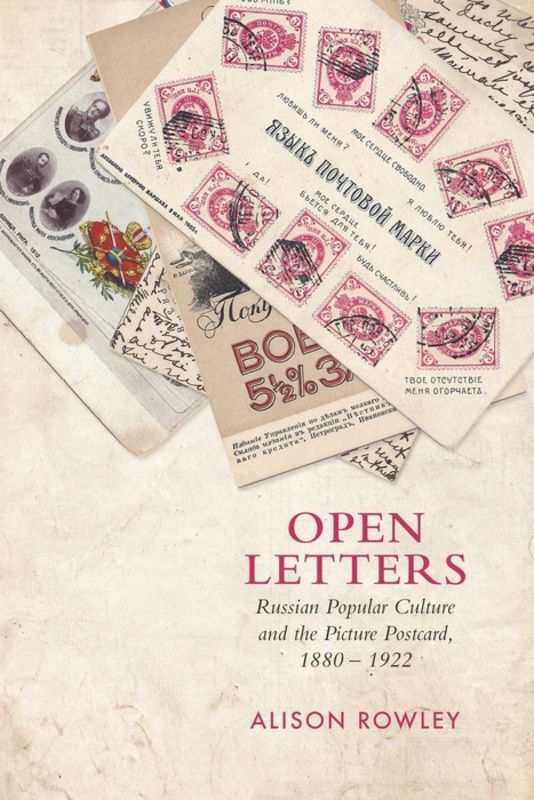
Open Letters
During the fin-de-siècle and early revolutionary eras, picture postcards were an important medium of communication for Russians of all backgrounds. In Open Letters, the most comprehensive study of Russian picture postcards to date, Alison Rowley uses this medium to explore a variety of aspects of Russian popular culture. The book is lavishly illustrated with more than 130 images, most of which have never been published before.Through her examinations of postcards, Rowley addresses a diverse range of topics: how landscape postcards conveyed notions of imperialism; the role of postcards in the rise of celebrity culture; depictions of the body on erotic and pornographic postcards; how postcards were employed to promote differing interpretations of the First World War; and the use of postcards by revolutionary groups seeking to overthrow the Tsarist government. Rowley determines the extent to which Russia was embedded in Europe-wide cultural trends by situating the Russian case within a larger European context.
eBook