
Catalogue Search | MBRL


Are you sure you want to remove the book from the shelf?

{{itemTitle}}
38
result(s) for
"Rugh, Andrea B"
Sort by:


The political culture of leadership in the United Arab Emirates
The book describes the impact of cultural perceptions on rulers' behaviors in the United Arab Emirates, once the Trucial States. Despite differences in size, economic resources, and external political pressures, the seven emirates' rulers utilized very similar cultural expectations to gain the support of others.
eBook


CULTURE-After the American Century: The Ends of U.S. Culture in the Middle East
[...]it is difficult to see how the influence of cultural products can be divorced from American power. [...]leading political scientists such as Joseph Nye, John Mearsheimer, and Stephen Walt have argued that the era of American predominance has not ended. According to Walt, \"the happy truth is that the United States is already very secure, and it enjoys geopolitical advantages that other states can only dream about.
Journal Article

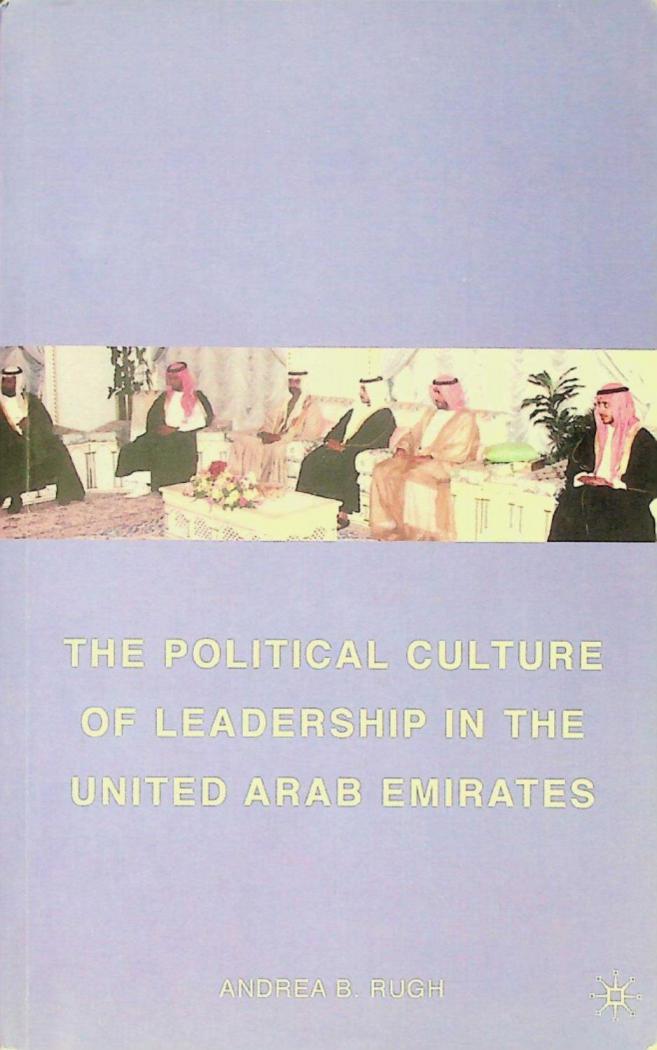
The political culture of leadership in the United Arab Emirates
The book describes the impact of cultural perceptions on rulers' behaviors in the United Arab Emirates, once the Trucial States. Despite differences in size, economic resources, and external political pressures, the seven emirates' rulers& utilized very similar cultural expectations to gain the support of others.& The author describes what has generally been only& touched upon before--the significant but largely \"invisible\" roles women and marriage play in the political process& of tribal societies.
Book

BULAQ'S FAMILIES
This paper, in answering to what has been called a crisis of relevance of Western social science in Middle Eastern cultures, is a detailed portrayal of family and community life in Bulaq, one of Cairo's most severely over-crowded and impoverished sectors. The present work describes the nature of the multiple and complex problems as they take place at each stage of the typical domestic cycle among Bulaq's families. It examines how families cope and struggle to maintain traditional values throughout the cycle of family life, and against overwhelming odds. Next, it assesses the impact of socio-economic factors on Bulaq's social organization, and in a postscript it states the implications of the findings for social policy.
Journal Article
ORPHANAGES AND HOMES FOR THE AGED IN EGYPT: CONTRADICTION OR AFFIRMATION IN A FAMILY ORIENTED SOCIETY
This study of orphanages and homes for the aged in Egypt examines the causes of recent growth in the populations of these institutions to determine whether such growth signifies a change in the basic structure and role of the family; the actual role of the family vis-a-vis these institutionalized individuals; and how these people are regarded by society generally. The findings are: that these institutions in most instances meet the needs of a small minority of young children and elderly whose families have abrogated their responsibilities not willingly but for important reasons; that the growth of such institutions does not necessarily reflect a widespread rejection of familial responsibilities; that certain institutions for the care of the elderly provide alternative ways of carrying out that responsibility—conceiving institutional care as a choice rather than a last resort; that institutional growth reflects the changing conditions over the past century that affect the way the obligations of family life are carried out. Orphanage data indicate that the children are victims of special circumstances where there was either no family from the start or where the family was broken inadvertently due to factors no longer under anyone's control. Data for the elderly reveal two groups: those who are also victims of special circumstances and those who chose the institutional alternative as a more satisfactory way to meet the new, emergent conditions of family life in a changing world. The latter category is applicable for the most part to the emerging middle classes who have developed a taste for independence and an ability to pay for it.
Journal Article