
Catalogue Search | MBRL


Are you sure you want to remove the book from the shelf?

{{itemTitle}}
31
result(s) for
"Rukgaber, Matthew"
Sort by:

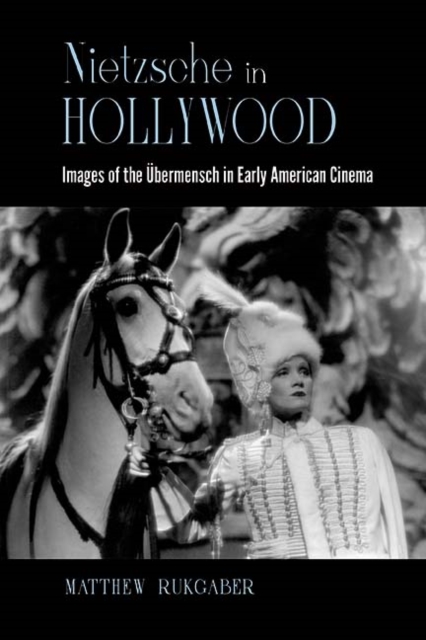
Nietzsche in Hollywood
Nietzsche in Hollywood offers a compelling and startling
history of Hollywood film in which the German philosopher Friedrich
Nietzsche and his idea of the Übermensch looms large.
Though Nietzsche's philosophy was attacked as egoistic and a
sociopathic version of Darwinism in films from the 1910s, it
undergoes a series of cinematic and philosophical transformations
in the 1920s and 1930s under the eye and pen of some of the most
significant names in early Hollywood, including Erich von Stroheim,
Josef von Sternberg, Ben Hecht, Howard Hawks, and Ernst Lubitsch.
In addition to establishing historical connections between
Nietzsche's philosophy and these filmmakers, the book provides
philosophical readings of many Hollywood films through the lens of
the Nietzschean ideas of \"perspectivism\" and the critique of
morality. Offering a new history of classic Hollywood films as well
as a new approach to film philosophy, Nietzsche in
Hollywood reveals a reading of the philosopher in American
culture that has largely been ignored.
eBook

The Asymmetry of Space: Kant’s Theory of Absolute Space in 1768
I propose that we interpret Kant’s argument from incongruent counterparts in the 1768 article ‘Concerning the Ultimate Ground of the Differentiation of Directions in Space’ in light of a theory of dynamic absolute space that he accepted throughout the 1750s and 1760s. This force-based or material conception of space was not an unusual interpretation of the Newtonian notion of absolute space. Nevertheless, commentators have continually argued that Kant’s argument is an utter failure that shifts from the metaphysics of space to its epistemology, because he has no way to connect ‘directionality’ and ‘handedness’ to absolute space. This supposed failure is based on an understanding of absolute space in purely mathematical terms and as an absolute void that lacks any qualitative or dynamic features. If we recognize that Kant held that space had an intrinsic directional asymmetry then his argument successfully connects incongruent counterparts to absolute space. The presence of this notion in Kant’s pre-Critical thought is rarely noted, and its necessity in understanding his incongruence argument is novel.
Journal Article

Immaterial Spirits and the Reform of First Philosophy
This article argues that Kant’s early metaphysics (1755–1764) remains unscathed by the arguments found in the 1766 work, Dreams of a Spirit-Seer. I expose the errors of the standard approaches to Dreams, which take the text to be either entirely opposed to metaphysics or at least critical of all present forms of metaphysics, Kant’s own early work included. Through a close reading of the text of Dreams, I show that Kant’s early metaphysics remains the standard of how metaphysics should be done, how it avoids any commitment to immaterial spirits, and what some of its actual conclusions are.
Journal Article

The implied theodicy of Kant’s Religion within the Boundaries of Mere Reason
This article begins with a brief survey of Kant’s pre-Critical and Critical approaches to theodicy. I maintain that his theodical response of moral faith during the Critical period appears to be a dispassionate version of what Leibniz called Fatum Christianum. Moral rationality establishes the existence and goodness of God and translates into an endless and unwavering commitment to following the moral law. I then argue that Religion within the Boundaries of Mere Reason offers a revision of Kant’s 1791 conception of “authentic theodicy.” Kant comes to recognize that the ends of morality and virtue, as well as the action needed to respond to the noumenal evil at the heart of humanity, outstrip the “religion of good life conduct.” This leads Kant to argue in favor of a new form of moral life embedded in a religious community and based on the love of God and of one’s fellow humans. Such a life is rooted in the incorporation of a holy principle in our noumenal selves that he terms “divine blessedness.”
Journal Article

Hegel’s Theory of Terrorism and Derrida’s Notion of Autoimmunity: Religious and Political Violence in the Name of Nothingness
Rather than model Hegel’s account of terrorism on the struggle for recognition and against domination, I maintain that his account is best understood according to Derrida’s notion of autoimmunity. The logic of autoimmunity models terrorism as a symbolic, suicidal act of violence that is created by and directed against the violence of hegemony. It is also continually stimulated by a messianic and nihilistic ideal. This article provides a historical account of Derrida’s elaboration of this concept through his continual dialogue with Hegel. That concept is then applied to Hegel’s account of religious and political terrorism. Ultimately, this analysis supports a reading of Hegel’s Phenomenology in which the confrontation with terrorism as autoimmunity is its lynchpin and which culminates in a moral community that is radically open to the other, to difference, and to the undecidable rather than being closed off and insulated by so-called absolute knowing.
Journal Article

“The Key to Transcendental Philosophy”: Space, Time and the Body in Kant
The thesis of this essay is that Kant's theory of the “forms of intuition” can be regarded as an account of the structure of our embodied perspective. The ideality and subjectivity of space is concluded to be an account of the perspective relative nature of the figure-ground relationship or how it is that objects emerge for us in empirical experience as being orientated in a spatio-temporal field. Time is regarded similarly as the event-series relationship. The significant role of embodiment in Kant's thought on space and time is explored through a textual analysis of all of Kant's writings on the subject. By recovering the importance of the body to Kant's theoretical philosophy, the ontological implications of his theory of space and time and his idealism can be made more plausible.
Journal Article
Social Phenomenology, Mass-Society and the Individual in Hegel and Heidegger
This article argues that Hegel’s dialectic of wealth and power in the stage of social development called ‘culture’ (Bildung) reveals that even in moments of profound social alienation, Spirit (Geist)—the labour of constructing identity and freedom—remains. This stands in sharp contrast to Heidegger’s theory of alienation and Dasein’s ‘publicity’ (Offentlichkeit), which paints modern social existence as a profound threat to the very ‘Being’ and ‘possibilities’ of human life. The supposed threats of inauthenticity and mass existence are, from a Hegelian perspective, failures of adequate social phenomenology. The desiring, affective subject is not absorbed in the ‘they’ (das Man) but is, instead, the negativity that constantly transforms culture and the structure of social selfhood.
Journal Article
The Revealing Mask
The films of Ernst Lubitsch offer us a sequence of Nietzschean films that I believe shows us a more “humanist” and “free spirited” conception of the Übermensch. While it would have made sense to turn to them after the chapter on Hecht, in which Design for Living was discussed, there are several reasons not to do so. Firstly, Lubitsch’s films end up affirming a more human conception of justice, even while also advocating for an immoral, sometimes even criminal, life of risk, play, and masquerade. Secondly, I turn to Lubitsch in this final chapter because his later films show us
Book Chapter
The Truth of Lies
In the comedies of Ben Hecht, the Übermensch appears both as a deceiver and as an artistic genius. My specific focus within four essential Hecht comedies—The Front Page (1931), Design for Living (1933), Twentieth Century (1934), and Nothing Sacred (1937)—will be how life and the natural use of the intellect are aimed at “dissimulation,” and how “truth” indicates the life of the bored, the average, and the compromised (PT p. 81).¹ The Hechtian Übermensch is a master of life, power, and art. Importantly, unlike the Überfrauen of the previous chapter, Hecht’s geniuses are masters of the word and,
Book Chapter