
Catalogue Search | MBRL


Are you sure you want to remove the book from the shelf?

{{itemTitle}}
159
result(s) for
"Runco, Mark A."
Sort by:
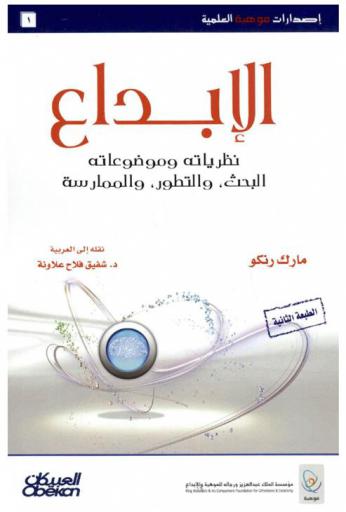
الإبداع : نظرياته وموضوعاته : البحث، والتطوير، والممارسة
جمع هذا الكتاب إسهامات متناثرة في علم النفس والتجارة، والتربية، وعلم الاجتماع، والاقتصاد، وموضوعات أخرى، مستقصيا ما تشير إليه نتائج البحوث بخصوص تطور الإبداع ومظاهره وتقويته. يبدأ الكتاب بمناقشة نظريات الإبداع، ثم يستعرض البحوث المتعلقة بالنقاش الدائر حول دور التنشئة والوراثة فيها، وكيفية ارتباطه بالشخصية، وكذلك كيفية تأثير السياق الاجتماعي فيه، ودور الصحة العقلية وعلاقتها به، إضافة إلى تأثير فروق النوع الاجتماعي الجندر وكذلك إلى كيفية ارتباط الإبداع بكل من الاختراع، والابتكار، والخيال، والتكيف، وكيف يختلف عنها. يتضمن هذا الكتاب أيضا القضايا المثيرة للجدل، والحقائق التاريخية، والقياسات... إلخ ؛ وعليه فإنه سيلقي نظرة ساحرة على هذا العالم ؛ عالم الإبداع.
BOOK

Creativity : theories and themes : research, development, and practice
An integrative introduction to the theories and themes in research on creativity, the second edition of Creativity is both a reference work and text for courses in this burgeoning area of research. The book begins with a discussion of the theories of creativity (Person, Product, Process, Place), the general question of whether creativity is influenced by nature or nurture, what research has indicated of the personality and style of creative individuals from a personality analysis standpoint, and how social context affects creativity. This wide-ranging work then proceeds to coverage of issues such as gender differences, whether creativity can be enhanced, if creativity is related to poor mental or physical health, and much more. The book contains boxes covering special interest items, including one-page biographies of famous creative individuals, and activities for a group or individual to test or encourage creativity, as well as references to Internet sites relating to creativity. Includes all major theories and perspectives on creativityConsolidates recent research into a single sourceIncludes key terms defined and text boxes with interesting related materialSingle authored for clarity and consistency of presentation
eBook

Creativity : theories and themes : research, development, and practice
An integrative introduction to the theories and themes in research on creativity, this book is both a reference work and text for courses in this burgeoning area of research. The book begins with a discussion of the theories of creativity (Person, Product, Process, Place), the general question of whether creativity is influenced by nature or nurture, what research has indicated of the personality and style of creative individuals from a personality analysis standpoint, how social context affects creativity, and then coverage of issues like gender differences, whether creativity can be enhanced, if creativity is related to poor mental or physical health, etc. The book contains boxes covering special interest items including one page biographies of famous creative individuals and activities for a group or individual to test and/or encourage creativity, as well as references to internet sites relating to creativity.
eBook

The Misleading Definition of Creativity Suggested by AI Must Be Kept out of the Classroom
The advent of AI is likely to make it difficult to support the creativity of students. This article points to the specific problem whereby the pseudo-creativity of AI is misinterpreted as authentic creativity, which could in turn mislead educators. The result would be a failure to optimally support the authentic creativity of students. There are suggestions that AI can be creative, but also compelling reasons to reject that claim. These include the need for a self in creativity and the role of the self in the creative process. Self-expression, for instance, requires a self, as part of the process. Then, there is the intrinsic motivation that characterizes the human creative experience and may be involved in the problem finding that is critical for the creative process. Each of these positions is reviewed in this article. The curious thing is that, even with compelling reasons to distinguish the authentic creativity of students from the artificial creativity of AI, definitions of creativity seem to be changing. The unique feature of the present effort is its examination of the reasons why definitions seem to be changing, even when, according to creativity research and theory, they should not. This article describes, (a) the surprising and incorrect position that AI can be creative, and, (b) problems that would occur if this position is applied in the classroom. It then (c) attempts to explain why that position is in fact taking hold, as is suggested by the changes in how creativity is defined. This explanation requires looking beyond creativity theory to broad social contexts, which are economic, political, scientific, and technological. This article concludes with (d) recommendations for supporting the authentic creativity of students. The recommendations exclude ideas suggested by the misleading definition of creativity, described in (a) and were instead selected based on their relationships specifically with authentic creativity.
Journal Article
Positive Creativity and the Intentions, Discretion, Problem Finding, and Divergent Thinking That Support It Can Be Encouraged in the Classroom
This article begins by presenting a definition of positive creativity. This definition is based in part on the standard view of creativity, which points to originality and effectiveness. A brief discussion of the distinction between benevolent creativity and malevolent creativity indicates that intentions should also be required of positive creativity. Intentions may seem like difficult things to monitor in the classroom, but several useful methods are described herein. The suggestions that are offered here to support positive creativity involve divergent thinking and decision making. The most novel claim in this article is that positive creativity may involve not just problem solving but also problem finding. A second important claim is that educators must be prepared to take the good with the bad. More specifically, when creativity is encouraged, students are likely to think in truly divergent directions, which means they may offer negative as well as positive ideas. Educators should be prepared for ideas that they themselves do not understand. Practical suggestions are offered, including the recommendation that educators should encourage careful decision-making about what constitutes a worthwhile problem (as well as how to solve such problems in a creative fashion). Quite a few instances of malevolence take the form of pseudo-problems. These must be recognized as such and attention must be directed instead to the significant problems that do plague society, such as the climate crisis, the protection of voting rights, and racial discrimination. Positive creativity is needed now more than ever before.
Journal Article

Scoring divergent thinking tests by computer with a semantics-based algorithm
Divergent thinking (DT) tests are useful for the assessment of creative potentials. This article reports the semantics-based algorithmic (SBA) method for assessing DT. This algorithm is fully automated: Examinees receive DT questions on a computer or mobile device and their ideas are immediately compared with norms and semantic networks. This investigation compared the scores generated by the SBA method with the traditional methods of scoring DT (i.e., fluency, originality, and flexibility). Data were collected from 250 examinees using the “Many Uses Test” of DT. The most important finding involved the flexibility scores from both scoring methods. This was critical because semantic networks are based on conceptual structures, and thus a high SBA score should be highly correlated with the traditional flexibility score from DT tests. Results confirmed this correlation (r = .74). This supports the use of algorithmic scoring of DT. The nearly-immediate computation time required by SBA method may make it the method of choice, especially when it comes to moderate- and large-scale DT assessment investigations. Correlations between SBA scores and GPA were insignificant, providing evidence of the discriminant and construct validity of SBA scores. Limitations of the present study and directions for future research are offered.
Journal Article

Enhancing creativity: Proper body posture meets proper emotion
This study tested whether compatibility or incompatibility between body posture and emotion was beneficial for creativity. In Study 1, participants were asked to solve the Alternative Uses Task (AUT) problems when performing open or closed body posture in positive or negative emotional state respectively. The results showed that originality of AUT performance was higher in the compatible conditions (i.e., open-positive and closed-negative) than in the incompatible conditions (i.e., closed-positive and open-negative). In Study 2, the compatibility effect was replicated in both the AUT and the Realistic Presented Problem test (i.e., RPP). Moreover, it was revealed that participants exhibited the highest associative flexibility in the open-positive condition, and the highest persistence in the closed-negative condition. These findings indicate that compatibility between body posture and emotion is beneficial for creativity. This may be because when the implicit emotions elicited by body posture match explicit emotions, the effects of emotions on creativity are enhanced, therefore promoting creativity through the flexibility or the persistence pathway respectively.
Journal Article
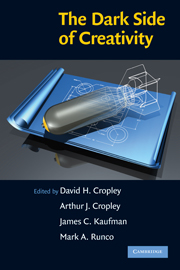
The Dark Side of Creativity
With few exceptions, scholarship on creativity has focused on its positive aspects while largely ignoring its dark side. This includes not only creativity deliberately aimed at hurting others, such as crime or terrorism, or at gaining unfair advantages, but also the accidental negative side effects of well-intentioned acts. This book brings together essays written by experts from various fields (psychology, criminal justice, sociology, engineering, education, history, and design) and with different interests (personality development, mental health, deviant behavior, law enforcement, and counter-terrorism) to illustrate the nature of negative creativity, examine its variants, call attention to its dangers, and draw conclusions about how to prevent it or protect society from its effects.
eBook

Convergent thinking, divergent thinking, and openness to experience as predictors of academic success among high-achieving and typical-achieving medical students
Background
Creativity-related cognitive processes and personality traits are not often examined together in educational contexts, particularly when discussing high-achieving subgroups of medical students. This study investigated these predictors of academic performance among high-achieving and typical-achieving medical students within a problem-based learning (PBL) environment of a medical school.
Methods
Data were collected from 274 Doctor of Medicine students at Arabian Gulf University during the 2024–2025 academic year. Participants completed assessments of convergent thinking (Raven’s Advanced Progressive Matrices and Watson–Glaser Critical Thinking Appraisal), divergent thinking (Alternative Uses Test and Figural Divergent Thinking Test), and openness to experience (NEO-FFI). Students’ grade point averages (GPAs) were obtained from institutional records. Hierarchical regression analyses and moderation tests were performed, controlling for age and sex.
Results
Convergent thinking (β = 0.20,
p
< .001) and divergent thinking (β = 0.25,
p
< .001) emerged as modest-to-moderate positive predictors of GPA, whereas openness to experience showed a small negative association (β = −0.13,
p
= .026). Achievement status, defined as high-achieving versus typical-achieving GPA, significantly moderated the effects of both convergent and divergent thinking, such that the academic benefits of higher thinking skills were meaningfully stronger among high-achieving students, while these associations were weaker among their typical-achieving peers. No moderating effect was observed for openness to experience.
Conclusions
Convergent and divergent thinking independently enhance academic performance in medical students, with amplified effects for high-achieving students. In contrast, openness to experience was negatively linked with GPA, reflecting the complex interplay between personality traits and structured medical training. These findings underscore the need for medical curricula that balance convergent reasoning with creative problem-solving while considering diverse student cognitive and personality profiles.
Journal Article

Commentary on creativity and curiosity
The target article covers a large amount of ground and offers a provocative perspective. This commentary focuses on (a) assumptions, namely that there are discrete stages in the creative process and that novelty and usefulness are inextricable, (b) hidden variables in the creativity–curiosity relationship, and (c) the difference between an explanation of creativity versus a description of influence on it.
Journal Article