
Catalogue Search | MBRL


Are you sure you want to remove the book from the shelf?

{{itemTitle}}
17,455
result(s) for
"Russell, A D"
Sort by:


Biocide use and antibiotic resistance: the relevance of laboratory findings to clinical and environmental situations
Antibiotics are used as chemotherapeutic drugs, and biocides are used as antiseptics, disinfectants, and preservatives. Several factors affect biocidal activity, notably concentration, period of contact, pH, temperature, the presence of interfering material, and the types, numbers, location, and condition of microorganisms. Bacterial cells as part of natural or artificial (laboratory) biofilm communities are much less susceptible than planktonic cells to antibiotics and biocides. Assessment of biocidal activity by bactericidal testing is more relevant than by determination of minimum inhibitory concentrations. Biocides and antibiotics may show some similarities in their mechanisms of action and common mechanisms of bacterial insusceptibility may apply, but there are also major differences. In the laboratory, bacteria can become less susceptible to some biocides. Decreased resistance may be stable or unstable and may be accompanied by a low-level increase in antibiotic resistance. Laboratory studies are useful for examining stress responses and basic mechanisms of action and of bacterial insusceptibility to antibacterial agents. Translation of such findings to the clinical and environmental situations to provide evidence of a possible relation between biocide use and clinical antibiotic resistance is difficult and should be viewed with caution.
Journal Article


The influence of food supply on the response of Olympia oyster larvae to ocean acidification
Increases in atmospheric carbon dioxide drive accompanying changes in the marine carbonate system as carbon dioxide (CO2) enters seawater and alters ocean pH (termed \"ocean acidification\"). However, such changes do not occur in isolation, and other environmental factors have the potential to modulate the consequences of altered ocean chemistry. Given that physiological mechanisms used by organisms to confront acidification can be energetically costly, we explored the potential for food supply to influence the response of Olympia oyster (Ostrea lurida) larvae to ocean acidification. In laboratory experiments, we reared oyster larvae under a factorial combination of pCO2 and food level. Elevated pCO2 had negative effects on larval growth, total dry weight, and metamorphic success, but high food availability partially offset these influences. The combination of elevated pCO2 and low food availability led to the greatest reduction in larval performance. However, the effects of food and pCO2 interacted additively rather than synergistically, indicating that they operated independently. Despite the potential for abundant resources to counteract the consequences of ocean acidification, impacts were never completely negated, suggesting that even under conditions of enhanced primary production and elevated food availability, impacts of ocean acidification may still accrue in some consumers.
Journal Article

How to study poetry = De audiendis poetis
\"Plutarch's essay 'How to Study Poetry' offers a set of reading practices intended to remove the potential damage that poetry can do to the moral health of young readers. It opens a window on to a world of ancient education and scholarship which can seem rather alien to those brought up in the highly sophisticated world of modern literary theory and criticism. The full Introduction and Commentary, by two of the world's leading scholars in the field, trace the origins and intellectual affiliations of Plutarch's method and fully illustrate the background to each of his examples. As such this book may serve as an introduction to the whole subject of ancient reading practices and literary criticism. The Commentary also pays particular attention to grammar, syntax and style, and sets this essay within the context of Plutarch's thought and writing more generally\"-- Provided by publisher.
BOOK

A Mycobacterial Systems Resource for the Research Community
Diseases caused by mycobacterial species result in millions of deaths per year globally, and present a substantial health and economic burden, especially in immunocompromised patients. Difficulties inherent in working with mycobacterial pathogens have hampered the development and application of high-throughput genetics that can inform genome annotations and subsequent functional assays. Functional characterization of bacterial proteins lags far behind the identification of new protein families. This is especially true for bacterial species that are more difficult to grow and genetically manipulate than model systems such as Escherichia coli and Bacillus subtilis . To facilitate functional characterization of mycobacterial proteins, we have established a Mycobacterial Systems Resource (MSR) using the model organism Mycobacterium smegmatis . This resource focuses specifically on 1,153 highly conserved core genes that are common to many mycobacterial species, including Mycobacterium tuberculosis , in order to provide the most relevant information and resources for the mycobacterial research community. The MSR includes both biological and bioinformatic resources. The biological resource includes (i) an expression plasmid library of 1,116 genes fused to a fluorescent protein for determining protein localization; (ii) a library of 569 precise deletions of nonessential genes; and (iii) a set of 843 CRISPR-interference (CRISPRi) plasmids specifically targeted to silence expression of essential core genes and genes for which a precise deletion was not obtained. The bioinformatic resource includes information about individual genes and a detailed assessment of protein localization. We anticipate that integration of these initial functional analyses and the availability of the biological resource will facilitate studies of these core proteins in many Mycobacterium species, including the less experimentally tractable pathogens M. abscessus , M. avium , M. kansasii , M. leprae , M. marinum , M. tuberculosis , and M. ulcerans . IMPORTANCE Diseases caused by mycobacterial species result in millions of deaths per year globally, and present a substantial health and economic burden, especially in immunocompromised patients. Difficulties inherent in working with mycobacterial pathogens have hampered the development and application of high-throughput genetics that can inform genome annotations and subsequent functional assays. To facilitate mycobacterial research, we have created a biological and bioinformatic resource ( https://msrdb.org/ ) using Mycobacterium smegmatis as a model organism. The resource focuses specifically on 1,153 proteins that are highly conserved across the mycobacterial genus and, therefore, likely perform conserved mycobacterial core functions. Thus, functional insights from the MSR will apply to all mycobacterial species. We believe that the availability of this mycobacterial systems resource will accelerate research throughout the mycobacterial research community.
Journal Article


Functional, biochemical and genetic diversity of prokaryotic nitrate reductases
Prokaryotic nitrate reduction can serve a number of physiological roles and can be catalysed by a number of biochemically distinct nitrate reductases. Three distinct nitrate reductase classes can be indentified in prokaryotes, NAS, NAR and NAP. NAS is located in the cytoplasmic compartment and participates in nitrogen assimilation. NAR is usually a three-subunit complex anchored to the cytoplasmic face of the membrane with its active site located in the cytoplasmic compartment and is involved in anaerobic nitrate respiration. NAP is a two-subunit complex, located in the periplasmic compartment, that is coupled to quinol oxidation via a membrane anchored tetraheme cytochrome. It shows considerable functional flexibility by participating in anaerobic respiration or redox energy dissipation depending on the organism in which it is found. The members of all three classes of enzymes bind the bis-molybdopterin guanine dinucleotide cofactor at the active site, but they differ markedly in the number and nature of cofactors used to transfer electrons to this site. Analysis of prokaryotic genome sequences available at the time of writing reveals that the different nitrate reductases are phylogenetically widespread.
Journal Article
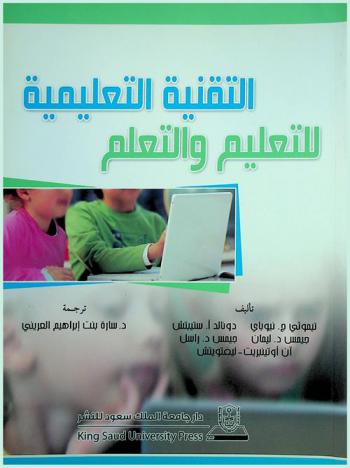
التقنية التعليمية للتعليم والتعلم
تنبع أهمية ترجمة الكتاب الدراسي \"التقنية التعليمية للتعليم والتعلم\" من رؤيته التي تسعى إلى تقديم أساس متين لتعزيز الخبرات التعليمية من خلال الدمج الهادف للتقنية. وبذلك فهو يمثل مصدرا متكاملا لتعريف المعلمين بالمبادئ الأساسية للتخطيط والتطوير الفاعل لاستخدام الأنواع المتعددة للمواد والتقنيات التعليمية، وعن الأساليب والوسائط المختلفة لاستثمارها بالشكل الأمثل وتعريفهم بالحاسوب والإنترنت باعتبارهما من الأدوات الفعالة في تخطيط التدريس وتطويره وتوصيله لفهم الطلبة وتقييمه بفعالية، بما يضمن أن يخرج القارئ بالمهارات المعرفية التالية: 1- إجادة اختيار وتعديل وتصميم المواد التعليمية. 2- القدرة على تخطيط التعليم الذي يعالج ويحل مشكلات التعلم المعقدة حسب احتياجات المتعلمين. 3- يساعدهم على التعرف على مجموعة من الأساليب والوسائط التعليمية حتى يتم الاختيار من بينها واستخدامها للتأثير على تدريس الطلاب بفعالية وكفاءة. لذا يعد هذا الكتاب دليلا تدريبيا دقيقا ومتكاملا تم تدعيمه بكثير من المراجع المرفقة ومراجع في مواقع إلكترونية وقد تخلله الكثير من الأدلة والأنشطة العملية.
BOOK

The elemental composition of purple sea urchin (Strongylocentrotus purpuratus) calcite and potential effects of pCO2 during early life stages
Ocean acidification will likely have negative impacts on invertebrates producing skeletons composed of calcium carbonate. Skeletal solubility is partly controlled by the incorporation of \"foreign\" ions (e.g. magnesium) into the crystal lattice of these skeletal structures, a process that is sensitive to a variety of biological and environmental factors. Here we explore effects of life stage, oceanographic region of origin, and changes in the partial pressure of carbon dioxide in seawater (pCO2 ) on trace elemental composition in the purple sea urchin (Strongylocentrotus purpuratus). We show that, similar to other urchin taxa, adult purple sea urchins have the ability to precipitate skeleton composed of a range of biominerals spanning low- to high-Mg calcites. Mg / Ca and Sr / Ca ratios were substantially lower in adult spines compared to adult tests. On the other hand, trace elemental composition was invariant among adults collected from four oceanographically distinct regions spanning a range of carbonate chemistry conditions (Oregon, Northern California, Central California, and Southern California). Skeletons of newly settled juvenile urchins that originated from adults from the four regions exhibited intermediate Mg / Ca and Sr / Ca between adult spine and test endmembers, indicating that skeleton precipitated during early life stages is more soluble than adult spines and less soluble than adult tests. Mean skeletal Mg / Ca or Sr / Ca of juvenile skeleton did not vary with source region when larvae were reared under present-day, global-average seawater carbonate conditions (400 μatm; pHT = 8.02 ± 0.03 1 SD; Ωcalcite = 3.3 ± 0.2 1 SD). However, when reared under elevated pCO2 (900 μatm; pHT = 7.73 ± 0.03; Ωcalcite = 1.8 ± 0.1), skeletal Sr / Ca in juveniles exhibited increased variance across the four regions. Although larvae from the northern populations (Oregon, Northern California, Central California) did not exhibit differences in Mg or Sr incorporation under elevated pCO2 (Sr / Ca = 2.10 ± 0.06 mmol mol-1 ; Mg / Ca = 67.4 ± 3.9 mmol mol-1 ), juveniles of Southern California origin partitioned ~8% more Sr into their skeletons when exposed to higher pCO2 (Sr / Ca = 2.26 ± 0.08 vs. 2.09 ± 0.005 mmol mol-1 1 SD). Together these results suggest that the diversity of carbonate minerologies present across different skeletal structures and life stages in purple sea urchins does not translate into an equivalent geochemical plasticity of response associated with geographic variation or temporal shifts in seawater properties. Rather, composition of S. purpuratus skeleton precipitated during both early and adult life history stages appears relatively robust to spatial gradients and predicted future changes in carbonate chemistry. An exception to this trend may arise during early life stages, where certain populations of purple sea urchins may alter skeletal mineral precipitation rates and composition beyond a given pCO2 threshold. This potential for geochemical plasticity during early development in contrast to adult stage geochemical resilience adds to the growing body of evidence that ocean acidification can have differing effects across organismal life stages.
Journal Article