
Catalogue Search | MBRL


Are you sure you want to remove the book from the shelf?

{{itemTitle}}
341
result(s) for
"Sánchez, George J"
Sort by:


Opening the Humanities to New Fields & New Voices
This essay explores efforts to enact effective “public humanities” among humanities practitioners as the “public” in the United States is changing profoundly. In particular, it explores the creation of the Boyle Heights Museum in East Los Angeles as an attempt to bridge the gap in historical practice and outreach between an immigrant and Latino community with a team of faculty, doctoral, and undergraduate students from the University of Southern California. Building four historical exhibitions in the Boyle Heights community, this team is a reflection of the growing awareness of the need to establish new institutional practices in archiving and historical presentations that reach new immigrant communities. New PhD students are in search of approaches to historical training, publishing, and output that engage with these new publics. Our own survival in the humanities fields is increasingly dependent on reaching these publics and creating this diversity of the humanities.
Journal Article

Why Are Multiracial Communities So Dangerous?: A Comparative Look at Hawai'i; Cape Town, South Africa; and Boyle Heights, California
This essay was the author's presidential address at the annual meeting of the Pacific Coast Branch, American Historical Association, in Waikoloa Beach, Hawai'i, on August 6, 2016. The address compares three multiracial communities -- in Boyle Heights, California; Cape Town, South Africa; and various sites in Hawai'I -- and asks why these areas often sparked controversy and were considered dangerous by the powers governing these societies. How these communities became multiracial through labor migration and urban land policies is explored, as well as the nature of interracial life that was created. Each of these communities shares a common history of interracial radicalism that threatened white supremacy, as well as confronting policies of forced removals that attempted to destroy their multiracial nature. Finally, the address, given in Hawai'i at the end of the Obama presidency, addresses the importance of keeping local histories alive through projects of historical memory and museums of conscience. [web URL: http://phr.ucpress.edu/content/86/1/153]
Journal Article

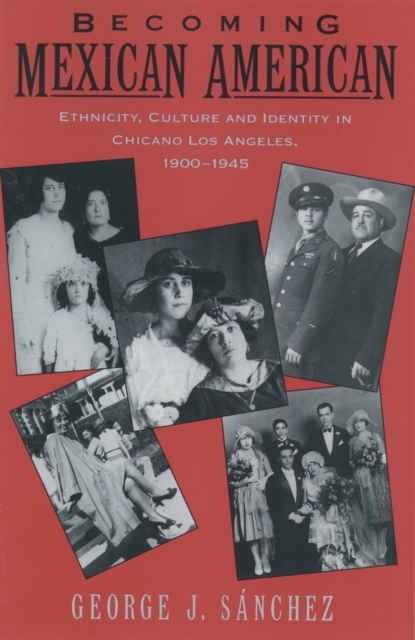
Becoming Mexican American
By focusing on Mexican immigrants to Los Angeles from 1900 to 1945, George J. Sanchez sheds light on the process by which temporary sojourners evolved into permanent residents, laying the foundation for a new Mexican-American culture. Analyzing not only government programs aimed at these newcomers, but also the world created by these immigrants through family networks, religious practice, musical entertainment, and work and consumption patterns, Sanchez uncovers the creative ways Mexicans adapted their culture to life in the United States. This award-winning study is among the first to examine this process in depth.
eBook

\What's Good for Boyle Heights Is Good for the Jews\: Creating Multiracialism on the Eastside during the 1950s
Boyle Heights neighborhood is often marked as a particular site of ethnic cooperation in the midst of racial segregation and political conservatism in Southern California of the 1950s. Here, Sanchez analyzes the factors that influence the creation of multiracialism culture in the neighborhood of Boyle Heights in 1950s.
Journal Article
Why Are Multiracial Communities So Dangerous?
This essay was the author’s presidential address at the annual meeting of the Pacific Coast Branch, American Historical Association, in Waikoloa Beach, Hawai’i, on August 6, 2016. The address compares three multiracial communities—in Boyle Heights, California; Cape Town, South Africa; and various sites in Hawai’i—and asks why these areas often sparked controversy and were considered dangerous by the powers governing these societies. How these communities became multiracial through labor migration and urban land policies is explored, as well as the nature of interracial life that was created. Each of these communities shares a common history of interracial radicalism that threatened white supremacy, as well as confronting policies of forced removals that attempted to destroy their multiracial nature. Finally, the address, given in Hawai’i at the end of the Obama presidency, addresses the importance of keeping local histories alive through projects of historical memory and museums of conscience.
Journal Article
Why Are Multiracial Communities So Dangerous?
This essay was the author’s presidential address at the annual meeting of the Pacific Coast Branch, American Historical Association, in Waikoloa Beach, Hawai‘i, on August 6, 2016. The address compares three multiracial communities—in Boyle Heights, California; Cape Town, South Africa; and various sites in Hawai‘i—and asks why these areas often sparked controversy and were considered dangerous by the powers governing these societies. How these communities became multiracial through labor migration and urban land policies is explored, as well as the nature of interracial life that was created. Each of these communities shares a common history of interracial radicalism that threatened white supremacy, as well as confronting policies of forced removals that attempted to destroy their multiracial nature. Finally, the address, given in Hawai‘i at the end of the Obama presidency, addresses the importance of keeping local histories alive through projects of historical memory and museums of conscience.
Journal Article

Latino History: An Interchange on Present Realities and Future Prospects
In her 2006 Organization of American Historians (OAH) presidential address, Vicki Ruiz invoked José Martí's landmark 1891 essay \"Nuestra América\" in calling for a more comprehensive, transhemispheric vision of the U.S. past, one that understands \"Latino history as United States history.\" For more than four decades, scholars have written about U.S. Latina and Latino experiences, often under the rubric of Mexican American or Chicano, Puerto Rican, Cuban American, or immigration history. The JAH is indebted to all of the participants for their willingness to enter into the online conversation: ADRIAN BURGOS JR is associate professor of history at the University of Illinois, where he teaches courses on U.S. Latino history, urban history, the history of sports, and African American studies. Cuban Exiles and Cuban Americans in South Florida, 1959-1994 (1996) and Seeking Refuge: Central American Immigration to Mexico, the United States, and Canada (2006).
Journal Article