
Catalogue Search | MBRL


Are you sure you want to remove the book from the shelf?

{{itemTitle}}
115
result(s) for
"S. ILAN TROEN"
Sort by:
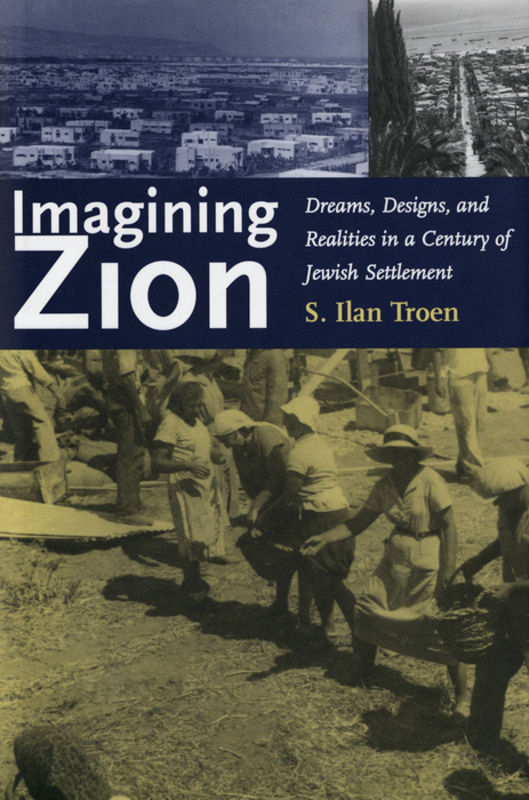
Imagining Zion
This timely book tells the fascinating story of how Zionists colonizers planned and established nearly 700 agricultural settlements, towns, and cities from the 1880s to the present. This extraordinary activity of planners, architects, social scientists, military personnel, politicians, and settlers is inextricably linked to multiple contexts: Jewish and Zionist history, the Arab/Jewish conflict, and the diffusion of European ideas to non-European worlds.S. Ilan Troen demonstrates how professionals and settlers continually innovated plans for both rural and urban frontiers in response to the competing demands of social and political ideologies and the need to achieve productivity, economic independence, and security in a hostile environment. In the 1930s, security became the primary challenge, shaping and even distorting patterns of growth.Not until the 1993 Oslo Accords, with prospects of compromise and accommodation, did planners again imagine Israel as a normal state, developing like other modern societies. Troen concludes that if Palestinian Arabs become reconciled to a Jewish state, Israel will reassign priority to the social and economic development of the country and region.
eBook

Tel-Aviv, the First Century
Tel-Aviv, the First Century brings together a broad range of disciplinary approaches and cutting-edge research to trace the development and paradoxes of Tel-Aviv as an urban center and a national symbol. Through the lenses of history, literature, urban planning, gender studies, architecture, art, and other fields, these essays reveal the place of Tel-Aviv in the life and imagination of its diverse inhabitants. The careful and insightful tracing of the development of the city's urban landscape, the relationship of its varied architecture to its competing social cultures, and its evolving place in Israel's literary imagination come together to offer a vivid and complex picture of Tel-Aviv as a microcosm of Israeli life and a vibrant modern global city.
eBook

Israeli Views of the Land of Israel/Palestine
The Jewish claim to the land of Israel were long rooted in a Jewish peoplehood as defined in a religious culture until the growing secularization of Jews during the 19th century shifter claims from an exclusively religious basis to one that incorporated increasing reliance on secular concepts, particularly nationalism with its demand for a polity. In other words, claims rooted in a religious tradition may be effective when directed to fellow-believers; claims expressed in secular terms are more acceptable in extra-communal discourse. Among other things Troen outlined the Jewish views of the right to the land necessarily takes into account that which is shared as well as differences that divide.
Journal Article

Divergent Jewish Cultures
Two creative centers of Jewish life rose to prominence in the twentieth century, one in Israel and the other in the United States. Although Israeli and American Jews share kinship and history drawn from their Eastern European roots, they have developed divergent cultures from their common origins, often seeming more like distant cousins than close relatives. This book explores why this is so, examining how two communities that constitute eighty percent of the world's Jewish population have created separate identities and cultures.Using examples from literature, art, history, and politics, leading Israeli and American scholars focus on the political, social, and memory cultures of their two communities, considering in particular the American Jewish challenge to diaspora consciousness and the Israeli struggle to forge a secular, national Jewish identity. At the same time, they seek to understand how a sense of mutual responsibility and fate animates American and Israeli Jews who reside in distant places, speak different languages, and live within different political and social worlds.
eBook

Frontier Myths and Their Applications in America and Israel: A Transnational Perspective
Troen discusses the comparison of frontiers in the historiographies of the United States and Israel. Even before World War II, American experts in social development attempted to export concepts and practices rooted in the special circumstances of the American frontier to the growing Jewish community in Palestine.
Journal Article
The Hebrew Translation of the Declaration of Independence
The first Hebrew version of the American Declaration of Independence appeared in Palestine in a 1945 textbook presenting the Western political tradition. Troen discusses various Hebrew translations of this document.
Journal Article
Indigeneity
The injection of \"indigeneity\" into the Arab-Israeli conflict is of recent vintage. Over the last century, numerous arguments have been leveled against a Jewish state. The use of this term conflates a critique of Zionism with a contemporary legal concept initially expected to protect the rights of authentic indigenous peoples such as the First Nations in Canada and the Aborigines in Australia; it was not intended to apply to the Arabs of Palestine and the Arab-Israeli conflict. When so employed, it attempts to present Palestinian Arabs as the sole indigenous people of the country and thereby challenges the legitimacy of Jewish settlement and the establishment of a Jewish state. Here, Troen and Troen discuss the \"indigeneity argument\".
Journal Article
Proclaiming Independence: Five Days in May from Ben-Gurion's Diary
AT EXACTLY 4:00 P.M. ON Friday, 14 May 1948, [Ben-Gurion] stood up in the auditorium of the Tel-Aviv Museum, rapped the gavel, and the assembled rose. The plan called for the Philharmonic, which was unseen on the upper floor, to play the Jewish national anthem. Anticipating the significance of the moment, the crowd spontaneously broke out with Hatikvah before the orchestra began to play. At the conclusion of the singing, Ben-Gurion announced: \"I shall now read to you the Scroll of the Independence which has passed its first reading by the National Council.\" He thereupon began: \"The Land of Israel was the birthplace of the Jewish people...\" His reading was interrupted by loud and prolonged applause when he concluded the dramatic passage midway through the Scroll: \"We hereby proclaim the establishment of the Jewish State in Palestine, to be called the State of Israel.\"(2) Ben-Gurion records succinctly and without comment that, at a meeting on Wednesday, May 12, there was a debate about whether to declare independence and whether such a declaration should also indicate specific borders. The brevity of this notation bears no relation to the significance or duration of deliberations. Ten of the thirteen individuals who composed the highest executive body of the Yishuv [the Jewish settlement in Palestine] spent about 12 hours in continuous discussion. Two were in Jerusalem and one was abroad. Creating an independent Jewish state was the clearly the objective of the entire group. It was for that purpose that years of practical settlement and diplomatic activity had been carried out. The immediate catalyst for this discussion was the return from the United States on May 11 of Moshe Shertok (Sharett), the Head of the Political Department of the Jewish Agency, with the message that the US State Department wanted independence postponed. The vote was divided, with six for declaring independence on May 14 and four for supporting postponement. The division crossed party lines and customary alliances. Within the Labor party (Mapai), Ben-Gurion and Moshe Sharett voted for the Declaration and Eliezer Kaplan and David Remez supported delay. Ben-Gurion had to apply the full force of his personality and position to achieve this slight majority in favor. It was clearly his influence that made the difference at this critical moment in Jewish history. The deliberations concerning independence consume little space. Ben-Gurion does not detail his own concerns or whatever doubts or anxieties his colleagues expressed. He had earlier made up his mind that the fateful decision for independence had to be taken. From the end of World War II, Ben-Gurion had been preparing himself and the Yishuv for this eventuality. These efforts became ever more intensive after the UN resolution for partition, when Arab governments and organizations publicly declared their opposition to the establishment of a Jewish state and their intention to destroy it if it were created. Ben-Gurion noted on May 11 that Golda Meyerson [Meir] brought him a report of her latest meeting with Abdullah, King of TransJordan, which provided further evidence of the certainty of imminent attack.
Journal Article
The Protocol of Sèvres: British/French/Israeli Collusion against Egypt, 1956
Key elements of how the war was planned and unfolded have been published by various participants in more or less authorized forms since the early 1960S. Nevertheless, until recently important documentation has been missing. In 1986, in accordance with the thirty-year rule permitting the publication of sensitive official documents, I was able to publish the relevant portions of Ben-Gurion's diary of 1956. In addition to revealing much of the Israeli involvement in the conflict, the diary contains perhaps the clearest and most \"official\" account of the final negotiations leading to the signing on 24 October 1956 of the document detailing the British-French-Israeli \"collusion\" -- the Protocol of Sèvres. The diary also discusses and quotes extensively from four other documents that were vital to putting the Protocol into operation. First, there was an \"Annex\" in which the French promised air and naval protection to Israel from possible Egyptian retaliation. There were also three brief letters in which the leaders of the British, French, and Israeli governments confirmed what was concluded at Sèvres and thereby gave operational authorization for the timetable and terms of battle outlined in the Protocol. The first was the letter of 25 October from British Prime Minister [Anthony Eden] to his French counterpart, Guy Mollet. The second, from 26 October, was a letter from Mollet to Ben-Gurion which included Eden's letter as an appendix. The third was Ben-Gurion response to Mollet of October 26. With this circle now complete, Ben-Gurion gave the order that evening to prepare for the initiation of hostilities. This series of documents is presented here -- the Protocol and Annex, presented in the original and in translation, together with the accompanying correspondence.(2) The meeting at Sèvres brought together a handful of political leaders and military experts from Britain, France, and Israel. The key French officials involved were Prime Minister Guy Mollet, Foreign Minister Christian Pineau, Minister of National Defence Maurice Bourgès-Maunoury, Director-General of the Defence Ministry Abel Thomas, Deputy to the Chief of Staff for Air Force Affairs General Maurice Challe and his deputy, General André Martin. Members of this group shuttled back and forth to Paris and even London. The British legation was the smallest and the most mobile, with its members traveling from London to Sèvres. Present at various stages during the two days were the British Foreign Minister Selwyn Lloyd, Patrick Dean, who was Deputy Secretary of State from the Foreign Office and Chairman of the Joint Intelligence Committee, and Donald Logan, a Private Secretary to Lloyd. The Israeli delegation was lead by Prime Minister David Ben-Gurion, who was accompanied by Chief of Staff Moshe Dayan and Director General of the Defence Ministry Shimon Peres. A handful of others -- notably Asher Ben-Natan, Representative of the Ministry of Defence in Europe, Mordechai Bar-On, head of Dayan's office, Nehemia Argov, Ben-Gurion's military secretary, and Yosef Nachmias, the Deputy Director of the Defence Ministry -- were ready to render assistance either at the villa in Sèvres or from Israeli offices in Paris. This representation reflected the understanding that the meeting at Sèvres was designed to coordinate a military campaign. Indeed, it was a council of war.
Journal Article
Israel
Israel presents a panoramic display of fresh interpretations and new research findings related to Israel's first decade of independence. Those years of rapid change are widely regarded as a formative period in the development of the state and the society. As new archival materials have become available for scrutiny, a new generation of historians and social scientists has begun to re-examine old issues and to raise new questions. In this context of academic ferment, scholars in diverse disciplines, of different generations and of opposing ideological orientations, have collaborated in this book in examining the period anew. Thirty-two authoritative essays offer new understandings from the diverse perspectives of history, political science, sociology, literary criticism, geography, anthropology, and law. The intention is to provide a wide-ranging reconsideration of post-independence Israel that will serve as a benchmark for future study and research.
eBook