
Catalogue Search | MBRL


Are you sure you want to remove the book from the shelf?

{{itemTitle}}
49
result(s) for
"STENSLIE, STIG"
Sort by:

INTELLIGENCE WARNING AND REVOLUTION: LESSONS FROM THE ARAB SPRING
Intelligence services have a notoriously poor track record in anticipating revolutions. The popular uprising in the Middle East in 2011, generally known as the Arab Spring, is no exception. In the ten years since the uprising swept across the Arab world, the driving forces behind and the consequences of the Arab Spring have been thoroughly studied. However, why intelligence agencies failed to anticipate the outbreak of the unrest is less discussed. This article examines the Norwegian Intelligence Services monitoring of political stability and change in advance of the Arab Spring to avoid similar intelligence failures in the future.
Journal Article


Regime Stability in Saudi Arabia
This book examines the structure of political power amongst elites inside Saudi Arabia and how they might cope with the very serious challenge posed by succession. Presenting a new and refreshing theoretical approach that links elite integration with regime stability, the author shows that the kingdom's royal elite is far more integrated than it has generally been given credit for.
Based on extensive field work inside Saudi Arabia, the book offers a detailed, up-to-date survey and assessment of all the key sectors of the elites in the country. The author examines how the succession process has been used in highly different circumstances - including deposition, assassination, and death by old age - and demonstrates how regime stability in Saudi Arabia rests on the royal family's ability to unite and to solve the challenge of succession. He offers a strong analysis of intra-ruling family mechanisms and dynamics in this notoriously private royal family, and addresses the question of whether, as the number of royals rapidly grows, the elite is able to remain integrated.
Providing a rare insight into the issues facing the royal family and ruling elite in Saudi Arabia, this book will be of great interest to scholars and students of Middle Eastern politics, and Saudi Arabia in particular.
eBook


Royal Succession in Saudi Arabia
Succession conflicts brought an end to the early Saudi kingdom in the 1800s, and were about to destroy the modern kingdom in the 1960s. With power follows prestige and wealth, and very much is at stake when power is to be transferred from one ruler to another. A family dynasty's ability to stay in power depends on whether its members hold together, and royal succession is the litmus test of internal cohesion. The coming generation change among the royals has for long been identified as a major challenge for the Al Saud (the House of Saud).
Keywords: Saudi Arabia; royal succession; Mohammad bin Salman; Al Saud; modern kingdom; transfer of power.
Book Chapter
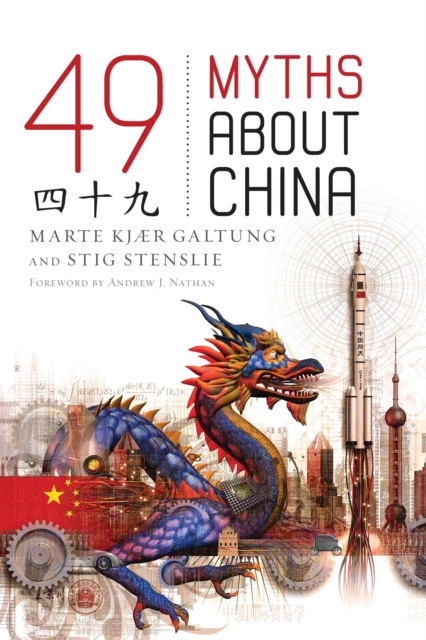
49 myths about China
Communism is dead in China. “China Inc.” is buying up the world. China has the United States over a barrel. The Chinese are just copycats. China is an environmental baddie, China is colonizing Africa. Mao was a monster. The end of the Communist regime is near. The 21st century belongs to China. Or does it? Marte Kjær Galtung and Stig Stenslie highlight 49 prevalent myths about China’s past, present, and future and weigh their truth or fiction. Leading an enlightening and entertaining tour, the authors debunk widespread “knowledge” about Chinese culture, society, politics, and economy. In some cases, Chinese themselves encourage mistaken impressions. But many of these myths are really about how we Westerners see ourselves, inasmuch as China or the Chinese people are depicted as what we are not. Western perceptions of the empire in the East have for centuries oscillated between sinophilia and sinophobia, influenced by historical changes in the West as much as by events in China. This timely and provocative book offers an engaging and compelling window on a rising power we often misunderstand.
eBook

Conclusion
As this book shows, the House of Sa'ud is far more integrated than it has generally been given credit for. Elite integration is undervalued in the literature. A revision of the existing literature on the subject is therefore needed in order to fully understand the stability of the regime. It is obviously fascinating to speculate around intrigues and succession struggles in the Royal Court of Riyadh, but it does not tell us much about the inner workings of the royal family.
Book Chapter
The Challenge of Succession
It heartened us to see this marvellous agreement (within the royal family) on pledging allegiance to 'Abdallah bin 'Abd al-'Aziz as monarch of the Kingdom and Custodian of the two Holy Mosques and on King 'Abdallah's choice of his brother Sultan bin 'Abd al-'Aziz as crown prince. We call on Muslims to pledge allegiance to them!
1
[H]istory has proved that the royal family is the family of unity, solidarity, cooperation, cordiality, and love. Your brothers, the royal family and people are all united behind you. We pin great hope on you. Your actions in the past foretold of a bright future.
2
I can assure you and everyone else that the royal family is united in one hand and one heart!
3
The House of Sa'ud's oligarchs and their allies repeatedly reaffirm in public the unity of the royals. Such statements must be understood as responses to the never-ending gossip about intrigues at the Royal Court. Western diplomats, journalists and researchers, no less than Saudi exiled dissidents, are obsessed by divisions within the royal family. The lack of institutionalized succession procedures has often been identified as the most glaring threat to elite unity. Ever since the death of Ibn Sa'ud, numerous observers have predicted a looming succession crisis, resulting in the disintegration of the royal family. As the sons of the late founding father grow older, warnings of succession struggles become louder. A new book is published every tenth year or so, addressing the dynamics of succession within the Al Sa'ud. The books of Alexander Bligh, Simon Henderson and Joseph A. Kechichian (as well as my own book) all fit perfectly into this interval.
4
As stressed in Chapter 1, since the mid-1990s, during King Fahd's 10 years of illness and even after, numerous rumours have indicated a power struggle between the heir apparent, 'Abdallah, on the one hand, and Sultan and the other Sudayri brothers on the other.
Book Chapter
Elite Integration and Regime Stability
Oil-wealth fuelled Saudi Arabia's rapid socio-economic development, which began in earnest in the 1960s and accelerated spectacularly in the 1970s. This new wealth made it possible to jump from a traditional pre-oil society into hyper-modern times within just one generation. Many prominent researchers predicted that this rapid socio-economic revolution would undermine the 'traditional' political order, which in turn would lead to the monarchy's fall. Samuel P. Huntington was one of them when, in 1968, he wrote about 'the king's dilemma' in Political Order in Changing Societies.
Book Chapter