
Catalogue Search | MBRL


Are you sure you want to remove the book from the shelf?

{{itemTitle}}
52
result(s) for
"Sabina Donati"
Sort by:

A Political History of National Citizenship and Identity in Italy, 1861–1950
This book examines the fascinating origins and the complex evolution of Italian national citizenship from the unification of Italy in 1861 until just after World War II. It does so by exploring the civic history of Italians in the peninsula, and of Italy's colonial and overseas native populations. Using little-known documentation, Sabina Donati delves into the policies, debates, and formal notions of Italian national citizenship with a view to grasping the multi-faceted, evolving, and often contested vision(s) ofitalianità. In her study, these disparate visions are brought into conversation with contemporary scholarship pertaining to alienhood, racial thinking, migration, expansionism, and gender.
As the first English-language book on the modern history of Italian citizenship, this work highlights often-overlooked precedents, continuities, and discontinuities within and between liberal and fascist Italies. It invites the reader to compare the Italian experiences with other European ones, such as French, British, and German citizenship traditions.
eBook
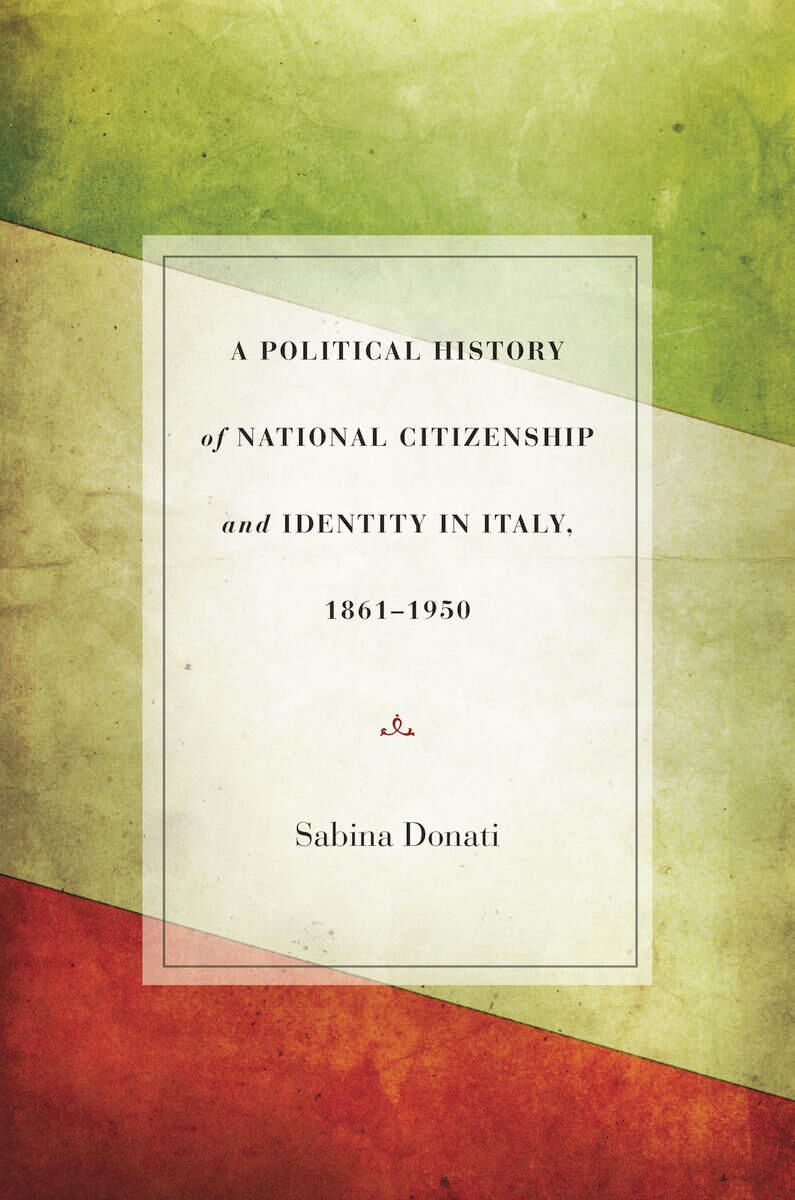
A Political History of National Citizenship and Identity in Italy, 1861–1950
This book examines the fascinating origins and the complex evolution of Italian national citizenship from the unification of Italy in 1861 until just after World War II. It does so by exploring the civic history of Italians in the peninsula, and of Italy's colonial and overseas native populations. Using little-known documentation, Sabina Donati delves into the policies, debates, and formal notions of Italian national citizenship with a view to grasping the multi-faceted, evolving, and often contested vision(s) of italianità. In her study, these disparate visions are brought into conversation with contemporary scholarship pertaining to alienhood, racial thinking, migration, expansionism, and gender. As the first English-language book on the modern history of Italian citizenship, this work highlights often-overlooked precedents, continuities, and discontinuities within and between liberal and fascist Italies. It invites the reader to compare the Italian experiences with other European ones, such as French, British, and German citizenship traditions.
eBook

ITALY'S INFORMAL IMPERIALISM IN TIANJIN DURING THE LIBERAL EPOCH, 1902–1922
This article examines the notion of ‘informal imperialism’ in East Asia and extends the related historiographical debate to the Italian case-study by focusing on liberal Italy's concession at Tianjin city port from 1902 through 1922. By doing so, it provides a fresh perspective on Italy's sole concession in China as well as offering specific theoretical insights and historical details that have not been sufficiently discussed in the literature pertaining to Italian expansionism in the liberal years. Within the context of an Italian informal imperial structure at its inception, the study carries out an historical investigation by using the economic lens on the one hand, and the political-administrative one on the other. In this way, it advances the current discussion about informal imperialism(s) in Tianjin by surveying issues pertaining not only to Italian trade, finance, and investments in imperial settings but also to foreign self-government and the establishment of an Italian Municipal Council as tools of imperial power relations. Based on a variety of Italian-language historical sources, archival material, and related academic works, the analysis is further enriched with comparisons drawn from the English-language scholarship on the British and the Japanese informal empires.
Journal Article
National Risorgimento, the Piedmontese Solution and the Origins of Italian Monarchical Subjecthood (1859–1866)
In March 1861, after almost thirteen centuries of political fragmentation and multiple states, the divided Italian peninsula was unified under the House of Savoy and the Italian kingdom proclaimed from the city of Turin. This Italian state stretched from the Western Alps to Sicily and excluded, for important reasons of international politics, the Venetian and the Roman provinces that remained under Austrian and pontifical rule until 1866 and 1870 respectively. Even though realized in a “truncated” way, the national ideal of political unification was finally achieved, thanks to a combination of skilled diplomatic negotiations, Piedmontese dynastic aspirations, French military interventions
Book Chapter