
Catalogue Search | MBRL


Are you sure you want to remove the book from the shelf?

{{itemTitle}}
3
result(s) for
"Sadowski, Piotr, 1957- author"
Sort by:


The Semiotics of Light and Shadows
Lighting and shadows are used within a range of art forms to create aesthetic effects. Piotr Sadowski’s study of light and shadow in Weimar cinema and contemporaneous visual arts is underpinned by the evolutionary semiotic theories of indexicality and iconicity. These theories explain the unique communicative and emotive power of light and shadow when used in contemporary indexical media including the shadow theatre, silhouette portraits, camera obscura, photography and film. In particular, Sadowski highlights the aesthetic and emotional significance of shadows. The ‘cast shadow’, as an indexical sign, maintains a physical connection with its near-present referent, such as a hidden person, stimulating a viewer’s imagination and provoking responses including anxiety or curiosity. The ‘cinematic shadow’ plays a stylistic role, by enhancing image texture, depth of field, and tonal contrast of cinematic moments. Such enhancements are especially important in monochromatic films, and Sadowski interweaves the book with accounts of seminal Weimar cinema moments. Sadowski's book is distinctive for combining historical materials and theoretical approaches to develop a deeper understanding of Weimar cinema and other contemporary art forms. The Semiotics of Light and Shadows is an ideal resource for both scholars and students working in linguistics, semiotics, film, media, and visual arts.
eBook
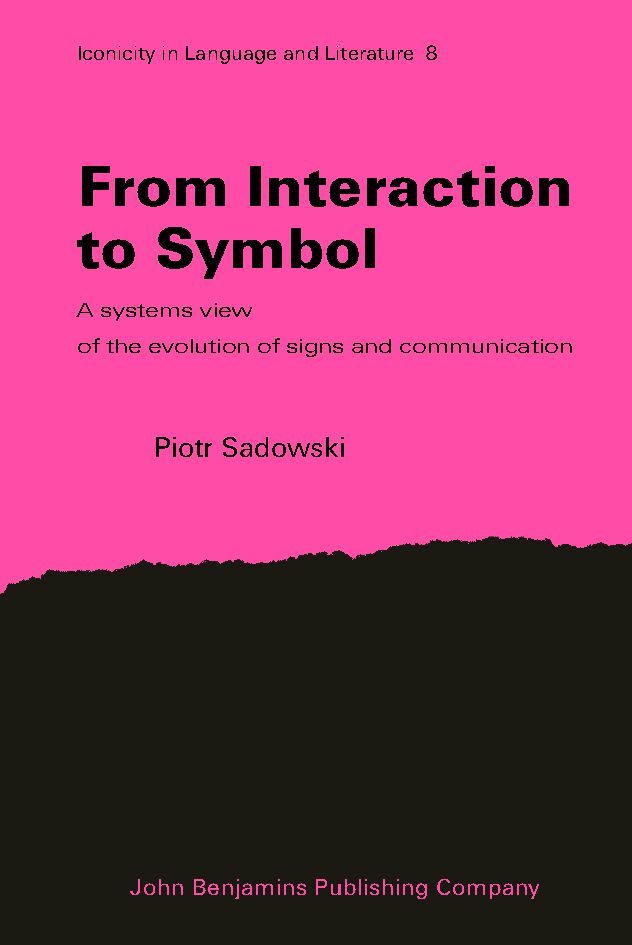
From interaction to symbol : a systems view of the evolution of signs and communication
Against the background of jargon-ridden and often obscure semiotic literature Sadowski's book offers a reader-friendly yet rigorous account of human communication and its evolution from animal and primate behaviour. What is specifically human about the way we exchange information with other people, and to what extent are our facial expressions, body language, and even emotive elements of speech still indebted to our pre-human ancestors? Why can the chimpanzees, smart as they are, not interpret animal tracks in the ground; why did religions often ban representational art; why is photography perceptually more powerful than painting; how have human syntactic speech and combinatorial grammar enabled the \"explosion\" of culture; and why do otherwise rational humans often strongly believe in the objective existence of unempirical, virtual entities such as religious and philosophic concepts? These and many other fascinating questions are addressed in the book within the methodological framework of systems theory and evolutionary psychology.
eBook