
Catalogue Search | MBRL


Are you sure you want to remove the book from the shelf?

{{itemTitle}}
7,990
result(s) for
"Sam, C."
Sort by:


Converting quadratic entropy to diversity: Both animals and alleles are diverse, but some are more diverse than others
The use of diversity metrics has a long history in population ecology, while population genetic work has been dominated by variance-derived metrics instead, a technical gap that has slowed cross-communication between the fields. Interestingly, Rao's Quadratic Entropy (RQE), comparing elements for 'degrees of divergence', was originally developed for population ecology, but has recently been deployed for evolutionary studies. We here translate RQE into a continuous diversity analogue, and then construct a multiply nested diversity partition for alleles, individuals, populations, and species, each component of which exhibits the behavior of proper diversity metrics, and then translate these components into [0,1]-scaled form. We also deploy non-parametric statistical tests of the among-stratum components and novel tests of the homogeneity of within-stratum diversity components at any hierarchical level. We then illustrate this new analysis with eight nSSR loci and a pair of close Australian marsupial (Antechinus) congeners, using both 'different is different' and 'degree of difference' distance metrics. The total diversity in the collection is larger than that within either species, but most of the within-species diversity is resident within single populations. The combined A. agilis collection exhibits more diversity than does the combined A. stuartii collection, possibly attributable to localized differences in either local ecological disturbance regimes or differential levels of population isolation. Beyond exhibiting different allelic compositions, the two congeners are becoming more divergent for the arrays of allele sizes they possess.
Journal Article

The repose of the spirits : a Sufi commentary on the divine names
The Repose of the Spirits' is a translation of one of the earliest and most comprehensive treatises on Sufism in the Persian language. Written by Ahmad Sam'ani, an expert in Islamic law from a famous Central Asian scholarly family in about the year 1135, it is one of the handful of early Sufi texts available in English and is by far the most accessible. It also may well be the longest and the most accurately translated. Ostensibly a commentary on the divine names, it avoids the abstract discourse of theological nitpicking and explains the human significance of the names with a delightful mix of Quranic verses and sayings of the Prophet and various past teachers, interspersed with original interpretations of the received wisdom. Unlike the usual books on the divine names (such as that of al-Ghazali), 'The Repose of the Spirits' reminds the reader of the later poetical tradition, especially the work of Rumi. The prose is richly embroidered with imagery and interspersed with a great variety of Arabic and Persian poetry. What is especially remarkable is the manner in which the author speaks to his readers about their own personal situations, explaining why they are driven by a love affair with God, a God who is full of compassion and good humor, whether they know it or not. William C. Chittick?s masterful new translation brings this work to an English-language audience for the first time.00Transl. from Persian by William C. Chittick.
BOOK

Long-term impacts of wildfire and logging on forest soils
Soils are a fundamental component of terrestrial ecosystems, and play key roles in biogeochemical cycles and the ecology of microbial, plant and animal communities. Global increases in the intensity and frequency of ecological disturbances are driving major changes in the structure and function of forest ecosystems, yet little is known about the long-term impacts of disturbance on soils. Here we show that natural disturbance (fire) and human disturbances (clearcut logging and post-fire salvage logging) can significantly alter the composition of forest soils for far longer than previously recognized. Using extensive sampling across a multi-century chronosequence in some of the tallest and most carbon-dense forests worldwide (southern Australian, mountain ash (Eucalyptus regnans) forests), we provide compelling evidence that disturbance impacts on soils are evident up to least eight decades after disturbance, and potentially much longer. Relative to long-undisturbed forest (167 years old), sites subject to multiple fires, clearcut logging or salvage logging were characterized by soils with significantly lower values of a range of ecologically important measures at multiple depths, including available phosphorus and nitrate. Disturbance impacts on soils were most pronounced on sites subject to compounding perturbations, such as multiple fires and clearcut logging. Long-lasting impacts of disturbance on soil can have major ecological and functional implications.Fires and logging alter soil composition and result in a significant reduction of soil nutrients that lasts for decades after the disturbance, suggests an analysis of soil samples across a multi-century sequence in mountain ash forests.
Journal Article
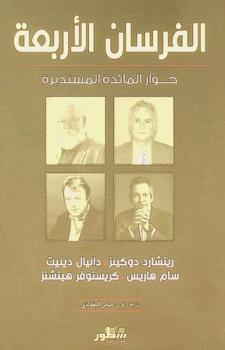
الفرسان الأربعة : حوار المائدة المستديرة
في فجر الحركة الإلحادية الجديدة جلس هؤلاء المفكرون الذين أصبحوا معروفين باسم الفرسان الأربعة معا حول الطاولة المستديرة. وما تبع ذلك كان جدالا واسعا وحادا ورائعا ومثيرا للاهتمام. شاهده الملايين منذ نشره لأول مرة على موقع اليوتيوب. هذا هو ضرب من التحقيق الفكري في أفضل حالاته، مبهج ومضحك وغير قابل للتكهن. ومخلص وصادق ويذكرنا بمدى تنوع خيوط الإلحاد الجديد. هنا نص الحوار مطبوع ومعززا بمقالات من المشاركين الأحياء، دوكينز وهاريس ودينات . هذه المقالات الجديدة التي كتب ستيفن فرأي مقدمتها تبين تطور تفكيرهم وتسلط الضوء على الجوانب الرنانة لهذا التبادل الملحمي بشكل خاص. تعامل كلا منهم مع أكثر الأسئلة الجوهرية فيما يتعلق بالوجود الإنساني وتحدوا الآخرين ليوضحوا موقفهم من الإله، الدين، النقد الثقافي، الروحانية، والجدال مع أهل الإيمان ومكونات الحياة الأخلاقية الحقيقية. الفرسان الأربعة هو حوار جريء ومثير لأربعة مفكرين هم الأبرز في العالم لمناقشة قضايا الدين والإلحاد.
Book

Hippocampal and medial prefrontal cortices encode structural task representations following progressive and interleaved training schedules
Memory generalisations may be underpinned by either encoding- or retrieval-based generalisation mechanisms and different training schedules may bias some learners to favour one of these mechanisms over the other. We used a transitive inference task to investigate whether generalisation is influenced by progressive vs randomly interleaved training, and overnight consolidation. On consecutive days, participants learnt pairwise discriminations from two transitive hierarchies before being tested during fMRI. Inference performance was consistently better following progressive training, and for pairs further apart in the transitive hierarchy. BOLD pattern similarity correlated with hierarchical distances in the left hippocampus (HIP) and medial prefrontal cortex (MPFC) following both training schedules. These results are consistent with the use of structural representations that directly encode hierarchical relationships between task features. However, such effects were only observed in the MPFC for recently learnt relationships. Furthermore, the MPFC appeared to maintain structural representations in participants who performed at chance on the inference task. We conclude that humans preferentially employ encoding-based mechanisms to store map-like relational codes that can be used for memory generalisation. These codes are expressed in the HIP and MPFC following both progressive and interleaved training but are not sufficient for accurate inference.
Journal Article


Effects of Contact‐Heat Stimulation Intensity on the Reliability of Subjective Pain Rating of Individuals With Different Heat Tolerance
Studies revealed that contact-heat stimulations mediate pain perception due to temporal summation of second pain (TSSP). How heat intensity affects the reliability of the pain rating of individuals with different heat tolerance is not well examined. This study investigated (1) the influence of the preceding contact-heat stimuli with different levels of intensity on the reliability of subjective pain rating and (2) the differences in reliability of subjective pain rating of participants with high and low sensory sensitivity or heat tolerance.
Participants with intact sensory function were divided into (1) high (
= 17) and low (
= 13) sensitivity groups based on the cutoff temperature of 42°C or (2) high (
= 18) and low (
= 12) pain-tolerance groups based on the cutoff temperature of 47°C equivalent to numerical rating scale (NRS) of 7. In each trial, participants were given a pair of 2-s contact-heat stimuli (an interstimulus interval of 2.5 s) at the left thenar eminence and were asked to report an NRS rating. Four blocks of intensity combinations were given: Low-Low, High-High, Low-High, and High-Low conditions, with 72 trials in each block.
Findings revealed that high heat-tolerance group results had lower intraclass correlation coefficients (ICCs) when contact-heat stimuli were preceded by another with higher intensity (ICC = 0.551-0.747) compared to those preceded by lower intensity (ICC = 0.724-0.818). In contrast, the ICCs of the low heat-tolerance group were found to be relatively higher regardless of heat intensity (ICC = 0.595-0.806).
The TSSP effect reflected by lower pain rating reliability appears to be induced in the high heat-tolerance group when a contact-heat stimulation is preceded by another stimulation with higher intensity but with the same duration. This is possibly due to the longer offset time of contact-heat stimulations with higher intensity, and also the top-down modulatory effects in this high heat-tolerance group. Further electrophysiological studies would be needed to investigate the underlying neural processes of TSSP in individuals with different heat tolerance.
Journal Article


Communal Reverie: A Wisdom Technology for Collective Imaginal Attunement
Communal Reverie, a group practice designed to facilitate the cultivation of collective imaginal attunement, has been framed a “collective wisdom technology.” It draws significant influence from the philosophy and practical protocols informing Collective Presencing, a modality of “we-space” practice developed by Ria Baeck. It is further informed by philosophical, mystical, and psychological traditions that advance various conceptions concerning the autonomous imagination’s value, both as a source of knowledge and a crucial element in transformative practice. Communal Reverie, to my present knowledge, is a distinctive practice modality insofar as it applies the technique of sourcing in service of a collective modality of imaginal encounter. The aspirations guiding the continual refinement of Communal Reverie’s theoretical and practical foundations are informed, most fundamentally, by thought traditions emphasizing engagement with the imaginal as a means toward advancing the evolutionary emergence of a modality of consciousness capable of assuming a co-creative and participatory role in relationship with transrational influences of a spiritual nature. The achievement of such participation may, furthermore, entail fundamental transformations in the phenomenal experience of both selfhood and time.
Journal Article