
Catalogue Search | MBRL


Are you sure you want to remove the book from the shelf?

{{itemTitle}}
15
result(s) for
"Sanderson, Rena"
Sort by:


From the Hemingway Letters Project
To be fair, his advice against writing about Hemingway came shortly before the vast trove of Hemingway's papers was opened to research at the John F. Kennedy Presidential Library in Boston in 1980, and before the publication of such posthumous works as The Garden of Eden (1986) opened new veins of scholarship and stoked powerful new waves of popular and scholarly interest in Hemingway that still show no signs of abating. Each cover will feature a photograph of Hemingway from the period of the volume, along with the stylized signature that was embossed on the cloth covers of many of the Scribner's editions of Hemingway's books during his lifetime. In many cases, it is necessary to consult the other side of the correspondence-the letter to which Hemingway is responding, either through copies we obtain from a repository (most frequently the Kennedy Library) or in the published correspondence of the recipient (such as Fitzgerald, Pound, or Dos Passos).
Journal Article
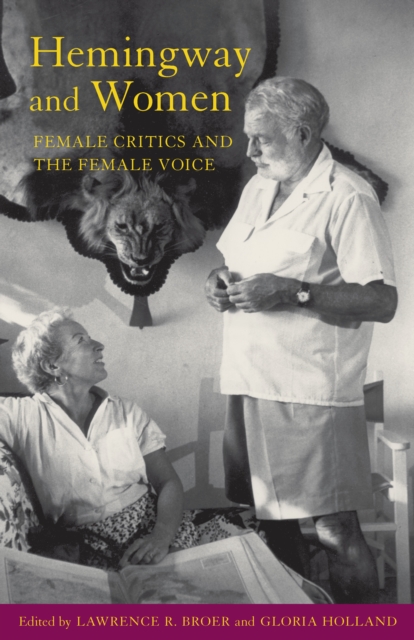
Hemingway and Women: Female Critics and the Female Voice
Female scholars reevaluate gender and the female presence in the life and work of one of America's foremost writers.Ernest Hemingway has often been criticized as a misogynist because of his portrayal of women. But some of the most exciting Hemingway scholarship of recent years has come from women scholars who challenge traditional views of Hemingway and women. The essays in this collection range from discussions of Hemingway's famous heroines Brett Ashley and Catherine Barkley to examinations of the central role of gender in his short stories and in the novel The Garden of Eden. Other essays address the real women in Hemingway's life-those who cared for him, competed with him, and, ultimately, helped to shape his art. While Hemingway was certainly influenced by traditional perceptions of women, these essays show that he was also aware of the struggle of the emerging new woman of his time. Making this gender struggle a primary concern of his fiction, these critics argue, Hemingway created women with strength, depth, and a complexity that readers are only beginning to appreciate.\"The authors focus on women connected to Hemingway in life, specific female characters, and issues of gender and sexual ambiguities and crossings embodied or enacted by male and female characters. Topics range from reading the feminine in nature to expanding the concept of the code hero to include major female characters.\"-American Literature\"Exceptionally thorough . . . this collection is impressive and unflinching in its exploration.\"-Ruth Prigozy, Hofstra UniversityLawrence Broer is Professor Emeritus of English at the University of South Florida and author of a number of books on American literature, including Sanity Plea: Schizophrenia in the Novels of Kurt Vonnegut and Rabbit Tales: Poetry and Politics in John Upike's Rabbit Novels. Gloria Holland is Adjunct Instructor in English at Hillsborough Community College and has coauthored papers with Lawrence Broer on Hemingway, Vonnegut, Norman Mailer, and F. Scott Fitzgerald.
eBook

Hemingway and women : female critics and the female voice
Female scholars reevaluate gender and the female presence in the life and work of one of America’s foremost writers. Ernest Hemingway has often been criticized as a misogynist because of his portrayal of women. But some of the most exciting Hemingway scholarship of recent years has come from women scholars who challenge traditional views of Hemingway and women. The essays in this collection range from discussions of Hemingway’s famous heroines Brett Ashley and Catherine Barkley to examinations of the central role of gender in his short stories and in the novel The Garden of Eden . Other essays address the real women in Hemingway’s life—those who cared for him, competed with him, and, ultimately, helped to shape his art. While Hemingway was certainly influenced by traditional perceptions of women, these essays show that he was also aware of the struggle of the emerging new woman of his time. Making this gender struggle a primary concern of his fiction, these critics argue, Hemingway created women with strength, depth, and a complexity that readers are only beginning to appreciate. "The authors focus on women connected to Hemingway in life, specific female characters, and issues of gender and sexual ambiguities and crossings embodied or enacted by male and female characters. Topics range from reading the feminine in nature to expanding the concept of the code hero to include major female characters." — American Literature "Exceptionally thorough . . . this collection is impressive and unflinching in its exploration." —Ruth Prigozy, Hofstra University Lawrence Broer is Professor Emeritus of English at the University of South Florida and author of a number of books on American literature, including Sanity Plea: Schizophrenia in the Novels of Kurt Vonnegut and Rabbit Tales: Poetry and Politics in John Upike’s Rabbit Novels . Gloria Holland is Adjunct Instructor in English at Hillsborough Community College and has coauthored papers with Lawrence Broer on Hemingway, Vonnegut, Norman Mailer, and F. Scott Fitzgerald.
eBook

\A Modern Mephistopheles\: Louisa May Alcott's Exorcism of Patriarchy
A critique of Louisa May Alcott's mature novel \"A Modern Mephistopheles\" is presented. The book reinscribes conflicts of creativity as conflicts of gender and sexual politics, calling into question masculine definitions of artistic productivity and offering a tentative feminist alternative.
Journal Article
Women in Fitzgerald’s fiction
F. Scott Fitzgerald is best known as a chronicler of the 1920s and as the writer who, more than any other, identified, delineated, and popularized the female representative of that era, the flapper. Though it is an overstatement to say that Fitzgerald created the flapper, he did, with considerable assistance from his wife Zelda, offer the public an image of a modern young woman who was spoiled, sexually liberated, self-centered, fun-loving, and magnetic. In Fitzgerald's mind, this young woman represented a new philosophy of romantic individualism, rebellion, and liberation, and his earliest writings enthusiastically present her as an embodiment of these new values. Although she is often seen now as a mere fashion of the bygone Jazz Age, the flapper should be regarded as one of the great authentic characters in American history. A virtual emblem of American modernity, she and all she stood for were envied, desired, feared, and emulated throughout much of theWestern world, and it was Fitzgerald's particular version of the flapper that “women imitated for more than four decades” (Solomon, Ain't We Got Fun?, 22). Fitzgerald’s early and widely publicized association with the flapper, however, has led many readers to misconstrue and to oversimplify the author’s portraits of women and of relations between the sexes. It is important to understand that, almost from the start, Fitzgerald was ambivalent toward his “creation,” fearing that the flapper embodied not freedom but moral anarchy and lack of direction. Increasingly he used her as a symbol not only of a new order, but also of social disorder and conflict. As he wrote to Edmund Wilson in May 1925, “If I had anything to do with creating the manners of the contemporary American girl I certainly made a botch of the job” (Life in Letters, 110).
Book Chapter
Hemingway and gender history
In a letter written to Charles Scribner in 1949, Ernest Hemingway listed “Mr. Turgenieff” and “Mr. Maupassant” as authors he had beaten in the ring. Among his prospective opponents were “Mr. Henry James,” “Mr. Cervantes,” and the redoubtable “Dr. Tolstoi.” Finally, he mentioned “some guys nobody could ever beat like Mr. Shakespeare (The Champion) and Mr. Anonymous” (SL 673). In the notorious 1950 Lillian Ross interview published in The New Yorker, Hemingway, with the same self-conscious braggadocio, repeated this list of authors and declared himself literary heavyweight champion, having won the title in the 1920s and defended it ever since (Ross 49).Hemingway's boxing metaphor and the male opponents (emphasized by the masculine forms of address) neatly convey his belief - this was before the discovery that Anonymous was a woman - that the world of writing should be a man's world, a boxing gym, no women allowed. And truly, his New Yorker performance and other, even less subtle, public displays have made “Papa Hemingway” synonymous with a stereotypical notion of masculinity. It is a standard rule of reading imaginative literature that one should distinguish between an author's actual life and the lives that appear in his or her fiction, but for many readers - especially women - Hemingway's fame as a man makes this rule hard to observe (Abbott 612). The accusation of male chauvinism hangs over the man and his work.
Book Chapter

Suicide and Literary Biography: The Case of Hemingway
A writer's suicide confronts his or her biographers with special problems and opportunities. Drawing primarily on biographies of Ernest Hemingway for its examples, this article examines the narrative and rhetorical strategies often employed to present literary lives that end in suicide.
Journal Article

