
Catalogue Search | MBRL


Are you sure you want to remove the book from the shelf?

{{itemTitle}}
724
result(s) for
"Saunders, Anna"
Sort by:


Constitution-Making as a Technique of International Law: Reconsidering the Post-war Inheritance
Over the last three decades, international lawyers and institutions have come to understand constitution-making as an accepted technique of international law and a means of delivering peace and security. In defending this technique from its critics, scholars have drawn on a particular tradition of constitution-making that understands constitutionalism as a lawful form of international action, realizable through a set of formal practices, and juridically distinct from material concerns. This Article explores the building of this tradition through the work of legal scholars within the United States in conversation with German and Jewish émigré scholars and argues that reimagining constitutionalism for the coming decades requires rethinking this separation between the juridical and the material, as well as asking what constitutionalism demands of the laws governing the global economy.
Journal Article


Memorializing the GDR
Since unification, eastern Germany has witnessed a rapidly changing memorial landscape, as the fate of former socialist monuments has been hotly debated and new commemorative projects have met with fierce controversy. Memorializing the GDR provides the first in-depth study of this contested arena of public memory, investigating the individuals and groups devoted to the creation or destruction of memorials as well as their broader aesthetic, political, and historical contexts. Emphasizing the interrelationship of built environment, memory and identity, it brings to light the conflicting memories of recent German history, as well as the nuances of national and regional constructions of identity.
eBook


Memorializing the GDR
Since unification, eastern Germany has witnessed a rapidly changing memorial landscape, as the fate of former socialist monuments has been hotly debated and new commemorative projects have met with fierce controversy.Memorializing the GDR provides the first in-depth study of this contested arena of public memory, investigating the individuals and groups devoted to the creation or destruction of memorials as well as their broader aesthetic, political, and historical contexts. Emphasizing the interrelationship of built environment, memory and identity, it brings to light the conflicting memories of recent German history, as well as the nuances of national and regional constructions of identity.
eBook

Comparison of Step-Based Metrics Under Laboratory and Free-Living Conditions in Femoroacetabular Impingement Syndrome
Femoroacetabular impingement syndrome (FAIS) causes pain and functional limitations. Little is known regarding walking characteristics, volume, and intensity evaluated in laboratory and free-living conditions and whether these measures differ between those with FAIS and uninjured individuals.
To examine the differences in laboratory gait measures and free-living step-based metrics between individuals with FAIS and uninjured control participants.
Comparative, cross-sectional study.
We enrolled 25 participants with FAIS and 14 uninjured controls.
We evaluated laboratory spatiotemporal gait measures (cadence, velocity, step length, stride length) during self-selected and fast walking speeds using an instrumented walkway. Participants then wore an accelerometer around the waist during waking hours for 7 consecutive days. Free-living step-based metrics included average daily steps, peak 1- and 30-minute cadence, and average daily time spent in walking cadence bands. We compared laboratory gait measures and step-based metrics between groups.
The groups did not differ in laboratory spatiotemporal gait measures during both speeds (all P > .05). The FAIS group took fewer daily steps (5346 ± 2141 versus 7338 ± 2787 steps/d; P = .030) and had lower peak 1-minute (92.9 ± 23.9 versus 119.6 ± 16.3 steps/min; P < .001) and 30-minute cadences (60.9 ± 27.1 versus 86.8 ± 22.4 steps/min; P = .003) compared with uninjured controls, respectively. The FAIS group also spent less time in slow (6.0 ± 3.6 versus 10.3 ± 3.4 min/d; P = .001), medium (4.5 ± 4.2 versus 8.9 ± 4.4 min/d; P = .005), and brisk/moderate (4.5 ± 6.2 versus 12.2 ± 10.3; P = .020) cadence bands compared with uninjured controls.
Clinical/laboratory gait measures alone may not be representative of real-world walking-related physical activity behavior in individuals with FAIS.
Journal Article
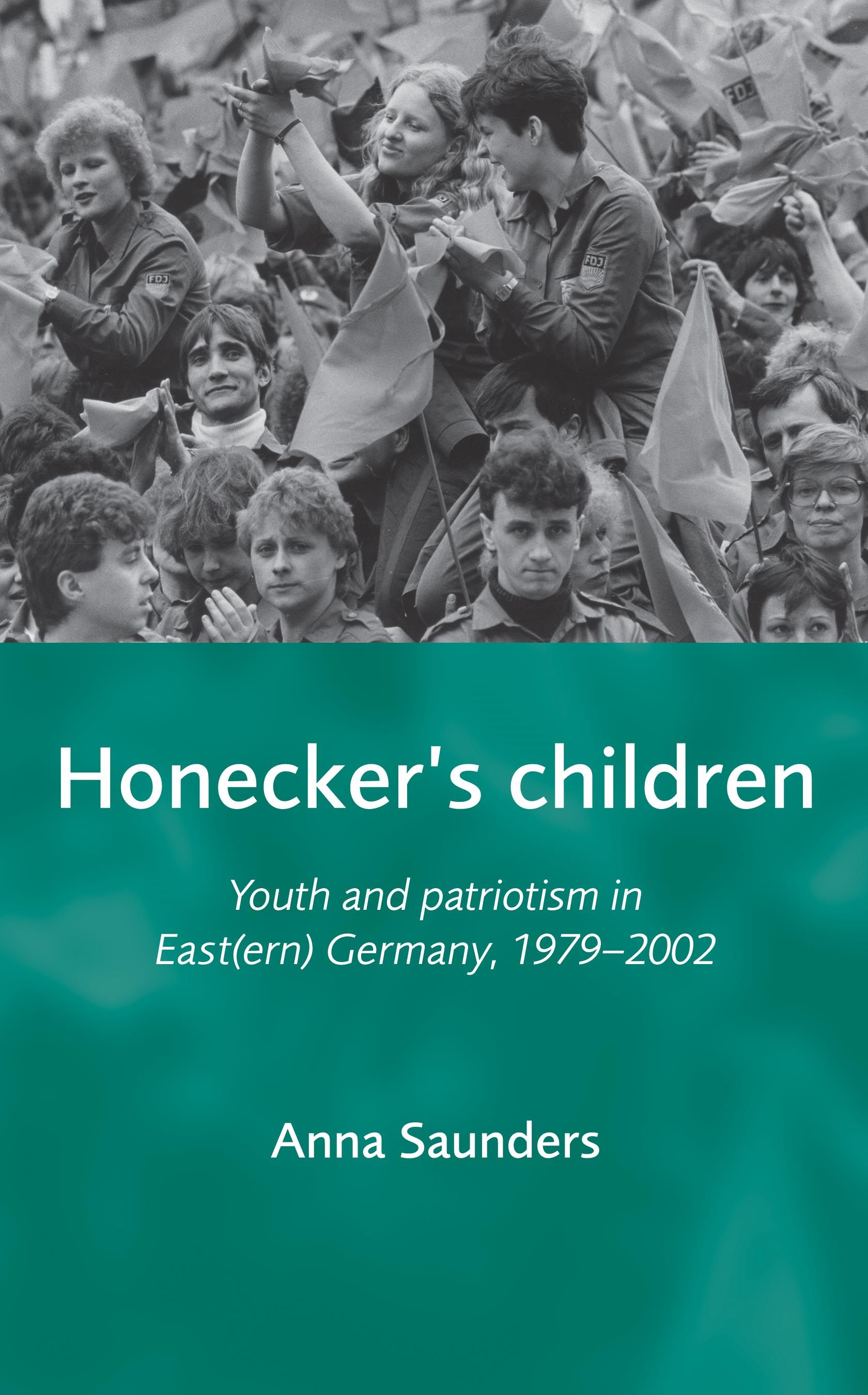
Honecker's Children
During the final decade of the German Democratic Republic (GDR), young citizens found themselves at the heart of a rigorous programme of socialist patriotic education, yet following the fall of the Berlin Wall, the emphasis of official state rhetoric, textbooks and youth activities changed beyond recognition. For the young generation growing up during this period, ‘normality’ was turned on its head, leaving a sense of insecurity and inner turmoil.Using a combination of archival research and interviews, together with educational materials and government reports, this book examines the relationship between young people and their two successive states in East(ern) Germany between 1979 and 2002. This unusual time-span straddles the 1989/1990 caesura which often delimits historical studies, and thus enables not only a detailed examination of GDR socialisation, but crucially also its influence in unified Germany. Anna Saunders explores the extent to which a young generation’s loyalties can be officially regulated in the face of cultural and historical traditions, changing material conditions and shifting social circumstances, and finds GDR socialisation to be influential to post-unification loyalties through its impact on the personal sphere, rather than through the official sphere of ideological propaganda. At a time of globalisation, this lucid study not only provides unique insight into the functioning of the GDR state and its longer-term impact, but also advances our broader understanding of the ways in which collective loyalties are formed. It will be of particular interest to those in the fields of German History and Politics, European Studies and Sociology.
eBook

Remembering Right-Wing Violence in Post-unification Eastern Germany
Abstract After the demise of the German Democratic Republic, social and economic instability, coupled with the growth of right-wing extremism, resulted in a number of violent and racist attacks on migrant workers as well as riots that lasted several days. This article examines the ways in which these attacks have been remembered in the public sphere since unification, with a particular focus on physical memorialization. Efforts to commemorate these events in the built environment have not, however, been without controversy and raise significant questions relating to notions of Heimat and its disruption. As the article argues, remembering these events today has increasingly become a central part of the construction of local identities and active socio-political spaces, and can be seen as an important element in the practice of Beheimatung.
Journal Article

Honecker's Children
During the final decade of the German Democratic Republic (GDR), young citizens found themselves at the heart of a rigorous programme of patriotic education, incorporating school lessons, extra-curricular activities, ritual ceremonies and organised holidays. As the second generation born in the GDR, they knew nothing other than the ‘normality’ of German division. However, following the fall of the Berlin Wall, they not only became citizens of a new state, but the emphasis of official state rhetoric, textbooks and free-time activities changed beyond recognition; young soldiers were expected to swear an oath of loyalty to their former enemy, loyalists were denounced as opportunists or informers, and rebels became heroes. For this young generation, ‘normality’ was turned on its head, leaving a sense of insecurity and inner turmoil. Using a combination of archival research and interviews, together with educational materials and government reports, this book examines the relationship between young people and their two successive states in East(ern) Germany between 1979 and 2002. This unusual time-span straddles the 1989/1990 caesura which so often delimits historical studies, and thus enables not only a detailed examination of GDR socialisation, but crucially also its influence in unified Germany, and the extent to which a young generation’s loyalties can be officially regulated in the face of cultural and historical traditions, changing material conditions and shifting social circumstances. In this study, Anna Saunders highlights the nature of the GDR as a state where the divides between state and society, as well as dissent and conformity, were less distinct than is frequently asserted. Her original research finds GDR socialisation to be influential to post-unification loyalties through its impact on the personal sphere, rather than through the ideological propaganda of socialist patriotic education. At a time of globalisation and European expansion, this lucid study not only provides unique insight into the functioning of the GDR state and its longer-term impact, but also advances our broader understanding of the ways in which collective loyalties are formed. It will be of particular interest to those in the fields of German History and Politics, European Studies and Sociology.
eBook