
Catalogue Search | MBRL


Are you sure you want to remove the book from the shelf?

{{itemTitle}}
182
result(s) for
"Saunders, Max"
Sort by:


‘Men’s Dwellings Were Thin Shells’: Uncertain Interiors and Domestic Violence in Ford Madox Ford’s War Writing
The standard image of First World War soldiers is of men in open trenches: waiting to attack or be attacked; walking, sitting, sleeping, dead. Ford’s Parade’s End includes such scenes. But it is a different kind of image which predominates in his war writings and often produces its most memorable passages: images of houses or house-like shelters. The mind seeks protection in such structures; but they offer little security against the destructiveness outside, against the bombardments, gas, shrapnel, bullets. Ford wrote that the experience of war revealed: ‘men’s dwellings were thin shells that could be crushed as walnuts are crushed. … all things that lived and moved and had volition and life might at any moment be resolved into a scarlet viscosity seeping into the earth of torn fields […]’. This realisation works in two ways. The soldier’s sense of vulnerability provokes fantasies of home, solidity, sanctuary, while for the returnee soldier, domestic architecture summons war-visions of its own annihilation: ‘it had been revealed to you’, adds Ford, ‘that beneath Ordered Life itself was stretched, the merest film with, beneath it, the abysses of Chaos’. It is now customary to read war literature through trauma theory. Building on analyses of Ford’s use of repression, but drawing instead on object relations theory, I argue that Ford’s houses of war are not screen memories but images of the failure of repression to screen off devastating experiences. The abysses of Chaos can be seen through the screen or projected upon it. Attending to Ford’s handling of this theme enables a new reading of his war writing and a new case for its coherence. The essay will connect the opening of No More Parades (in a hut, during a bombardment) with the war poem ‘The Old Houses of Flanders’; the postwar poem A House; the memoir It Was the Nightingale (quoted above); and the otherwise puzzling, fictionalised memoir No Enemy, structured in terms of ‘Four Landscapes’ and ‘Certain Interiors’.
Journal Article

Ford Madox Ford's 'The good soldier' : centenary essays
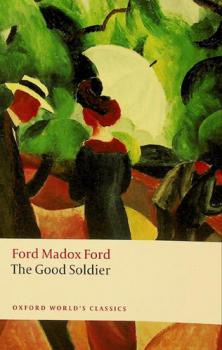
\"The controversial British writer Ford Madox Ford is increasingly recognized as a major presence in early twentieth-century literature. He is best-known for his fiction, especially 'The Good Soldie', long considered a modernist masterpiece; and 'Parade's End', which was adapted by Tom Stoppard for the acclaimed 2012 television series, starring Benedict Cumberbatch. This volume marks the centenary of 'The Good Soldier', with eighteen essays by established experts and new scholars. It includes groundbreaking work on the novel's narrative technique, chronology, and genre; plus pioneering work considering the treatment of bodies and minds; eugenics; poison; and surveillance. Innovative comparative studies discuss Ford's novel in relation to Henry James, Violet Hunt, H. G. Wells, Franz Kafka, Jean Rhys, David Jones, and Lawrence Durrell.\"--Back cover.
BOOK

Ford Madox Ford
A critical biography of the great modernist editor and novelist. Ford Madox Ford (1873-1939) lived among several of the most important artists and writers of his time. Raised by Pre-Raphaelites and friends with Henry James, H. G. Wells, and Joseph Conrad, Ford was a leading figure of the avant-garde in pre-WWI London, responsible for publishing Ezra Pound, Wyndham Lewis, and D. H. Lawrence. After the war, he moved to Paris, published Gertrude Stein, and discovered Ernest Hemingway. A prolific writer in his own right, Ford wrote the modernist triumph The Good Soldier (1915) as well as one of the finest war stories in English, the Parade's End tetralogy (1924-1928). Drawing on newly discovered letters and photographs, this critical biography further demonstrates Ford's vital contribution to modern fiction, poetry, and criticism.
eBook


Autofiction, Autobiografiction, Autofabrication, and Heteronymity: Differentiating Versions of the Autobiographical
The story so far: the term autofiction is said to have been coined by Serge Doubrovsky, who used it to describe his 1977 novel Fils, where he defines it-fairly broadly-as Fiction, of strictly factual events and facts: autofiction, if you will\" [Fiction, d'événements et de faits strictement réels; si l'on veut, autofiction].1 While initially associated with postmodernist French novelists such as Doubrovsky himself, Marguerite Duras, Annie Ernaux, Hervé Guibert, Marie Darrieussecq, or Catherine Millet, it has come to acquire a broader use, to describe various combinations of the autobiographical and the fictional. Primarily, and most loosely, it is taken as a synonym for some form of autobiographical novel.4 Indeed, Sidonie Smith and Julia Watson begin their definition of it as \"the French term for autobiographical fiction, or fictional narrative in the first-person mode\" (Reading Autobiography 186). The revised Wikipedia definition continues: \"An author may decide to recount their life in the third person, to modify significant details and characters, using fictive subplots and imagined scenarios with real life characters in the service of a search for self.\" A classic example is The Education of Henry Adams, in which Harvard historian Henry Adams recounts his own life with a historian's emphases, aiming to make his individual experience representative of general historical experience, so as to illustrate misconceptions about the utility of education, say, or the transition from a religious to a mechanical ethos.
Journal Article

Ford Madox Ford’s The Good Soldier
This volume marks the centenary of Ford Madox Ford's masterpiece The Good Soldier. It includes groundbreaking work on the novel's narrative technique, chronology, and genre; pioneering work on bodies and minds; eugenics; poison; and surveillance; and innovative comparative studies.
eBook

The Edwardian Ford Madox Ford
The controversial British writer Ford Madox Ford (1873-1939) is increasingly recognized as a major presence in early twentieth-century literature. This series of International Ford Madox Ford Studies was founded to reflect the recent resurgence of interest in him. Each volume is based upon a particular theme or issue; and relates aspects of Ford's work, life, and contacts, to broader concerns of his time. Ford is best-known for his fiction, especially The Good Soldier, long considered a modernist masterpiece; and Parade's End, which Anthony Burgess described as 'the finest novel about the First World War', Samuel Hynes has called 'the greatest war novel ever written by an Englishman', and which has been adapted by Tom Stoppard for the acclaimed BBC/HBO television series. This volume focuses on Ford's work from the Edwardian decade and a half before the First World War. It contains Michael Schmidt's Ford Madox Ford Lecture, and fourteen other essays by British, American, French and German experts, both leading authorities and younger scholars. Chapters on Ford's fiction, poetry, criticism of literature and painting, writing about England, and dealings on the Edwardian literary scene as editor and with publishers, bring out his versatility and ingenuity throughout his first major creative phase.
eBook
