
Catalogue Search | MBRL


Are you sure you want to remove the book from the shelf?

{{itemTitle}}
5
result(s) for
"Scanlon, Thomas, author"
Sort by:

Why does inequality matter?
Inequality is widely regarded as morally objectionable: T. M. Scanlon investigates why it matters to us. Demands for greater equality can seem puzzling, because it can be unclear what reason people have for objecting to the difference between what they have and what others have, as opposed simply to wanting to be better off. This book examines six such reasons. Inequality can be objectionable because it arises from a failure of some agent to give equal concern to the interests of different parties to whom it is obligated to provide some good. It can be objectionable because it involves or gives rise to objectionable inequalities in status. It can be objectionable because it gives the rich unacceptable forms of control over the lives of those who have less. It can be objectionable because it interferes with the procedural fairness of economic institutions, or because it deprives some people of substantive opportunity to take part in those institutions. Inequality can be objectionable because it interferes with the fairness of political institutions. Finally, inequality in wealth and income can be objectionable because it is unfair: the institutional mechanisms that produce it cannot be justified in the relevant way. Scanlon's aims is to provide a moral anatomy of these six reasons, and the ideas of equality that they involve. He also examines objections to the pursuit of equality on the ground that it involves objectionable interference with individual liberty, and argues that ideas of desert do not provide a basis either for justifying significant economic inequality or for objecting to it. -- c From book jacket.
Book
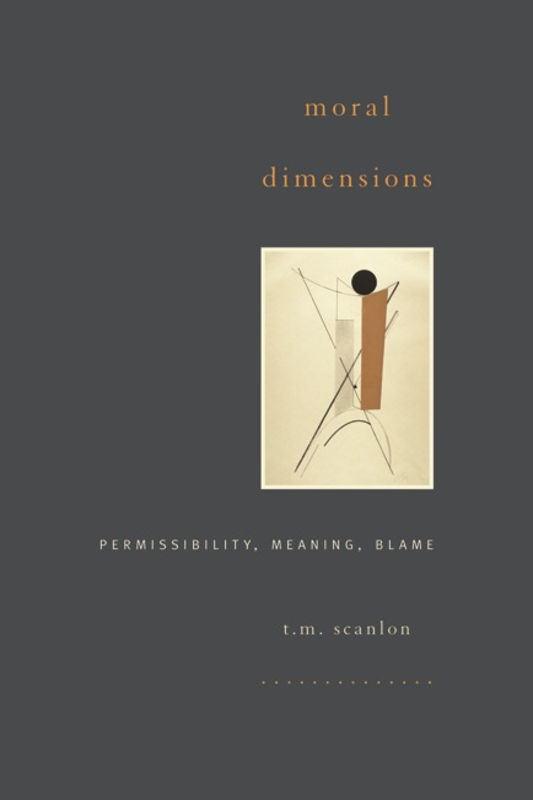
Moral Dimensions
In a clear and elegant style, T. M. Scanlon reframes current philosophical debates as he explores the moral permissibility of an action. Permissibility may seem to depend on the agent's reasons for performing an action. For example, there seems to be an important moral difference between tactical bombing and a campaign by terrorists—even if the same number of non-combatants are killed—and this difference may seem to lie in the agents' respective aims. However, Scanlon argues that the apparent dependence of permissibility on the agent's reasons in such cases is merely a failure to distinguish between two kinds of moral assessment: assessment of the permissibility of an action and assessment of the way an agent decided what to do.
Distinguishing between these two forms of assessment leads Scanlon to an important distinction between the permissibility of an action and its meaning: the significance for others of the agent's willingness to act in this way. An action's meaning depends on the agent's reasons for performing it in a way that its permissibility does not. Blame, he argues, is a response to the meaning of an action rather than its permissibility. This analysis leads to a novel account of the conditions of moral responsibility and to important conclusions about the ethics of blame.
eBook


The Difficulty of Tolerance
These essays in political philosophy by T. M. Scanlon, written between 1969 and 1999, examine the standards by which social and political institutions should be justified and appraised. Scanlon explains how the powers of just institutions are limited by rights such as freedom of expression, and considers why these limits should be respected even when it seems that better results could be achieved by violating them. Other topics which are explored include voluntariness and consent, freedom of expression, tolerance, punishment, and human rights. The collection includes the classic essays 'Preference and Urgency', 'A Theory of Freedom of Expression', and 'Contractualism and Utilitarianism', as well as a number of other essays that have hitherto not been easily accessible. It will be essential reading for all those studying these topics from the perspective of political philosophy, politics, and law.
eBook

Greek Historiography
This volume provides an accessible, comprehensive, and up-to-date survey of the ancient Greek genre of historical writing from its origins before Herodotus to the Greek historians of the Roman imperial era, seven centuries later.
* Focuses on the themes of power and human nature, causation, divine justice, leadership, civilization versus barbarism, legacy, and literary reception
* Includes thorough summaries alongside textual analysis that signpost key passages and highlight thematic connections, helping readers navigate their way through the original texts
* Situates historical writing among the forms of epic and lyric poetry, drama, philosophy, and science
* Uses the best current translations and includes a detailed list of further reading that includes important new scholarship
eBook