
Catalogue Search | MBRL


Are you sure you want to remove the book from the shelf?

{{itemTitle}}
3
result(s) for
"Schama, Simon. Citizens : a chronicle of the French Revolution"
Sort by:
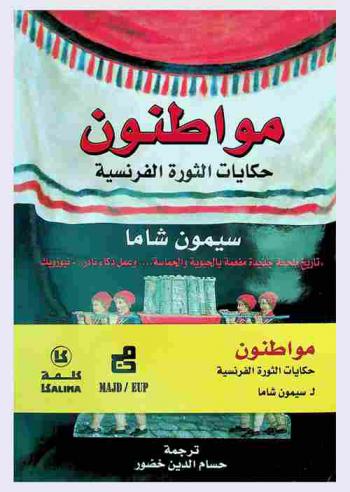
مواطنون : حكايات الثورة الفرنسية
\"عمل ضخم ممتع للقراءة وصف حي للأحداث الكبرى نقوش ملونة للشخصيات البارزة والغامضة أيضا يجلبهم إلى الحياة هنا كما لم يفعل عمل آخر... وفوق كل شيء يقدم السيد شاما قصة ويرويها بطريقة رائعة، \"دنيويورك تايمزبوك رفيو\" نحن بين يدي راو بارع، لوحة شاما الزاهية، الدرامية، المثيرة للتفكير في الثورة مفاجئة غالبا... يقنعنا سرده الرائع بأن الكثير مما ظننا أننا نعرفه هو خطأ\"
Book

TELEVISION; PBS Storms the Barricades
For there are not only two cities, London and Paris, there are two Evremondes: the evil Marquis and his enlightened nephew, Charles Darnay. There are, in effect, also two Darnays - Charles himself and the London barrister Sydney Carton, so like him physically but, until the end, utterly unlike him morally. The book begins with the ''recalling to life'' of the Marquis's victim, Dr. Alexandre Manette; at the end, there are two further resurrections: that of Darnay, rescued from the guillotine, and of Carton, given moral life through self-sacrifice. There may even be two Charles Dickenses in the novel: the noble figure of self-denial whom [DICKENS], an enthusiastic amateur actor, had recently portrayed in Wilkie Collins's play ''The Frozen Deep,'' and the self-accusing Dickens, possessed by inner demons, who had just sepa-ratd from his wife. The pattern of two's that traces its way throughout the book is the measure of its distance from real history. For the French Revolution was actively hostile to the number two - to divisibility and to the reconciliation of opposites. Its obsessions were with one's and with three's, both, by definition, indivisible. The motto of the Republic was Une et Indivisible; its sacred revolutionary trinity, Liberte, Egalite, Fraternite. Its proudest claim was to have fused the three feudal orders, or estates - clergy, nobles and bourgeoisie - into one nation. At the root of Dickens's ultimate horror of the French Revolution (as for Thomas Carlyle, whose epic history was the novelist's major source) was its merciless hostility to distinctions: between innocent and guilty, the private and the public life. Though ostensibly at liberty, Sydney Carton is also a prisoner - of his own purposeless and self-hating nature. In Dickens's seraphic climax he finds, not death, but a kind of new life, signaled not only by the ''far, far better rest'' that he goes to but also by the quotation that immediately precedes his end: '' 'I am the Resurrection and the Life, saith the Lord: he that believeth in me, though he were dead, yet shall he live.' '' This is among the most powerfully spiritual passages in all of Dickens, and it follows a novel that is not just dramatized history or melodramatized family romance, but a record of great journeys through darkness and light that touch readers to the quick, reminding us of our own sense of opportunity or insecurity in the face of great public events. Quite rightly, [Arthur Hopcraft] gives Dickens's most intensely dramatic moments their full due, avoiding the shrouded subtleties that marked his superlative television versions of the same author's ''Bleak House,'' shown here in 1985, and John le Carre's ''Tinker, Tailor, Soldier, Spy,'' in 1980. When a cask of wine breaks before the Defarge wine shop, one of the key haunts of the sans-culotte militants, men, women and children greedily lap it from the cobbles. Evremonde's carriage and horses tear through the streets - people scatter in front of them like scurrying animals -before crushing the body of a small child under a wheel. The Hopcraft version is also unapologetic about the intensity of the romance of Dr. Manette's daughter, Lucie, and the saintly aura that it projects on the Manette household in London, where the former victim of aristocratic oppression is, in effect, resurrected. One of the gambles of the bold Anglo-French casting was to have Jean-Pierre Aumont (a veteran of Claude Chabrol thrillers) play Dr. Manette in a way that, against the odds, is straightforward and unsentimental.
Newspaper Article
THE FOLLY AND THE SQUALOR
[Paul Fussell] is a connoisseur of fiasco. His acclaimed work on World War I, ''The Great War and Modern Memory,'' drew much of its ironic power from the discrepancy between grandiose strategy and pointless slaughter. The tone of that powerful book was tragic. In ''Wartime,'' the note struck is more often darkly comic. Early on in his account, the author relates the episode of Slapton Sands - the aptly named location in Devon of a botched rehearsal for the American landings in Normandy. The chaos of the exercise was such that in the dark some German gunboats managed to slip themselves into the Allied flotilla, causing tremendous havoc and leaving more than 700 dead. For Mr. Fussell, Slapton Sands is a paradigm of World War II, a great bloody pratfall, immediately recognized as such by the troops who had to endure it but later suppressed in the interests of perpetuating the myth of an unblemished moral crusade. What ''Wartime'' wants to do is to strip away those pieties and recover memories closer to Evelyn Waugh than Herman Wouk, less the bracing ''Winds of War'' and more stumble and bumble. The author's irritation with the military interruption of civility, moreover, leads him to bizarre emphases. [Cyril Connolly]'s Horizon magazine rates some 14 pages (including an interminable list of contributions), while popular culture (except for military language, on which the author is very good) gets much meaner rations. For the all-important contribution of the BBC, Mr. Fussell has a tin ear. Listening to the comic wireless genius of Tommy Handley (unmentioned in the book) with his ''Ministry of Mysteries and Aggravation'' might have persuaded Mr. Fussell that there were plenty of astringent antidotes in British wartime culture to the sugary cheerfulness of Vera Lynn (not that I see much wrong with that either). To discuss the song ''Run Rabbit Run'' without invoking the strained tenor of Bud Flanagan and the gravelly bass of Chesney Allen and to condescend to J. B. Priestley is to miss entirely the authentic feeling of a community sustaining itself in terrible times that, as Tom Harrisson's brilliant work ''Living Through the Blitz'' has shown, was not at all a myth but a reality in World War II Britain. A repeated taste for high-cultural skepticism leads Mr. Fussell to the manifestly absurd claim that Churchill's broadcasts and speeches had little effect on popular morale, a statement based on the not exactly dependable authority of Evelyn Waugh.
Book Review