
Catalogue Search | MBRL


Are you sure you want to remove the book from the shelf?

{{itemTitle}}
3
result(s) for
"Schmidt-Thomâe, Philipp"
Sort by:

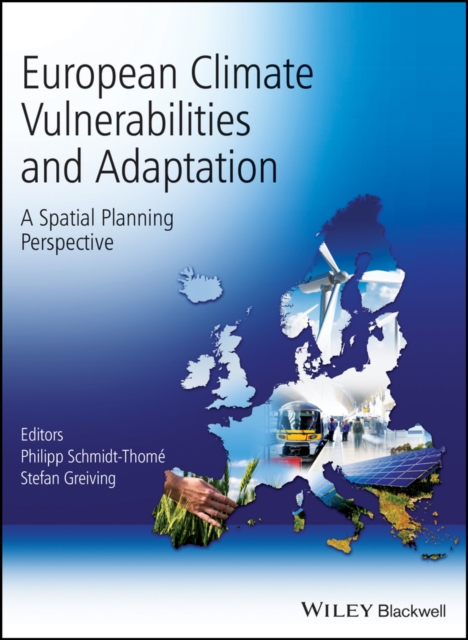
European climate vulnerabilities and adaptation
European Climate Vulnerabilities and Adaptation: A Spatial Planning Perspective analyses the impacts climate change might have on regions and their local economies. Regions clearly differ in view of the complex patterns of climate change impact, but also regarding the given vulnerability and coping capacity.
Impacts of climate change can have a marked effect on the functioning of regions and sectors of the society, if not properly addressed. Readiness to adapt to the impacts and lasting changes counts towards vulnerability of the regions.
The book builds upon the findings of a project conducted under the European observation network for territorial development and cohesion (ESPON), The ESPON Climate project. Following the stipulations of the ESPON programme and the tender for this project the territorial focus is the raison d'être and methodological core of the project as a whole and its various research actions: The outcomes of each action will be focused on what impacts global climate change will have for the different European regions and how the regions can cope with the projected impacts in order to become less vulnerable to climate change.
This book:
* Provides a comprehensive analysis of climate change impacts on 29 European regions and their local economies
* Takes an interdisciplinary approach dealing with the physical, social, economic, environmental, cultural and institutional aspects of climate change vulnerability and the consequences for spatial planning
* Builds on the findings of the ESPON Climate project with a policy focused approach
* Is in full colour throughout with a broad range of case studies
eBook

Climate change adaptation in practice
Climate change adaptation is increasingly recognized as complementary part to climate change mitigation. Climate change affects sea level, the extent of flood prone areas and precipitation patterns among many others. To adapt to these changes, the tasks of municipalities and cities are to implement policies and strategies for changes in land use and coastal management as part of their future development. It is of vital importance to address the uncertainties of climate change scenarios when proposing adaptation measures that are socially viable and economically reasonable. The decision making process, promoted here, is based on scientific excellence as well on an integrated communication process.
This book provides a comprehensive overview of key elements required for effective analysis and assessment of climate change impacts, economic cost-benefit analysis, communication processes and creation and transfer of knowledge, governance issues and implementation of related policies. It describes the results achieved by the BaltCICA (www.baltcica.org [http://www.baltcica.org/]) project whose contributors come from the scientific and public administration communities. The regional cooperation has led to the implementation of climate change adaptation in several case studies. The BaltCICA project developed concepts, methodologies and tools for climate change adaptation that can be translated across other global regions.
Scientists and students working on the development of climate change and adaptation strategies; public administrators in the related fields on local, regional and state level including environment, water management, civil defense; as well as professionals working with adaptation technologies, including engineering, technological solutions, urban planning agencies and construction, will value this innovative book.
eBook