
Catalogue Search | MBRL


Are you sure you want to remove the book from the shelf?

{{itemTitle}}
21
result(s) for
"Schottmann, Sven"
Sort by:

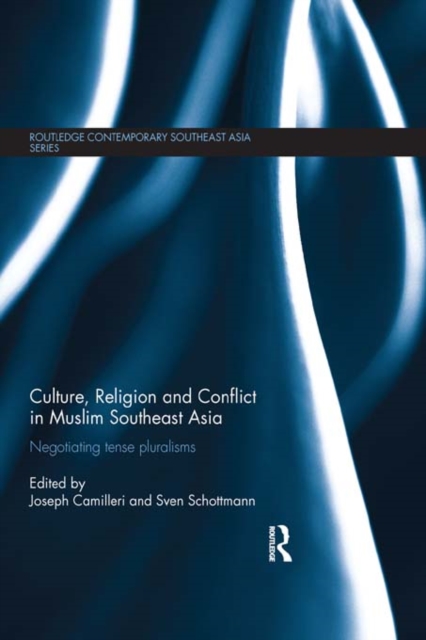
Culture, Religion and Conflict in Muslim Southeast Asia
By examining the sometimes surprising and unexpected roles that culture and religion have played in mitigating or exacerbating conflicts, this book explores the cultural repertoires from which Southeast Asian political actors have drawn to negotiate the pluralism that has so long been characteristic of the region.
Focusing on the dynamics of identity politics and the range of responses to the socio-political challenges of religious and ethnic pluralism, the authors assembled in this book illuminate the principal regional discourses that attempt to make sense of conflict and tensions. They examine local notions of \"dialogue,\" \"reconciliation,\" \"civility\" and \"conflict resolution\" and show how varying interpretations of these terms have informed the responses of different social actors across Southeast Asia to the challenges of conflict, culture and religion. The book demonstrates how stumbling blocks to dialogue and reconciliation can and have been overcome in different parts of Southeast Asia and identifies a range of actors who might be well placed to make useful contributions, propose remedies, and initiate action towards negotiating the region's pluralism.
This book provides a much needed regional and comparative analysis that makes a significant contribution to a better understanding of the interfaces between region and politics in Southeast Asia.
eBook


From duty to choice: marketing Islamic banking in Malaysia
A content analysis of print advertisements and customer websites of Islamic banks in Malaysia, this paper examines the changing marketing and branding landscape of Islamic banking products and financial services. When Islamic banks were first set up in Malaysia in the early 1980s, their advertising material emphasized the religious obligations of Muslims to save and invest with shari'a-compliant financial products and services. Amid the ongoing liberalization of Malaysia's Islamic banking sector since the mid-1990s, a transformation of this marketing strategy appears to have taken place. Islamic banks no longer emphasize a priori the religious imperatives or even the ethical principles that underlie their business model. Rather, they tend to stress that banking according to the principles of the shari'a is an economically rational alternative to the conventional system. Islamic banks in Malaysia portray themselves not simply as Islamic banks, but as better, more profitable and safer alternatives to the crisis-prone conventional, interest-based banking sector. This paper examines this transformation, and seeks to relate the three broad trends it has identified in the advertisement of Islamic banking services to the wider socio-cultural, economic and political changes that have been under way in Malaysia since the late 1960s.
Journal Article

'Melayu Islam Beraja': The Politics of Legitimisation in a Malay Islamic Monarchy
The weakness of ethno-culturally derived legitimacy and the potential costs and risks of Islamisation as populist nationalism moved towards a more state-oriented and Islamic variant are discussed. The prime rationale behind this transformation is the unswerving political obedience commanded by orthodox Sunni Islam.
Journal Article

4 Paving the ground?
The common theme of this book is the management of the religious, cultural, and ethnic diversity of Southeast Asia. Most of the contributors focus on the implications of inter-communal differences, and in many, relations between Muslims and non-Muslims loom large. This chapter also examines the management of Southeast Asia's religious, cultural and ethnic diversity, but seeks to do so by exploring what is in many ways an intra-communal debate about the proper relationship between the state and its official religion among Malaysian Muslims. Focusing on the Mahathir government's (1981-2003) articulation of Islam's place in the public sphere, this chapter argues for the need to examine the role of the state as an important but hitherto under-recognized enabler of what has been described elsewhere as 'post-Islamism' or, parallels with Europe's post-war Christian Democrats intended, as 'Muslim Democracy' (Anwar 2006; Bayat 2007).
Book Chapter

