
Catalogue Search | MBRL


Are you sure you want to remove the book from the shelf?

{{itemTitle}}
133
result(s) for
"Schulte Nordholt, Henk"
Sort by:

The spell of power : a history of Balinese politics, 1650-1940
The first comprehensive history of Balinese politics from the middle of the 17th century till the end of Dutch colonial rule in 1942. Based on extensive research in colonial archives in the Netherlands and Indonesia, a variety of Balinese historical narratives, interviews with former colonial officials as well as many Balinese, and fieldwork data concerning temples, rituals, and oral histories.
Book

Indonesia in the 1950s: Nation, modernity, and the post-colonial state
This essay explores discussions in the 1950s about Indonesian national identity, which were primarily framed in cultural terms. The early years of this decade witnessed optimistic efforts to shape a new nation driven by modernity. Gradually these efforts were aborted by the encroachment of the state. In this respect questions are raised concerning the post-colonial nature of the Indonesian middle class which inhabited this state.
Journal Article

Environment, trade and society in Southeast Asia : a longue durée perspective
\"Eleven historians bring their knowledge and insights to bear on the long Braudelian sweep of Southeast Asian history. In doing so they seek both to debunk simplistic assumptions about fragile traditions and transformational modernities, and to identify real repeating patterns in Southeast Asia's past: clientelistic political structures, periodic tectonic and climatic disasters, ethnic occupational specializations, long cycles of economic globalization and deglobalization. Their contributions range across many centuries: from the Austronesian expansion to the Aceh tsunami, and from the Sanskrit cosmopolis to the Asian financial crisis. The book is inspired by, and dedicated to, Peter Boomgaard, a scholar whose work has embodied the Braudelian spirit in Southeast Asian historiography\"-- Provided by publisher.
Book

Modernity and cultural citizenship in the Netherlands Indies: An illustrated hypothesis
Conventional historiography presumes a linear development from urbanisation, the rise of indigenous middle classes and the spread of modernity towards nationalism as the logical outcome of this process. This article aims to disconnect modernity from nationalism by focusing on the role of cultural citizens in the late colonial period for whom modernity was a desirable lifestyle. The extent to which their desires and the interests of the colonial regime coincided is illustrated by a variety of advertisements and school posters, which invited members of the indigenous urban middle class to become cultural citizens of the colony.
Journal Article

Urban Middle Classes in Colonial Java (1900–1942)
This study investigates Java’s urban middle classes and their importance in the formation of ‘modern’ lifestyles in Indonesia. They formed the backbone of both the Dutch colonial project and the resultant Indonesian nation-state. By foregrounding lifestyle as the defining factor of middle-class identity, we demonstrate how language and images provide a methodological framework to reconstruct this group’s ambitions and aspirations. Their language, an urban variety of Malay, was key to accessing and, in fact, creating discourses of modernity. This transformation was accelerated by the ‘visual turn’ in the late-colonial Netherlands Indies—and, indeed, globally. Advertisements and other visual messages, typically through the medium of the Malay language, promoted new ways to dress, work, travel, and consume. Yet Java’s middle classes were by no means uncritical recipients of these colonial and global novelties. A counter-discourse soon emerged, which questioned the consequences of being modern and the dangers of losing traditional values.
Journal Article
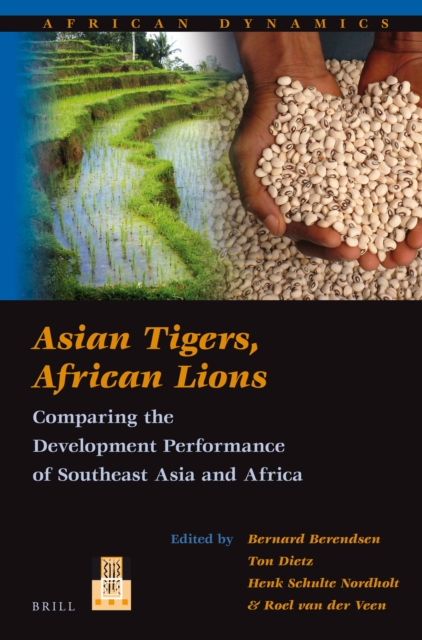
Asian tigers, African lions : comparing the development performance of Southeast Asia and Africa
Asian Tigers, African Lions is an anthology of contributions by scholars and (former) diplomats related to the 'Tracking Development' research project, funded by the Netherlands Ministry of Foreign Affairs, and coordinated by the African Studies Centre and KITLV, both in Leiden, in collaboration with scholars based in Africa and Asia. The project compared the performance of growth and development of four pairs of countries in Southeast Asia and Sub-Sahara Africa during the last sixty years. It tried to answer the question how two regions with comparable levels of income per capita in the 1950s could diverge so rapidly. Why are there so many Asian tigers and not yet so many African lions? What could Africa learn from Southeast Asian development trajectories?.
eBook

Linking Destinies
Trade flows, cities and kinship relations can all be seen as elements of complex networks. In this collection of essays, all of which deal with Asia, we argue that there are good reasons to envisage them as various dimensions of the same networks.
eBook

Dams and Dynasty, and the Colonial Transformation of Balinese Irrigation Management
This article takes issue with Stephen Lansing's bottom-up model of Balinese irrigation management. Based on archival research and extensive fieldwork in the former south Balinese kingdom of Mengwi, it is argued that in pre-colonial days large scale irrigation depended largely on dynastic involvement. During the colonial period (1906-1942) the Dutch took over the role of regional irrigation management while they strengthened the autonomy of local irrigation associations.
Journal Article