
Catalogue Search | MBRL


Are you sure you want to remove the book from the shelf?

{{itemTitle}}
2,926
result(s) for
"Schultz, H."
Sort by:
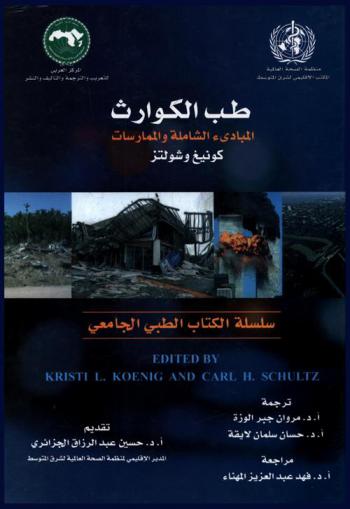
طب الكوارث : المبادئ الشاملة والممارسات
لقد نما اختصاص طب الكوارث على نحو كبير بعد الهجمات الإرهابية في الولايات المتحدة في 11 سبتمبر/ أيلول عام 2001، وما يدعم هذا النمو نشر عدد من الكتب المرجعية المتعلقة بالكوارث، وقد شارك في بعض الحالات فرق 9/12 ؛ وهم أشخاص أصبحوا مهتمين فجأة بالأمر، وغدو \"خبراء\" في الكوارث بعد أن أصبح الموضوع رائجا وازداد جريان التمويل الاتحادي المتعلق به بسهولة، وقد جعل ذلك تمويل الكثير من الأعمال ذات الصلة على نحو فعال ممكنا، وبقي التحدي المتعلق بوضع مؤلفين وطنيين ودوليين لكتاب محدد قائما، وقد فكرنا بتحرير مثل هذا الكتاب خلال السنوات العشر الماضية، لكن التوقيت لم يكن مناسبا، وقد ساورتنا الشكوك بإمكانية تحقيق ذلك \"بالطريقة الصحيحة\" دوما ؛ لأننا لم نكن ندري على وجه الدقة \"ما سننجزه\". من هنا جاءت فكرة هذا الكتاب الذي يعد فريد من نواح عديدة. حيث إننا اتخذنا أسلوبا متعدد الاختصاصات، وتعاونا مع أكاديميين وباحثين مرموقين من أنحاء العالم، وقد يوجد في بعض الحالات عدم اتفاق على طريقة وصف تحديات طب الكوارث أو مقاربتها، وبدلا من تقديم وجهة نظر واحدة نقدم مقاربة متوازنة مزودة بأفضل العلوم لدعم كل من وجهات النظر، وقد قدمنا من خلال هذا البناء وجهات نظر عالمية.
BOOK

Thrombosis and Thrombocytopenia after ChAdOx1 nCoV-19 Vaccination
This report describes a very rare but life-threatening sequela of vaccination with ChAdOx1 nCoV-19. Within 10 days after a first injection, five health care workers presented with thrombocytopenia and thromboses, including cerebral venous sinus thrombosis with catastrophic outcome. The apparent cause is an anti-PF4 antibody capable of platelet activation; intravenous immune globulin may be therapeutic.
Journal Article

Identification of typical marker proteins of Treponema pallidum in compact human bone using morphological and biochemical techniques
In ancient human compact bone tissue, we can present the identified marker proteins of
Treponema pallidum
, the lipoproteins 47 kDa, 17 kDa and 15 kDa in three adult individuals from Austria (thirteenth–seventeenth century CE), and in a 5 to 6-years-old child from Germany (seventeenth–nineteenth century CE). These three identified lipoproteins are also used to diagnose syphilis in current medicine. The individuals selected for this study predominantly exhibit the macroscopic and microscopic features of treponemal disease. However, the result of the proteomic analysis can confirm the diagnosis of treponematosis without any doubt. The extracellular matrix (ECM) proteins in well-preserved ancient human compact bone are still tightly bound to hydroxyapatite and/or collagen. With our solubilization technique, the entrapped ECM proteins are solubilized and identified with special antibodies in Western blot. Our techniques open up more possibilities to diagnose also other infectious diseases and tumors in humans who lived many thousands years ago.
Journal Article

Cognitive task information is transferred between brain regions via resting-state network topology
Resting-state network connectivity has been associated with a variety of cognitive abilities, yet it remains unclear how these connectivity properties might contribute to the neurocognitive computations underlying these abilities. We developed a new approach—information transfer mapping—to test the hypothesis that resting-state functional network topology describes the computational mappings between brain regions that carry cognitive task information. Here, we report that the transfer of diverse, task-rule information in distributed brain regions can be predicted based on estimated activity flow through resting-state network connections. Further, we find that these task-rule information transfers are coordinated by global hub regions within cognitive control networks. Activity flow over resting-state connections thus provides a large-scale network mechanism for cognitive task information transfer and global information coordination in the human brain, demonstrating the cognitive relevance of resting-state network topology.
Resting-state functional connections have been associated with cognitive abilities but it is unclear how these connections contribute to cognition. Here Ito et al present a new approach, information transfer mapping, showing that task-relevant information can be predicted by estimated activity flow through resting-state networks.
Journal Article
Constructing neural network models from brain data reveals representational transformations linked to adaptive behavior
The human ability to adaptively implement a wide variety of tasks is thought to emerge from the dynamic transformation of cognitive information. We hypothesized that these transformations are implemented via conjunctive activations in “conjunction hubs”—brain regions that selectively integrate sensory, cognitive, and motor activations. We used recent advances in using functional connectivity to map the flow of activity between brain regions to construct a task-performing neural network model from fMRI data during a cognitive control task. We verified the importance of conjunction hubs in cognitive computations by simulating neural activity flow over this empirically-estimated functional connectivity model. These empirically-specified simulations produced above-chance task performance (motor responses) by integrating sensory and task rule activations in conjunction hubs. These findings reveal the role of conjunction hubs in supporting flexible cognitive computations, while demonstrating the feasibility of using empirically-estimated neural network models to gain insight into cognitive computations in the human brain.
The brain dynamically transforms cognitive information. Here the authors build task-performing, functioning neural network models of sensorimotor transformations constrained by human brain data without the use of typical deep learning techniques.
Journal Article

Investigating the topology of interacting networks
Network theory provides various tools for investigating the structural or functional topology of many complex systems found in nature, technology and society. Nevertheless, it has recently been realised that a considerable number of systems of interest should be treated, more appropriately, as interacting networks or networks of networks. Here we introduce a novel graph-theoretical framework for studying the interaction structure between subnetworks embedded within a complex network of networks. This framework allows us to quantify the structural role of single vertices or whole subnetworks with respect to the interaction of a pair of subnetworks on local, mesoscopic and global topological scales. Climate networks have recently been shown to be a powerful tool for the analysis of climatological data. Applying the general framework for studying interacting networks, we introduce coupled climate subnetworks to represent and investigate the topology of statistical relationships between the fields of distinct climatological variables. Using coupled climate subnetworks to investigate the terrestrial atmosphere’s three-dimensional geopotential height field uncovers known as well as interesting novel features of the atmosphere’s vertical stratification and general circulation. Specifically, the new measure “cross-betweenness” identifies regions which are particularly important for mediating vertical wind field interactions. The promising results obtained by following the coupled climate subnetwork approach present a first step towards an improved understanding of the Earth system and its complex interacting components from a network perspective.
Journal Article

A scoping review of incidence and assessment tools for post-intensive care syndrome following cardiac surgery
Post-intensive care syndrome is a new or worsening persistent deterioration in cognitive, mental, and/or physical health following a prolonged admission to an intensive care unit. Post-intensive care syndrome remains underexplored following cardiac surgery, with a lack of understanding of the incidence and tools used to measure the symptoms. A scoping review was conducted to determine the incidence and to identify the tools commonly used to measure symptoms of post-intensive care syndrome following cardiac surgery.
The electronic databases Medline (Ovid), EMBASE (Ovid), PsycINFO (Ovid), Scopus, and CINAHL (EBSCOhost) and Google Scholar were searched with keywords and controlled vocabulary to describe both cardiac surgery and post-intensive care syndrome (cardiac surgical procedures, heart surgery, and post-intensive care symptoms) and symptoms (delirium, depression, mobility and quality of life). Included were articles written in English and published after 2005 that described cognitive, mental, and physical symptoms of post-intensive care syndrome following cardiac surgery. 3,131 articles were found, with 565 duplicates, leaving 2,566 articles to be screened. Of these, seven unique studies were included.
Five studies explored cognitive health, three mental health, one cognitive and mental health, and none physical health. No identified studies reported the overall incidence of post-intensive care syndrome following cardiac surgery. The incidence of cognitive health issues ranged from 21% to 38%, and mental health issues ranged from 16% to 99%. In total, 17 different tools were identified − 14 for cognitive health and three for mental health. No identified studies used the same tools to measure symptoms. No single tool was found to measure all three domains.
This scoping review identified a literature gap specific to the incidence and inconsistency of assessment tools for post-intensive care syndrome in cardiac surgery patients.
This work impacts clinical practice for the bedside nurse by raising awareness of an emerging health issue.
Journal Article

Self-reported concussion history is not related to cortical volume in college athletes
The long-term consequences of concussion are still being uncovered but have been linked to disruptions in cognition and psychological well-being. Previous studies focusing on the association between concussion history and structural changes in the brain have reported inconsistent results. We sought to examine the effect of concussion history on cortical volume with a focus on functional networks. These networks are associated with many of the functions that can be disrupted in those with an extensive concussion history. We collected baseline behavioral data including the Immediate Post-Concussion Assessment and Cognitive Testing, a self-report measure of the number of diagnosed concussions, and structural MRI in college athletes (n=296; 263 men and 33 women, age range 17-24). Behavioral measures were collected by members of the Department of Athletics concussion management team using a standardized protocol as part of their on-boarding process. Collegiate athletes in the present study who self-reported concussion history did not report different baseline symptoms and did not exhibit consistent differences in cognitive performance relative to those who reported no concussion history. We found that concussion history was not related to cortical volume at the network or region level, even when we compared participants with two or more concussions to those with no concussion history. We did identify relationships between cortical volume in the visual network and dorsal attention network with cognitive performance. In addition to comparing cortical volume between individuals with and without reported concussion history, we also examined whether cortical volume changes could be observed within individuals from baseline to acutely following concussion. We found that network level cortical volume did not change within subjects from baseline measurement to acutely post-concussion. Together, these results suggest that both self-reported concussion history and acute concussion effects are not associated with changes in cortical volume in young adult athletes.
Journal Article

The Risk of Cancer from CT Scans and Other Sources of Low-Dose Radiation: A Critical Appraisal of Methodologic Quality
Concern exists that radiation exposure from computerized tomography (CT) will cause thousands of malignancies. Other experts share the same perspective regarding the risk from additional sources of low-dose ionizing radiation, such as the releases from Three Mile Island (1979; Pennsylvania USA) and Fukushima (2011; Okuma, Fukushima Prefecture, Japan) nuclear power plant disasters. If this premise is false, the fear of cancer leading patients and physicians to avoid CT scans and disaster responders to initiate forced evacuations is unfounded.
This investigation provides a quantitative evaluation of the methodologic quality of studies to determine the evidentiary strength supporting or refuting a causal relationship between low-dose radiation and cancer. It will assess the number of higher quality studies that support or question the role of low-dose radiation in oncogenesis.
This investigation is a systematic, methodologic review of articles published from 1975-2017 examining cancer risk from external low-dose x-ray and gamma radiation, defined as less than 200 millisievert (mSv). Following the PRISMA guidelines, the authors performed a search of the PubMed, Cochrane, Scopus, and Web of Science databases. Methodologies of selected articles were scored using the Newcastle Ottawa Scale (NOS) and a tool identifying 11 lower quality indicators. Manuscript methodologies were ranked as higher quality if they scored no lower than seven out of nine on the NOS and contained no more than two lower quality indicators. Investigators then characterized articles as supporting or not supporting a causal relationship between low-dose radiation and cancer.
Investigators identified 4,382 articles for initial review. A total of 62 articles met all inclusion/exclusion criteria and were evaluated in this study. Quantitative evaluation of the manuscripts' methodologic strengths found 25 studies met higher quality criteria while 37 studies met lower quality criteria. Of the 25 studies with higher quality methods, 21 out of 25 did not support cancer induction by low-dose radiation (P = .0003).
A clear preponderance of articles with higher quality methods found no increased risk of cancer from low-dose radiation. The evidence suggests that exposure to multiple CT scans and other sources of low-dose radiation with a cumulative dose up to 100 mSv (approximately 10 scans), and possibly as high as 200 mSv (approximately 20 scans), does not increase cancer risk.
Journal Article

LCROSS Cratering Experiment
As its detached upper-stage launch vehicle collided with the surface, instruments on the trailing Lunar Crater Observation and Sensing Satellite (LCROSS) Shepherding Spacecraft monitored the impact and ejecta. The faint impact flash in visible wavelengths and thermal signature imaged in the mid-infrared together indicate a low-density surface layer. The evolving spectra reveal not only OH within sunlit ejecta but also other volatile species. As the Shepherding Spacecraft approached the surface, it imaged a 25- to-30-meter-diameter crater and evidence of a high-angle ballistic ejecta plume still in the process of returning to the surface--an evolution attributed to the nature of the impactor.
Journal Article