
Catalogue Search | MBRL


Are you sure you want to remove the book from the shelf?

{{itemTitle}}
36
result(s) for
"Schwab, Christiane"
Sort by:

Sailors, Book Hawkers, and Bricklayer’s Laborers
This essay explores how the modern obsession with systems of human classification manifested and spread in an increasing market of periodical literature in nineteenth-century Europe. It examines the various epistemic and rhetorical techniques of social typification developed in “sociographic” sketch writing, focusing on examples from the multiauthored serials Heads of the People; or, Portraits of the English (1840–41) and Les Français peints par eux-mêmes (1840–42). The essay claims that, by combining depictions of social types with political commentary, economic and sociohistorical considerations, and satirical allusions, the epistemic-narrative strategy of typecasting met the educational and entertainment needs of a growing reading public. It furthermore evaluates the works of investigative reporters such as Henry Mayhew and Angus Bethune Reach as interfaces between journalistic-literary and “scientific” ways of social study. The essay aims to stimulate an understanding of literary typecasting as a sort of “popular sociology” by interpreting the popularity of typecasting in the context of an increased interest in social structures on the verge of modernity, expressed in prose and arts as well as social thought.
Journal Article
Sailors, Book Hawkers, and Bricklayer’s Laborers
Christiane Schwab, “Sailors, Book Hawkers, and Bricklayer’s Laborers: Social Types and the Production of Social Knowledge in Nineteenth-Century Periodical Literature” (pp. 403–426) This essay explores how the modern obsession with systems of human classification manifested and spread in an increasing market of periodical literature in nineteenth-century Europe. It examines the various epistemic and rhetorical techniques of social typification developed in “sociographic” sketch writing, focusing on examples from the multiauthored serials Heads of the People; or, Portraits of the English (1840–41) and Les Français peints par eux-mêmes (1840–42). The essay claims that, by combining depictions of social types with political commentary, economic and sociohistorical considerations, and satirical allusions, the epistemic-narrative strategy of typecasting met the educational and entertainment needs of a growing reading public. It furthermore evaluates the works of investigative reporters such as Henry Mayhew and Angus Bethune Reach as interfaces between journalistic-literary and “scientific” ways of social study. The essay aims to stimulate an understanding of literary typecasting as a sort of “popular sociology” by interpreting the popularity of typecasting in the context of an increased interest in social structures on the verge of modernity, expressed in prose and arts as well as social thought.
Journal Article

Sind wir stets (trans-)national gewesen? Die Fachgeschichtsschreibung der Volkskunde auf dem Prufstand
This article discusses ‚transnational Volkskunde / folklore studies‘ as both a historical phenomenon and an interpretative framework. To this day, the examination of transnational entanglements in the history of Volkskunde / folklore studies – known in German-speaking regions today as Empirische Kulturwissenschaft, Europaische Ethnologie, or Kulturanthropologie – remains a neglected area, particularly with regard to its institutionalization in the late 19th century. Studies on this period almost exclusively follow national or regional narratives. In our article, we first examine the background that may have led to the absence of transnational considerations in the historiography of Volkskunde / folklore studies. Building on this, we demonstrate how new approaches in the history and anthropology of knowledge within our discipline open up fresh possibilities for studying transnational developments in folkloristic knowledge production. The following section addresses the methodological and practical challenges of investigating such entangled histories of Volkskunde / folklore studies. We also outline our approach to tackling these challenges within the DFG project „Actors – Narratives – Strategies: Constellations of Transnational Folklore Studies, 1875–1905“ (funding period: 2022–2027). In the final section, we reflect on how ‚transnational Volkskunde / folklore studies‘ can be understood and used not only as an object of investigation, but also as an instrument of interpretation.
Journal Article
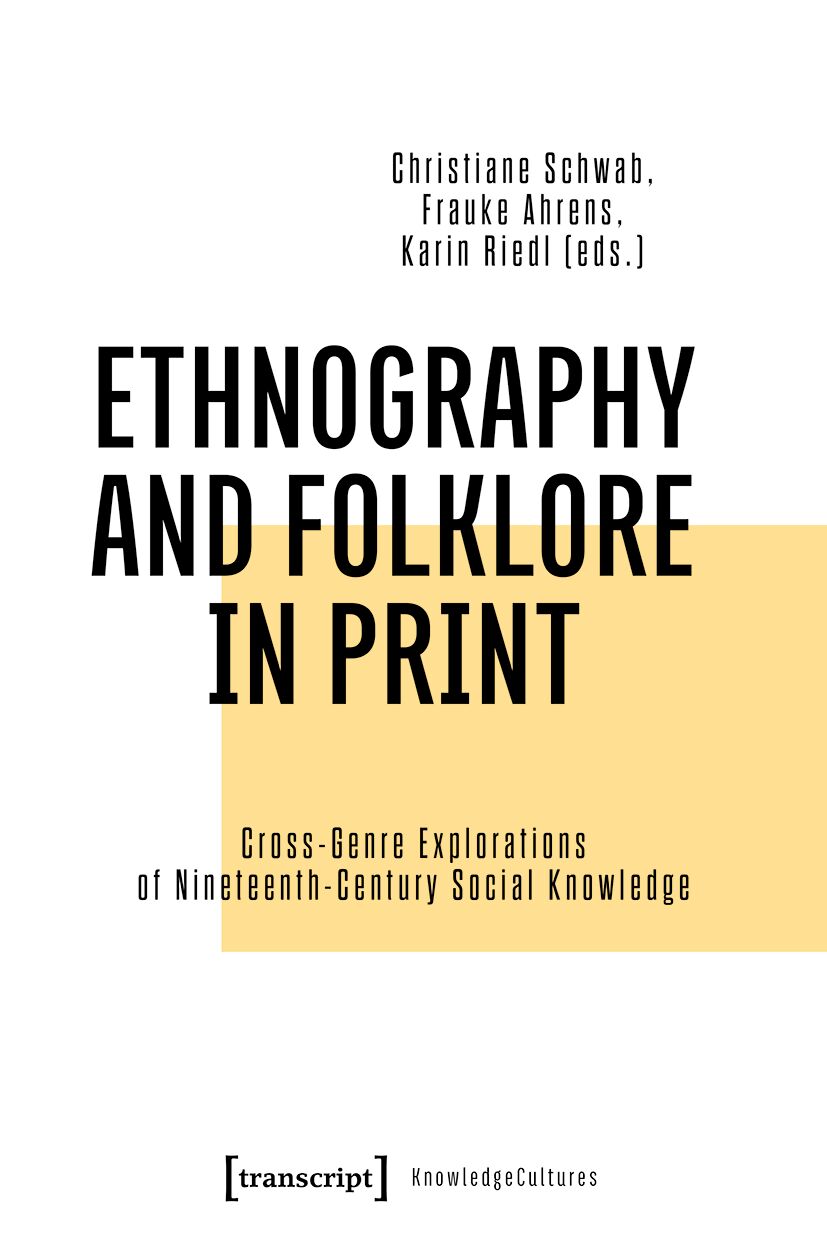
Ethnography and Folklore in Print
Throughout the nineteenth century, social expressions and
dynamics have been reflected in the surge of various printed
products. The contributors analyze a diverse range of sources,
such as caricatures, journalistic reports, travelogues,
scholarly volumes, social novels, and fairytale collections,
viewing them as early manifestations of social knowledge and
ethnographic representation situated at the confluence of
›popular‹ and ›scientific‹ publishing.
Their comprehensive exploration unveils alternative contexts
and dimensions of early ethnographic knowledge production,
providing insights into a history of social knowledge that
surpasses disciplinary, national, and genre-related
boundaries.
eBook

The transforming city in nineteenth-century literary journalism: Ramón de Mesonero Romanos’ ‘Madrid scenes’ and Charles Dickens’ ‘Street sketches
Nineteenth-century urbanization and industrialization in western Europe have clearly contributed to the formation of societal knowledge and self-reflexive cultural iconographies. Especially from the 1820s onwards, one major context for discussing the social and cultural diversity of the city and concomitant socio-political tensions was the emerging market of journals and magazines. Based upon the writings of two exemplary authors, this article investigates with which techniques and metaphors nineteenth-century journalistic sketches depicted urban sociability and conditions. Furthermore, it reflects on how not only the ever more differentiating urban environments but also the proximity of different networks and institutions of knowledge encouraged the refinement of social observation and thought. Exploring a neglected genre of social knowledge production, the article proposes new perspectives for urban history and aims at stimulating a critical review of contemporary research practices in all branches of the social sciences.
Journal Article
Zwischen Naturgeschichte, Statistik und Gesellschaftsroman: Soziographische Wissensordnungen im Kontext einer europäischen Publizistik im 19. Jahrhundert1
During the first half of the nineteenth century, the rise of market-oriented periodical publishing correlated with an increasing desire to inspect the modernizing societies. The journalistic pursuit of examining the social world is in a unique way reflected in countless periodical contributions that, especially from the 1830s onwards, depicted social types and behaviours, new professions and technologies, institutions, and cultural routines. By analysing how these \"sociographic sketches\" proceeded to document and to interpret the manifold manifestations of the social world, this article discusses the interrelationships between epistemic and political shifts, new forms of medialization and the systematization of social research. It thereby focuses on three main areas: the creative appropriation of narratives and motifs of moralistic essayism, the uses of description and contextualization as modes of knowledge, and the adaptation of empirical methods and a scientific terminology. To consider nineteenth-century sociographic journalism as a format between entertainment, art, and science provokes us to narrate intermedial, transnational and interdisciplinary tales of the history of social knowledge production.
Journal Article
Sind wir stets (trans-)national gewesen?: Die Fachgeschichtsschreibung der Volkskunde auf dem Prüfstand 1
This article discusses ,transnational Volkskunde / folklore studies' as both a historical phenomenon and an interpretative framework. To this day, the examination of transnational entanglements in the history of Volkskunde / folklore studies - known in German-speaking regions today as Empirische Kulturwissenschaft, Europäische Ethnologie, or Kulturanthropologie - remains a neglected area, particularly with regard to its institutionalization in the late 19th century. Studies on this period almost exclusively follow national or regional narratives. In our article, we first examine the background that may have led to the absence of transnational considerations in the historiography of Volkskunde / folklore studies. Building on this, we demonstrate how new approaches in the history and anthropology of knowledge within our discipline open up fresh possibilities for studying transnational developments in folkloristic knowledge production. The following section addresses the methodological and practical challenges of investigating such entangled histories of Volkskunde / folklore studies. We also outline our approach to tackling these challenges within the DFG project „Actors - Narratives - Strategies: Constellations of Transnational Folklore Studies, 1875-1905\" (funding period: 2022-2027). In the final section, we reflect on how ,transnational Volkskunde / folklore studies' can be understood and used not only as an object of investigation, but also as an instrument of interpretation.
Journal Article
Ethnography, Folklore, and Nineteenth-Century Print Culture
At the turn of the nineteenth century, transformations in economic, social, political, and technological domains across Europe sparked an unprecedented interest in the study of modernizing societies. Simultaneously, the rise of market-oriented publishing transformed the study of social realities into a public affair. The widespread availability of printed materials opened up avenues for the profusion of documentary-ethnographic representations of the socio-cultural universe, facilitating knowledge transfer and political mobilization (Anderson 1991). Recognizing the press as a catalyst for “societal self-reflection”¹ (Osterhammel 2011: 63), this volume’s contributions aim to delve into the interdependencies between the expanding market(s) of printed goods and the
Book Chapter
Sketches of manners, esquisses des moeurs: Die journalistische Gesellschaftsskizze (1830-1860) als ethnographisches Wissensformat
In the first half of the 19th centur y - originating in London and Paris - journalistic descriptions of social types and cultural routines became a popular medium for the measurement of ever more diverse societies. This paper examines the sketch of society as a format of early social and cultural research. It deals with the genesis of the sketch of society in the context of a liberalized press market, sheds light on its stylistic and epistemic versatility and brings the popularity of this journalistic format and its forms of representation in connection with the recover y of experiential images of society and scientific principles as well as with politically engaged social research. The sketches of society are meaningful products and agents of a consolidating public dialogue based on social and cultural research, which only in the second half of the 19th centur y broke away from literary forms and was differentiated within academic disciplines.
Journal Article