
Catalogue Search | MBRL


Are you sure you want to remove the book from the shelf?

{{itemTitle}}
252
result(s) for
"Schwartz, Jeff"
Sort by:

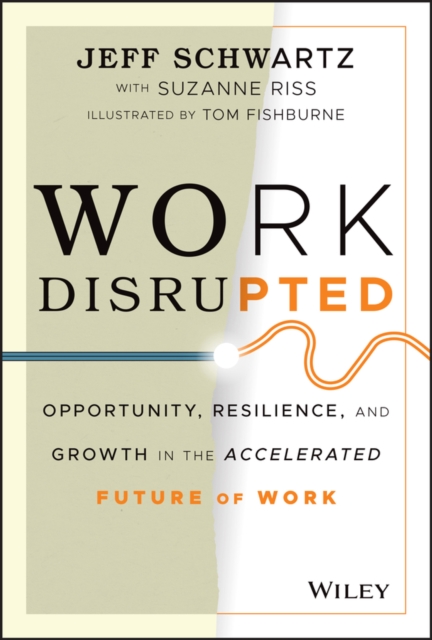
Work disrupted : opportunity, resilience, and growth in the accelerated future of work
If you only read one book on the future of work, Work Disrupted: Opportunity, Resilience, and Growth in the Accelerated Future of Work should be that book.
The future of work swept in sooner than expected, accelerated by Covid-19, creating an urgent need for new maps, new mindsets, new strategies-- and most importantly, a trusted guide to take us on this journey. That guide is Jeff Schwartz. A founding partner of Deloitte Consulting's Future of Work practice, Schwartz brings clarity, humor, wisdom, and practical advice to the future of work, a topic surrounded by misinformation, fear, and confusion. With a fundamental belief in the power of human innovation and creativity, Schwartz presents the key issues, critical choices, and potential pitfalls that must be on everyone's radar.
* If you're anxious about robots taking away your job in the future, you will take comfort in the realistic perspective, fact-based insights, and practical steps Schwartz offers.
* If you're not sure where to even begin to prepare, follow his level-headed advice and easy-to-follow action plans.
* If you're a business leader caught between keeping up, while also being thoughtful about the next moves, you will appreciate the playbook directed at you.
* If you're wondering how Covid-19 will change how and where you will work, Work Disrupted has you covered.
Written in a conversational style by Schwartz, with Suzanne Riss, an award-winning journalist and book author, Work Disrupted offers a welcome alternative to books on the topic that lack a broad perspective or dwell on the problems rather than offer solutions. Timely and insightful, the book includes the impact of Covid-19 on our present and future work. Interviews with leading thinkers on the future of work offer additional perspectives and guidance.Cartoons created for the book by leading business illustrator Tom Fishburne bring to life the reader's journey and the complex issues surrounding the topic.
Told from the perspective of an economist, management advisor, and social commentator, Work Disrupted offers hope--and practical advice--exploring such topics as:
How we frame what lies ahead is a critical navigational tool. Discover the signposts that can serve as practical guides for individuals who have families to support, mortgages to pay, and want to stay gainfully employed no matter what the future holds.
The importance of recognizing the rapidly evolving opportunities in front of us. Learn how to build resilience—in careers, organizations, and leaders—for what lies ahead.
Why exploring new mental models helps us discover the steps we need to take to thrive. Individuals can decide how to protect their livelihood while businesses and public institutions can consider how they can lead and support workforces to thrive in twenty-first-century careers and work.
\"Jeff's marvelous book is a roadmap for the new world of work with clear signposts. His insights will help readers discover opportunities, take action, and find hope in uncertain times. The ideas are fresh, beautifully crafted, and immediately applicable. This is not only a book to be read, but savored and used.\"
— Dave Ulrich, Rensis Likert Professor, Ross School of Business, University of Michigan;Partner, the RBL Group; Co-author Reinventing the Organization
eBook

What Ifs and Multi-directional symptoms PBL cases : two simple and functional adjuncts to problem-based learning materials
Although problem-based learning (PBL) is widely used in medical education for its many virtues, a number of deficiencies exist. As means of enhancing the experience of PBL for students, two relatively simple adjuncts to PBL are presented. What Ifs are short hypothetical scenarios, appended to the end of a PBL case, that require students to revisit elements of the PBL case just completed and apply their newly acquired knowledge to clinical reasoning in an altered scenario or to explore anew another dimension of the PBL case. Multi-directional symptoms PBL cases are cases where a common presenting symptom, rather than a specific pathology, is the focus of the PBL case and, following a core narrative of the initial patient presentation, a series of independent continuation narratives with appropriate histories, examination findings and investigation results, lead students to divergent diagnoses and management issues. In addition to keeping the PBL process fresh by rotating new materials regularly, these adjuncts extend the PBL process in the direction of case-based learning. [Author abstract]
Journal Article

Work Disrupted
Cover -- Title Page -- Copyright Page -- Contents -- Foreword -- Introduction -- Our Collective Pause -- Our Long and Winding Careers -- Our Frame -- Our Challenge -- Our Opportunity -- Chapter 1 From Fear to Growth : Mindsets and Playbooks for Twenty-first-century Careers and Work -- Panic or Pivot -- Racing with the Machines -- We Have Choices -- From Disruption to Innovation to Creation -- Defining the Future of Work -- Maps That Matter -- A Twenty-first-century Sherpa -- New Technology Has Always Created More Jobs -- Why ATMs Did Not Replace Bank Tellers -- Employees Are More Adaptable Than We Think -- Growth and Innovation -- Signposts for the Future -- Part I: Opportunity (Chapters 2, 3, 4) -- Part ll: Resilience (Chapters 5, 6, 7) -- Part lll: Growth (Chapters 8, 9, 10) -- Part I Find Opportunity in a Time of Accelerated Change: Redesigning Work, Workforces, and Workplaces -- Chapter 2 People and Machines Working Together: Integrating AI and Workers on Every Team, in Every Job -- Where Robots Come From -- Meaningful Work -- Superminds: Humans Working With and Next to AI -- Humans + Machines in Healthcare -- Meet Moxi -- Renaissance Radiologists -- AI as Therapist -- How to Keep a Job While Racing with Machines -- From Superminds to Superjobs and Superteams -- Chapter 3 Making Alternative Work a Meaningful Opportunity: The Workforce Will Include More Part-time, Contract, Freelance, Gig, and Crowd Workers -- The Rise of Alternative Work -- Alternative Work Comes in Many Shapes and Sizes13 -- The High Price of Flexibility -- A Tale of Two Janitors -- Workers in the Platform Economy -- The Ghost Worker Underclass -- Identity and Work Routines -- Making Alternative Work a Meaningful Opportunity -- At a Crossroads.
Book
Work Disrupted
If you only read one book on the future of work, Work Disrupted: Opportunity, Resilience, and Growth in the Accelerated Future of Work should be that book.The future of work swept in sooner than expected, accelerated by Covid-19, creating an urgent need for new maps, new mindsets, new strategies-- and most importantly, a trusted guide to take us on this journey. That guide is Jeff Schwartz. A founding partner of Deloitte Consulting’s Future of Work practice, Schwartz brings clarity, humor, wisdom, and practical advice to the future of work, a topic surrounded by misinformation, fear, and confusion. With a fundamental belief in the power of human innovation and creativity, Schwartz presents the key issues, critical choices, and potential pitfalls that must be on everyone’s radar.If you're anxious about robots taking away your job in the future, you will take comfort in the realistic perspective, fact-based insights, and practical steps Schwartz offers.If you're not sure where to even begin to prepare, follow his level-headed advice and easy-to-follow action plans.If you're a business leader caught between keeping up, while also being thoughtful about the next moves, you will appreciate the playbook directed at you.If you're wondering how Covid-19 will change how and where you will work, Work Disrupted has you covered.Written in a conversational style by Schwartz, with Suzanne Riss, an award-winning journalist and book author, Work Disrupted offers a welcome alternative to books on the topic that lack a broad perspective or dwell on the problems rather than offer solutions. Timely and insightful, the book includes the impact of Covid-19 on our present and future work. Interviews with leading thinkers on the future of work offer additional perspectives and guidance.Cartoons created for the book by leading business illustrator Tom Fishburne bring to life the reader’s journey and the complex issues surrounding the topic.Told from the perspective of an economist, management advisor, and social commentator, Work Disrupted offers hope--and practical advice--exploring such topics as:How we frame what lies ahead is a critical navigational tool. Discover the signposts that can serve as practical guides for individuals who have families to support, mortgages to pay, and want to stay gainfully employed no matter what the future holds.The importance of recognizing the rapidly evolving opportunities in front of us. Learn how to build resilience—in careers, organizations, and leaders—for what lies ahead.Why exploring new mental models helps us discover the steps we need to take to thrive. Individuals can decide how to protect their livelihood while businesses and public institutions can consider how they can lead and support workforces to thrive in twenty-first-century careers and work.\"Jeff's marvelous book is a roadmap for the new world of work with clear signposts. His insights will help readers discover opportunities, take action, and find hope in uncertain times. The ideas are fresh, beautifully crafted, and immediately applicable. This is not only a book to be read, but savored and used.\"—Dave Ulrich, Rensis Likert Professor, Ross School of Business, University of Michigan; Partner, the RBL Group; Co-author Reinventing the Organization
eBook

The Singular Role of Public Pension Funds in Corporate Governance
With more than $6 trillion in assets, public pension funds are significant players in financial markets. Like private asset managers, public pension fund managers are typically expected to exercise their discretion over investing and engagement to serve the interests of the funds' beneficiaries exclusively, a model that we term \"beneficiary primacy.\" To this end, beneficiary primacy imposes fiduciary duties on fund managers to maximize the economic value of the fund. We argue that the application of beneficiary primacy to public pensions is wrong. It misapprehends the nature of public pension plans and leads to misguided public policy. Public pension funds differ from private funds along a variety of critical dimensions. Most importantly, their beneficiaries receive a defined benefit that does not vary based on the fund's economic performance, and their investment policies are subject to political and market accountability. Because of these differences, we maintain that public pension funds should be understood as principals serving a broader public interest that is informed by the goals and values of plan beneficiaries, public employees, taxpayers, government officials, and local communities. In serving as agents for the fund, and not its beneficiaries, fund managers can and should balance the sometimescompeting interests of the fund's multiple stakeholders. The most significant consequence of our retheorization of public pension funds is that their managers would no longer have a narrow mandate to focus exclusively on maximizing portfolio value. Beneficiary primacy is problematic because it delegitimizes values-based fund management decisions. Under the beneficiary primacy model, fiduciary principles create litigation risk for fund managers who include environmental and social values or local interests in their investing and engagement activities. Beneficiary primacy has also led prominent commentators to criticize the political dimension of public pensions and to suggest ways to better align fund manager incentives with economic value creation. But the political nature of public pensions is a feature, not a bug. As principals with a uniquely public dimension, public pension funds are valuable players in financial markets and corporate governance and provide a distinctive source of accountability for corporate leadership. Unlike private asset managers, public pension funds have embraced their role as engaged owners. They also give voice to typically disenfranchised groups and provide a mechanism for incorporating public objectives into the capital markets. Once we recognize the distinctive structure and singular role of public pension funds, it becomes clear that fund managers should not be constrained by inapposite fiduciary principles but instead should invest and engage in accordance with the broader interests they represent, interests that include dimensions of both economic value and societal values.
Journal Article
Corporate Democracy and the Intermediary Voting Dilemma
Corporate governance is changing. For the past two decades, the Jocus of shareholder voting and engagement was deconstructing impediments to shareholder power and increasing managerial accountability. The goal of these interventions was to increase firm value by reducing agency costs. Increasingly, however, environmental and social issues have risen to the fore. This new focus is arguably more about values than value. This Article is the first to argue that, because of this shift, institutional intermediaries-namely pension and mutual fund managers-can no longer vote and engage on the affairs of their porfolio companies without seeking the input of the pension-plan participants and mutual fund shareholders who are their beneficiaries. We argue that the fiduciary duties of fund managers compel them to seek this input. We further argue that regulators should supplement existing fiduciary standards by adopting formal requirements that managers of mutual funds and pension funds seek input from their beneficiaries on their views, reflect those views in both their engagement efforts and their votes, and publicly disclose how they have complied. At the same time, we caution against an approach in which fund managers shirk their intermediary role by implementing pass-through voting or rigidly voting in proportion to the preferences expressed by their beneficiaries. Instead, fund managers should engage in informed intermediation-a stewardship process in which they continue to exercise voting power over the securities in the porfolios that they manage and retain discretion in how to incorporate the input they receive from fund beneficiaries. This enables professional fund managers to use their sophistication and experience to translate beneficiary preferences- which might be incomplete, vague, or contradictory-into individualized and informed votes at each of their porfolio firms. It also preserves the ability of fund managers to leverage the economic power of dispersed beneficiaries consistent with their historical success in reducing the traditional collective action problems associated with shareholder voting. In reconceptualizing the role of intermediaries, this approach maintains the benefits of intermediation while better aligning intermediary stewardship with beneficiary best interests.
Journal Article

