
Catalogue Search | MBRL


Are you sure you want to remove the book from the shelf?

{{itemTitle}}
44
result(s) for
"Scolieri, Paul A"
Sort by:


Dancing the New World
From Christopher Columbus to \"first anthropologist\" Friar Bernardino de Sahagún, fifteenth- and sixteenth-century explorers, conquistadors, clerics, scientists, and travelers wrote about the \"Indian\" dances they encountered throughout the New World. This was especially true of Spanish missionaries who intensively studied and documented native dances in an attempt to identify and eradicate the \"idolatrous\" behaviors of the Aztec, the largest indigenous empire in Mesoamerica at the time of its European discovery.
Dancing the New Worldtraces the transformation of the Aztec empire into a Spanish colony through written and visual representations of dance in colonial discourse-the vast constellation of chronicles, histories, letters, and travel books by Europeans in and about the New World. Scolieri analyzes how the chroniclers used the Indian dancing body to represent their own experiences of wonder and terror in the New World, as well as to justify, lament, and/or deny their role in its political, spiritual, and physical conquest. He also reveals that Spaniards and Aztecs shared an understanding that dance played an important role in the formation, maintenance, and representation of imperial power, and describes how Spaniards compelled Indians to perform dances that dramatized their own conquest, thereby transforming them into colonial subjects. Scolieri's pathfinding analysis of the vast colonial \"dance archive\" conclusively demonstrates that dance played a crucial role in one of the defining moments in modern history-the European colonization of the Americas.
eBook
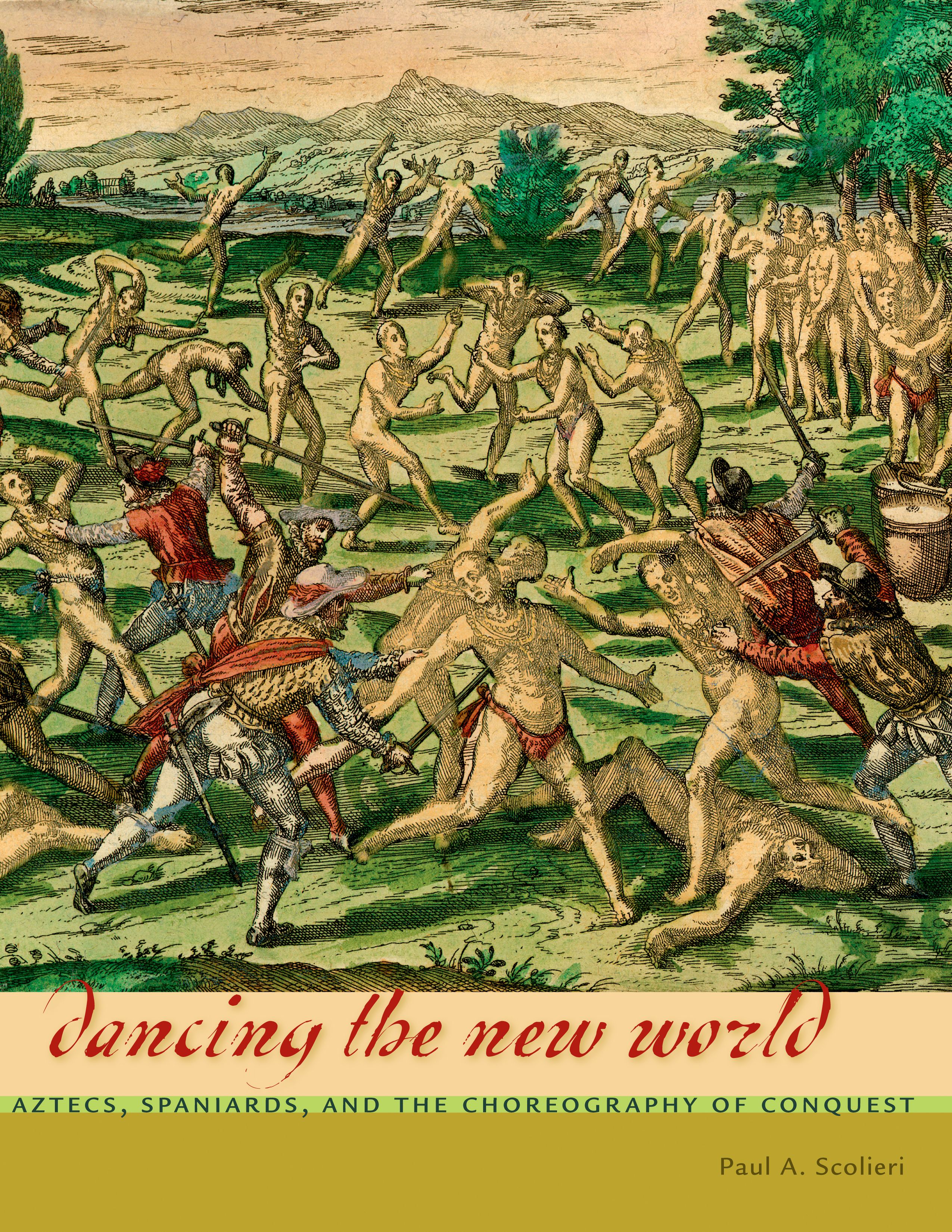
Dancing the New World
Winner, Oscar G. Brockett Book Prize in Dance Research, 2014 Honorable Mention, Sally Banes Publication Prize, American Society for Theatre Research, 2014 de la Torre Bueno® Special Citation, Society of Dance History Scholars, 2013 From Christopher Columbus to “first anthropologist” Friar Bernardino de Sahagún, fifteenth- and sixteenth-century explorers, conquistadors, clerics, scientists, and travelers wrote about the “Indian” dances they encountered throughout the New World. This was especially true of Spanish missionaries who intensively studied and documented native dances in an attempt to identify and eradicate the “idolatrous” behaviors of the Aztec, the largest indigenous empire in Mesoamerica at the time of its European discovery. Dancing the New World traces the transformation of the Aztec empire into a Spanish colony through written and visual representations of dance in colonial discourse—the vast constellation of chronicles, histories, letters, and travel books by Europeans in and about the New World. Scolieri analyzes how the chroniclers used the Indian dancing body to represent their own experiences of wonder and terror in the New World, as well as to justify, lament, and/or deny their role in its political, spiritual, and physical conquest. He also reveals that Spaniards and Aztecs shared an understanding that dance played an important role in the formation, maintenance, and representation of imperial power, and describes how Spaniards compelled Indians to perform dances that dramatized their own conquest, thereby transforming them into colonial subjects. Scolieri’s pathfinding analysis of the vast colonial “dance archive” conclusively demonstrates that dance played a crucial role in one of the defining moments in modern history—the European colonization of the Americas.
eBook
unfaithful imitation
On January 25, 1524, Friar Toribio de Benavente (ca. 1490–1569) joined a delegation of eleven other Franciscan missionaries and left Spain for the New World. They arrived near Veracruz, Mexico, on May 13, and shortly thereafter traced the steps of the conquistadors to Tenochtitlan, where they arrived on June 18. Along the way, Friar Toribio had a life-defining conversion. When natives saw the barefoot friar in threadbare clothes, they purportedly shouted “motolinía” at him. Learning thatmotoliníain Nahuatl means “poor” or “unfortunate one,” Friar Toribio declared: “That shall be my name for my entire life.”¹
Given that Indians
Book Chapter
dances of death
Huitzilopochtli (“Hummingbird from the South”) was the Mexica god of the sun and war. Conceived immaculately by his mother, Coatlicue (“The One with the Skirt of Serpents”), Huitzilopochtli was deified over the course of several hundred years, a history that parallels the imperial rise of the Mexica culture itself. Huitzilopochtli guided the Mexica on their mythic migration from their fabled homeland of Aztlán (“The Place of Whiteness”) to their arrival in Tenochtitlan in 1325. Wherever Huitzilopochtli established temporary residence on this journey, his followers erected a temple in his honor. He once led the Mexica to the site of his
Book Chapter
on the areíto
On December 26, 1492, during his first voyage to the “New World,” Christopher Columbus encountered acacique(Indian “chief”) named Guacanagari, whom he invited, along with other Indians, aboard his ship theNiña. The Indians allegedly brought pieces of gold to exchange for hawks’ bells; they immediately hung the bells on their bodies and began to dance to the chiming sounds they made.¹
And so we see that one of the first encounters between Europeans and natives in the New World precipitated a dance. In his journal, Columbus mentioned his surprise at learning that Indians had such a fondness for
Book Chapter
the mystery of movement
In 1522, upon hearing of the final conquest of the Aztec, Charles V appointed Hernán Cortés governor and captain general of New Spain. Within the next few years, Cortés continued his military campaigns until the Spanish colony was almost double the size of the former Aztec empire. Bernal Díaz del Castillo tells us that in 1524 Cortés set out on yet another expedition to amass even more wealth and land. As he made his journey toward South America, he passed through various towns, where he was welcomed with “great reception andfiestas.” For instance, in the gulf city of Coatzacoalcos,
Book Chapter