
Catalogue Search | MBRL


Are you sure you want to remove the book from the shelf?

{{itemTitle}}
83
result(s) for
"Scott, Shirley V"
Sort by:


THE IRRELEVANCE OF NON-RECOGNITION TO AUSTRALIA'S ANTARCTIC TERRITORY TITLE
It is often noted that few States recognize the seven national claims to Antarctic territory. Australia, one of the claimants, asserts title over 42 per cent of the continent and yet only four States have recognized its claim. Some States have expressly rejected Australia's claim. This article examines the legal significance of such widespread non-recognition. It does so through interrogating the evolution of the legal regime of territorial acquisition, its historical function and application to Antarctica, and relevant decisions of international courts and tribunals. The article identifies, and distinguishes amongst, several categories of non-recognition and considers the relevance of each. The analysis finds that the seemingly meagre level of recognition of Australia's title to the Australian Antarctic Territory does not detract from the validity of that title. This article points to possible reasons as to why a number of polar scholars may have suggested otherwise.
Journal Article

The Imperial Over-Stretch of International Law
In presenting the international law community with a call to action in defense of the liberal international order against a trend towards “authoritarian international law,” Tom Ginsburg prompts us to assess the systemic dynamics at play in the contemporary international legal order. In doing so, we should be cautious about assuming that the consequences for international law of any particular actor will be positive or otherwise. A couple of decades ago even American international lawyers were concerned about what they perceived to be the threat posed to international law by the United States as global hegemon. And yet from today's vantage point, it seems that the imperial actor during the post-Cold War period may not have been the United States so much as transnational civil society. The very openness of the system of international law that enables both democratic and authoritarian regimes to promote norms reflective of their policy preferences has also enabled civil society to advance norms, processes, and institutional structures that go beyond the policy preferences of dominant states. In doing so, civil society—a hallmark of what we might refer to as the “pseudo-democratic” international legal system—has challenged the delicate balance between power politics and the realization of a pure international rule of law. The consequences appear serious.
Journal Article

National encounters with the International Court of Justice: Avoiding litigating Antarctic sovereignty
This article examines the two episodes during which the International Court of Justice ('ICJ') came closest to directly considering who has sovereignty over which portion of the Antarctic continent. The first was the period from 1947 to 1955, when the United Kingdom made multiple attempts to take Chile and Argentina to the ICJ. The second was the 'Whaling in the Antarctic' case commenced by Australia in 2010, which concerned Japan's whaling program off the Australian Antarctic Territory. Of the six countries involved in these two episodes, only the UK was favourably disposed to having the ICJ determine the question. Viewed with hindsight, it may well have worked out for the better that the Court did not rule on the matter because if UK confidence had indeed been reflected in the resultant judgment, the UK may not have been prepared to agree to art IV of 'The Antarctic Treaty', by which claimants agreed not to press their claims while also agreeing to accept that other states would not recognise their sovereignty on the continent. The agreement to disagree as contained in art IV has underpinned the operation of what is widely regarded as one of the most successful of international regimes.
Journal Article

Implications of climate change for the UN Security Council: mapping the range of potential policy responses
Over the last decade there has been an evolving debate both within the United Nations and within the scholarly literature as to whether it would be feasible, appropriate and/or advantageous for the United Nations Security Council (UNSC) to consider climate change to be within its remit. Given that irreversible global warming is under way and that this will inevitably have multiple global security implications—and indeed, that the Council has to some degree already addressed the issue—such a debate has become anachronistic. What is needed at this stage is nuanced analysis of how this complex policy issue may have already impacted, and may in future impact, the function and functioning of the Council. This article first reviews key variables that need to be taken into account in moving beyond a binary discussion of whether or not the Security Council should consider climate change. It then maps four broad categories of possible UNSC response, spanning from rejection of any involvement through to the Council using its Chapter VII powers and functioning as the peak body in respect of global climate change governance. It then places developments to date within those categories and concludes by considering the prospects for an increased UNSC role in the future.
Journal Article

Does the UNFCCC Fulfil the Functions Required of a Framework Convention? Why Abandoning the United Nations Framework Convention on Climate Change Might Constitute a Long Overdue Step Forward
Negotiations are currently underway for a new global compact on climate change, to build on the United Nations Framework Convention on Climate Change (UNFCCC). This article asks whether the UNFCCC is adequate to the task or whether, despite the urgency of the need to agree a path ahead, it would be more appropriate to supplant, rather than further to supplement, the UNFCCC. The article answers this question through application of the theory of Cognitive Structures of Cooperation (CSC Theory) and the light it sheds on the role of the foundational treaty in a multi-treaty regime. Applied to the UNFCCC CSC Theory suggests that despite incorporating a rich tapestry of ideational components, the UNFCCC does not offer a strong conceptual basis on which to build further and recommends reappraising the assumption that a new agreement be concluded on the same basis.
Journal Article

Inserting Visions of Justice into a Contemporary History of International Law
The history of international law is often told in terms of the rise and fall of great powers or as a mechanism of colonial subjugation. To the extent that these accounts consider justice, it is usually to demonstrate its absence. This paper points out that justice has been integral to the evolution of international law in the era of the United States. Individuals and members of civil society in the US and Europe have influenced systemic developments in international law through their efforts to realize a vision of justice in interstate relations, their vision being of a body of international law and a world court which together obviate the need for war. To suggest the possibility of an historical narrative constructed around justice is not to deny the validity of other histories focused on inequitable relations of power, but to point to the scope for nuance in the frameworks within which we portray international law and its history.
Journal Article
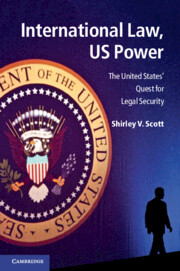
International Law, US Power
Observers of the USA's attitude towards international law seem to be perpetually taken aback by its actions, whether those relate to the use of force, the International Criminal Court or human rights. This book sets out to articulate the considerable degree of continuity in the nature of US engagement with international law. International Law, US Power explains that the USA has throughout its history pursued a quest for defensive and offensive legal security and that this was a key ingredient in the rise of the USA. Although skilful strategic involvement with international law was an ingredient in the USA 'winning' the Cold War, the rise of China and the growing negotiating strength of leading developing countries mean that the USA is likely to find it increasingly difficult to use the same set of techniques in the future.
eBook
Climate change and peak oil as threats to international peace and security : is it time for the security council to legislate?
Legality and scope for Security Council legislative action on climate change - possible role for the Security Council with recent introduction of legislative decision-making - UN Charter - environmental threats to peace.
Journal Article

Does Legality Really Matter? Accounting for the Decline in US Foreign Policy Legitimacy Following the 2003 Invasion of Iraq
The perceived legitimacy of US foreign policy plummeted in the wake of the US-led
2003 invasion of Iraq. Most commentators would agree that international law, or at
least US actions in relation to international law, had something to do with this
decline. But, what the recent debate as to how best to restore US legitimacy has
starkly revealed, is that we know little as to just how international law accords
legitimacy to certain foreign policy endeavours. While the legality of the action
may have much to do with it, the relationship between international law, foreign
policy and legitimacy appears to be more complex than is suggested by a
straightforward legal–illegal categorization of behaviour. A theorization
of international law as ideology can provide an overall explanation of the role of
international law in the decline in US foreign policy legitimacy following the
invasion of Iraq.
Journal Article