
Catalogue Search | MBRL


Are you sure you want to remove the book from the shelf?

{{itemTitle}}
210
result(s) for
"Seaford, Richard"
Sort by:

Foragers, farmers, and fossil fuels : how human values evolve
\"Most people in the world today think democracy and gender equality are good, and that violence and wealth inequality are bad. But most people who lived during the 10,000 years before the nineteenth century thought just the opposite. Drawing on archaeology, anthropology, biology, and history, Ian Morris, author of the best-selling Why the West Rules--for Now, explains why. The result is a compelling new argument about the evolution of human values, one that has far-reaching implications for how we understand the past--and for what might happen next. Fundamental long-term changes in values, Morris argues, are driven by the most basic force of all: energy. Humans have found three main ways to get the energy they need--from foraging, farming, and fossil fuels. Each energy source sets strict limits on what kinds of societies can succeed, and each kind of society rewards specific values. In tiny forager bands, people who value equality but are ready to settle problems violently do better than those who aren't; in large farming societies, people who value hierarchy and are less willing to use violence do best; and in huge fossil-fuel societies, the pendulum has swung back toward equality but even further away from violence. But if our fossil-fuel world favors democratic, open societies, the ongoing revolution in energy capture means that our most cherished values are very likely to turn out--at some point fairly soon--not to be useful any more. Originating as the Tanner Lectures delivered at Princeton University, the book includes challenging responses by novelist Margaret Atwood, philosopher Christine Korsgaard, classicist Richard Seaford, and historian of China Jonathan Spence\"-- Provided by publisher.
BOOK

Money and the Early Greek Mind
How were the Greeks of the sixth century BC able to invent philosophy and tragedy? In this book Richard Seaford argues that a large part of the answer can be found in another momentous development, the invention and rapid spread of coinage which produced the first ever thoroughly monetised society. By transforming social relations, monetisation contributed to the ideas of the universe as an impersonal system (presocratic philosophy) and of the individual alienated from his own kin and from the gods (in tragedy). Seaford argues that an important precondition for this monetisation was the Greek practice of animal sacrifice, as represented in Homeric Epic, which describes a premonetary world on the point of producing money. This book combines social history, economic anthropology, numismatics and the close reading of literary, inscriptional, and philosophical texts. Questioning the origins and shaping force of Greek philosophy, this is a major book with wide appeal.
eBook

Cosmology and the Polis
This book further develops Professor Seaford's innovative work on the study of ritual and money in the developing Greek polis. It employs the concept of the chronotope, which refers to the phenomenon whereby the spatial and temporal frameworks explicit or implicit in a text have the same structure, and uncovers various such chronotopes in Homer, the Homeric Hymn to Demeter, Presocratic philosophy and in particular the tragedies of Aeschylus. Mikhail Bakhtin's pioneering use of the chronotope was in literary analysis. This study by contrast derives the variety of chronotopes manifest in Greek texts from the variety of socially integrative practices in the developing polis - notably reciprocity, collective ritual and monetised exchange. In particular, the Oresteia of Aeschylus embodies the reassuring absorption of the new and threatening monetised chronotope into the traditional chronotope that arises from collective ritual with its aetiological myth. This argument includes the first ever demonstration of the profound affinities between Aeschylus and the (Presocratic) philosophy of his time.
eBook

ARISTOCRACY AND MONETIZATION
If there was an ‘aristocracy’ in the archaic and classical polis , how was it differentiated from the rest of the polis ? There are various possible criteria for differentiating a socio-political elite, notably birth, legal status, education, virtue, power, access to deity, wealth, and performance (or display). European history has left us with a strong association between ‘aristocracy’ and the criterion of birth, which produces a relatively closed elite. As for the ancient Greek polis , however, an excellent recent collection of essays entitled ‘Aristocracy’ in Antiquity edited by Nick Fisher and Hans van Wees generally rejects earlier assumptions that a hereditary aristocracy is clearly identifiable, and gives some prominence instead to the criterion of display or performance (such as competing in Panhellenic games or erecting an image of an ancestor). My concern is not directly with this interesting controversy, but rather with a historical process that is almost entirely omitted by ‘Aristocracy’ in Antiquity (and by most other discussions of Greek aristocracy), namely the monetization of the polis that was made pervasive by the invention of coinage and its rapid spread in Greek culture from the early sixth century bce .
Journal Article

Universe and Inner Self in Early Indian and Early Greek Thought
From the sixth century BCE onwards there occurred a revolution in thought, with novel ideas such as such as that understanding the inner self is both vital for human well-being and central to understanding the universe. This intellectual transformation is sometimes called the beginning of philosophy. And it occurred – independently it seems - in both India and Greece, but not in the vast Persian Empire that divided them. How was this possible? This is a puzzle that has never been solved. This volume brings together Hellenists and Indologists representing a variety of perspectives on the similarities and differences between the two cultures, and on how to explain them. It offers a collaborative contribution to the burgeoning interest in the Axial Age and will be of interest to anyone intrigued by the big questions inspired by the ancient world.
eBook

MYSTIC LIGHT IN AESCHYLUS’ BASSARAI
Martin West has produced a new \"working text\" of a passage from Aeschylus' \"Bassarai\", of which otherwise almost nothing survives. Tries to illuminate the theme, dramatised by Aeschylus, of Orpheus rejecting Dionysus for the sun (identified with Apollo) after visiting Hades. Orpheus as author of mystic discourse was claimed by groups who were in opposition: adherents of Dionysus and Pythagorean adherents of Apollo. Aeschylus, apart from his absorption in the mysteries of his birthplace Eleusis, was as a tragic poet closely associated with Dionysus. He was also said to have been a Pythagorean, and the \"Oresteia\" exhibits patterns of thought very similar to, if not influenced by, Pythagoreanism. He was therefore well qualified to dramatise the opposition and reconciliation of Dionysiac and Pythagorean ideas of the next world. (Quotes from original text)
Journal Article
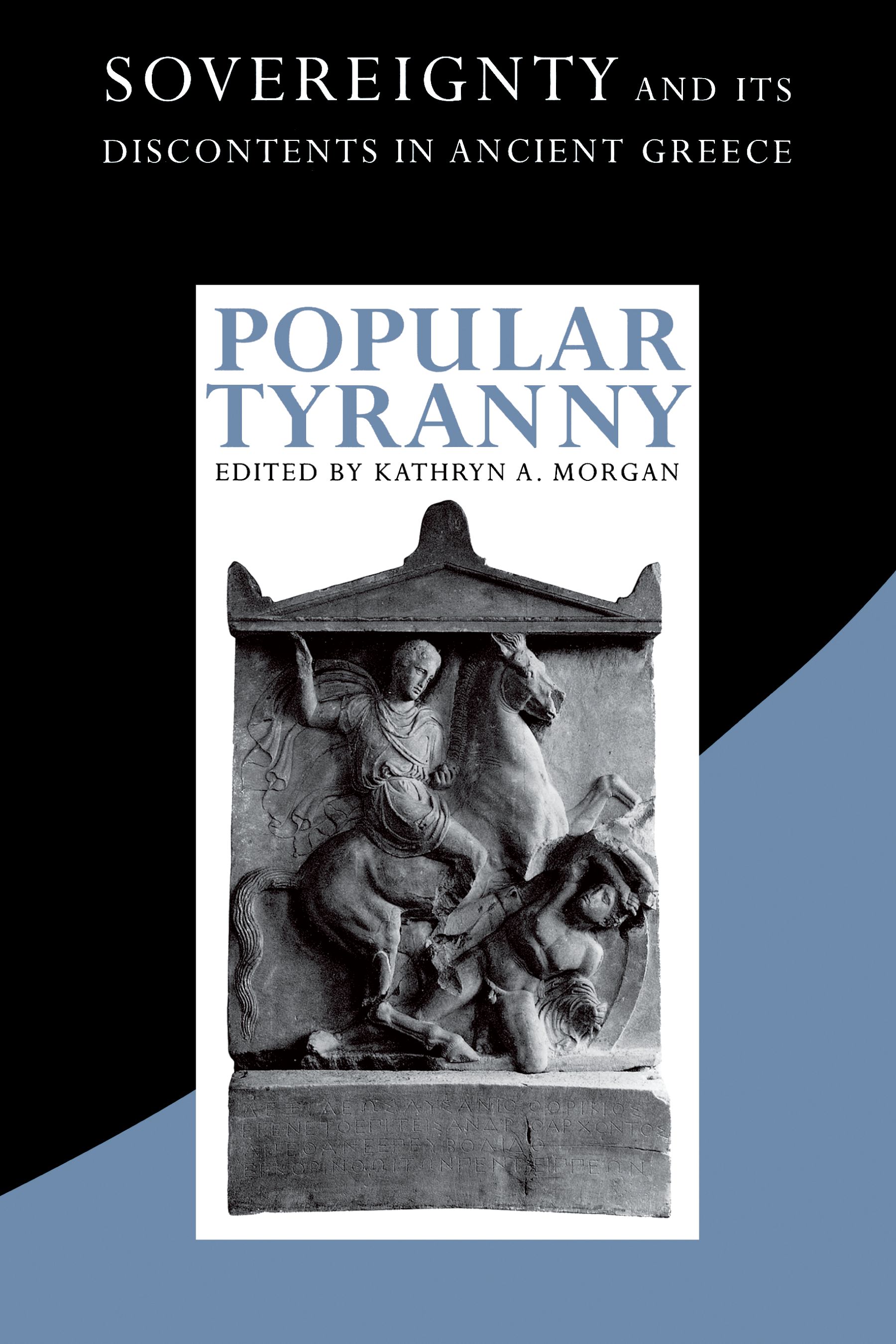
Popular Tyranny
The nature of authority and rulership was a central concern in ancient Greece, where the figure of the king or tyrant and the sovereignty associated with him remained a powerful focus of political and philosophical debate even as Classical Athens developed the world's first democracy. This collection of essays examines the extraordinary role that the concept of tyranny played in the cultural and political imagination of Archaic and Classical Greece through the interdisciplinary perspectives provided by internationally known archaeologists, literary critics, and historians. The book ranges historically from the Bronze and early Iron Age to the political theorists and commentators of the middle of the fourth century B.C. and generically across tragedy, comedy, historiography, and philosophy. While offering individual and sometimes differing perspectives, the essays tackle several common themes: the construction of authority and of constitutional models, the importance of religion and ritual, the crucial role of wealth, and the autonomy of the individual. Moreover, the essays with an Athenian focus shed new light on the vexed question of whether it was possible for Athenians to think of themselves as tyrannical in any way. As a whole, the collection presents a nuanced survey of how competing ideologies and desires, operating through the complex associations of the image of tyranny, struggled for predominance in ancient cities and their citizens.
eBook