
Catalogue Search | MBRL


Are you sure you want to remove the book from the shelf?

{{itemTitle}}
19
result(s) for
"Seay, Gary"
Sort by:

Themes from G. E. Moore
These sixteen original essays, whose authors include some of the world's leading philosophers, examine themes from the work of the Cambridge philosopher G. E. Moore (1873-1958), and demonstrate his considerable continuing influence on philosophical debate. Part I bears on epistemological topics, such as scepticism about the external world, the sign.
eBook

Themes from G.E. Moore : new essays in epistemology and ethics
These sixteen original essays, whose authors include some of the world's leading philosophers, examine themes from the work of the Cambridge philosopher G. E. Moore (1873-1958), and demonstrate his considerable continuing influence on philosophical debate. Part I bears on epistemological topics, such as scepticism about the external world, the significance of common sense, and theories of perception. Part II is devoted to themes in ethics, such as Moore's open question argument, his non-naturalism, utilitarianism, and his notion of organic unities.
eBook

REASONING, NORMATIVITY, AND EXPERIMENTAL PHILOSOPHY
The development of modern science, on one widely held view, has come largely through naturalizing domains of inquiry that were historically parts of philosophy. Theories based on speculation about matters empirical were replaced with law-based, predictive explanatory theories that invoked empirical data as supporting evidence. Although philosophers have, by and large, applauded such developments, there is no consensus about whether inquiry into normative domains can be naturalized. Since the early twentieth century, attempts at naturalizing ethics have been at the center of heated debates, and later attempts at naturalizing epistemology triggered similarly contentious disputes. But there have so far been no substantial reactions to attempts at naturalizing inquiry into another plainly normative domain, that of reasoning. Nuccetelli and Seay offer here a partial remedy to this state of affairs by challenging a naturalistically minded argument call it the 'cognitive-diversity argument'--offered by Stephen Stich and his collaborators against the Goodman account of the justification of rules of inference.
Journal Article

Can There Be a “Duty to Die” without a Normative Theory?
Unlike many philosophers who write on biomedical ethics, John
Hardwig is not primarily concerned to test our intuitions about
the limits of normative theories by thought experiments or
problematic borderline cases. Rather, he presses us to accept
the conclusions to which our most firmly held principles commit
us. But these conclusions, if Hardwig is right, turn out to
be quite startling claims about moral duty that would undermine
much of contemporary bioethical theory regarding end-of-life
decisions. On his view, we must face squarely the moral
implications of our present arrangement of healthcare funding
in the United States, where more and more of the financial
responsibility of care is being shifted onto the families of
patients, often with disastrous results. Yet, in the context of this
increasingly unstable arrangement, our chief principle of medical
decisionmaking also holds that their interests are
not morally relevant at all in deciding what should be done
for the patient, and only the patient's wishes
count (insofar as we can determine them). Now Hardwig thinks
that this rule is irrational in the present circumstances, and
that it would make more sense to admit the moral relevance of
the interests of family members, but also that if we do give
appropriate weight to their concerns, we shall be led in some
cases to the conclusion that the patient has a duty to die.
Journal Article
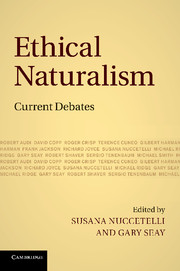
Ethical Naturalism
Ethical naturalism is narrowly construed as the doctrine that there are moral properties and facts, at least some of which are natural properties and facts. Perhaps owing to its having faced, early on, intuitively forceful objections by eliminativists and non-naturalists, ethical naturalism has only recently become a central player in the debates about the status of moral properties and facts which have occupied philosophers over the last century. It has now become a driving force in those debates, one with sufficient resources to challenge not only eliminativism, especially in its various non-cognitivist forms, but also the most sophisticated versions of non-naturalism. This volume brings together twelve new essays which make it clear that, in light of recent developments in analytic philosophy and the social sciences, there are novel grounds for reassessing the doctrines at stake in these debates.
eBook

Relieving Pain and Foreseeing Death: A Paradox About Accountability and Blame
In a familiar moral dilemma faced by physicians who care for the dying, some patients who are within days or hours of death may experience suffering in a degree that cannot be relieved by ordinary levels of analgesia. In such cases, it may sometimes be possible to honor a competent patient's request for pain relief only by giving an injection of narcotics in a dosage so large that the patient's death is thereby hastened. Doctors rightly worry that taking an action likely to result in a patient's death may violate the Hippocratic injunction against the direct killing of anyone in their care.
Journal Article


By Popular Demand
Your May 29 front-page epilogue to efforts to integrate higher education in the United States gives the impression that the persistence of racially separate institutions in tax-supported higher education is an exclusively Southern phenomenon. But a visit to central Brooklyn will confirm that is not the case.
Newspaper Article

Personality and Saving Behavior Among Older Adults
This study investigates how psychological characteristics influence saving behavior within a sample of 1,380 U.S. preretirees aged 50–70 from the Health and Retirement Study (HRS). Using the 3M Model of Motivation and Personality as a theoretical basis, structural equation model results revealed that financial self-efficacy (FSE) directly explains saving behavior and is central to understanding the link between other psychological characteristics and the saving behavior of older adults. Through higher FSE, increased positive affect and reduced negative affect indirectly supported saving behavior. Moreover, the results revealed personality traits indirectly explained saving behavior. Conscientiousness and extroversion indirectly supported saving behavior; whereas openness to experience and neuroticism indirectly undermined saving behavior. This study connects broad personality traits with saving behavior, which provides information about how older adults’ psychological composition is related to their saving practices.
Journal Article