
Catalogue Search | MBRL


Are you sure you want to remove the book from the shelf?

{{itemTitle}}
3
result(s) for
"Segal, Ariel, author"
Sort by:

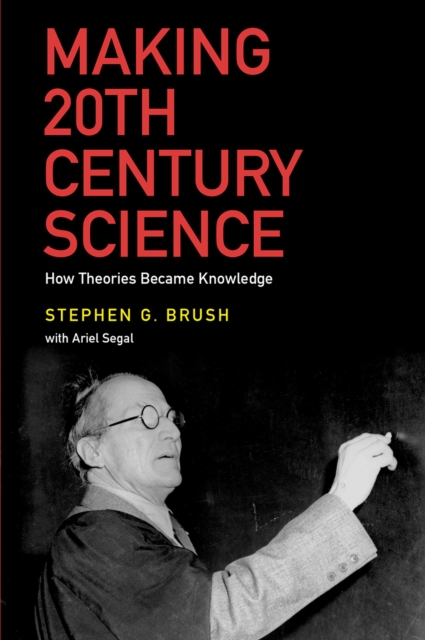
Making 20th century science : how theories became knowledge
Historically, the scientific method has been said to require proposing a theory, making a prediction of something not already known, testing the prediction, and giving up the theory (or substantially changing it) if it fails the test. A theory that leads to several successful predictions is more likely to be accepted than one that only explains what is already known but not understood. This process is widely treated as the conventional method of achieving scientific progress, and was used throughout the twentieth century as the standard route to discovery and experimentation. But does science really work this way? In Making 20th Century Science, Stephen G. Brush discusses this question, as it relates to the development of science throughout the last century. Answering this question requires both a philosophically and historically scientific approach, and Brush blends the two in order to take a close look at how scientific methodology has developed. Several cases from the history of modern physical and biological science are examined, including Mendeleev's Periodic Law, Kekule's structure for benzene, the light-quantum hypothesis, quantum mechanics, chromosome theory, and natural selection. In general it is found that theories are accepted for a combination of successful predictions and better explanations of old facts. Making 20th Century Science is a large-scale historical look at the implementation of the scientific method, and how scientific theories come to be accepted.
eBook

Yotvata
This book presents the final report of the excavations at
Yotvata, the largest oasis in the Arabah Valley, conducted by the
Sonia and Marco Nadler Institute of Archaeology of Tel Aviv
University in 1974-1980 under the direction of Dr. Zeʾev Meshel.
The report covers two central sites: a fortified Iron I site and an
Early Islamic settlement.
The Iron I remains consist of an irregular casemate wall
surrounding a courtyard. The location of this site suggests that
the settlement was established in order to protect the water
sources and to overlook and supervise the nearby crossroads. Based
on the relative proximity of the site to Timna, it may be concluded
that the oasis formed the main source of water and wood for the
population involved in copper production in that region.
The rich finds uncovered at the Early Islamic
settlement-including a large courtyard building and a nearby
bathhouse, among other structures-point to habitation from the end
of the seventh to the early ninth century CE. The proximity of the
settlement to a sophisticated irrigation system ( qanat )
and the administrative/economic ostraca discovered at the site
suggest that it served as the center of an agricultural estate
owned by an elite Muslim family. Among the unique finds is a large
assemblage of locally produced, handmade pottery, which is
thoroughly studied here.
The findings from the excavations at the Yotvata oasis have made
a major contribution to the study of Early Islamic settlement and
material culture in the greater Arabah region and beyond.
eBook