
Catalogue Search | MBRL


Are you sure you want to remove the book from the shelf?

{{itemTitle}}
29
result(s) for
"Sekerke, Matt"
Sort by:
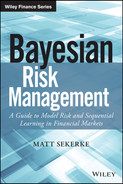
Bayesian Risk Management
A risk measurement and management framework that takes model risk seriouslyMost financial risk models assume the future will look like the past, but effective risk management depends on identifying fundamental changes in the marketplace as they occur. Bayesian Risk Management details a more flexible approach to risk management, and provides tools to measure financial risk in a dynamic market environment. This book opens discussion about uncertainty in model parameters, model specifications, and model-driven forecasts in a way that standard statistical risk measurement does not. And unlike current machine learning-based methods, the framework presented here allows you to measure risk in a fully-Bayesian setting without losing the structure afforded by parametric risk and asset-pricing models. Recognize the assumptions embodied in classical statisticsQuantify model risk along multiple dimensions without backtestingModel time series without assuming stationarityEstimate state-space time series models online with simulation methodsUncover uncertainty in workhorse risk and asset-pricing modelsEmbed Bayesian thinking about risk within a complex organizationIgnoring uncertainty in risk modeling creates an illusion of mastery and fosters erroneous decision-making. Firms who ignore the many dimensions of model risk measure too little risk, and end up taking on too much. Bayesian Risk Management provides a roadmap to better risk management through more circumspect measurement, with comprehensive treatment of model uncertainty.
eBook

Bayesian Risk Management
A risk measurement and management framework that takes model risk seriously
Most financial risk models assume the future will look like the past, but effective risk management depends on identifying fundamental changes in the marketplace as they occur. Bayesian Risk Management details a more flexible approach to risk management, and provides tools to measure financial risk in a dynamic market environment. This book opens discussion about uncertainty in model parameters, model specifications, and model-driven forecasts in a way that standard statistical risk measurement does not. And unlike current machine learning-based methods, the framework presented here allows you to measure risk in a fully-Bayesian setting without losing the structure afforded by parametric risk and asset-pricing models.
* Recognize the assumptions embodied in classical statistics
* Quantify model risk along multiple dimensions without backtesting
* Model time series without assuming stationarity
* Estimate state-space time series models online with simulation methods
* Uncover uncertainty in workhorse risk and asset-pricing models
* Embed Bayesian thinking about risk within a complex organization
Ignoring uncertainty in risk modeling creates an illusion of mastery and fosters erroneous decision-making. Firms who ignore the many dimensions of model risk measure too little risk, and end up taking on too much. Bayesian Risk Management provides a roadmap to better risk management through more circumspect measurement, with comprehensive treatment of model uncertainty.
eBook


Bank Regulation as Monetary Policy: Lessons from the Great Recession
In this article, we depart from the consensus view by suggesting that growth rates of broad money are a better indication of the postcrisis stance of monetary policy in the United States than the federal funds rate. Viewed from the perspective of broad money-we prefer the unweighted \"M4 minus\" (hereafter, M4 -) aggregate compiled by the Center for Financial Stability - the stance of monetary policy has been relatively tight since the beginning of the credit crisis. Postcrisis legislation and changes to the international bank regulatory regime are primarily responsible for reduced broad money growth. Their combined effect has been to establish bank regulation as the primary determinant of monetary conditions, as opposed to a regime of central bank dominance or fiscal dominance. The Federal Reserve has been able to partially offset the monetary effects of these regulatory changes through quantitative easing (QE). But an unintended consequence of QE has been to divert attention from obstacles to money creation by the banking system. The pattern of bank lending that may be expected to prevail without large-scale support from the Fed's balance sheet has serious implications for any QE exit strategy.
Journal Article
Bayesian Inference in State‐Space Time Series Models
State‐space models are introduced as a coherent, rigorous, and overarching framework for the elements of Bayesian inference discussed in previous chapters. The notion of a latent state space is introduced along with the classical problems of filtering and smoothing state estimates. Sequential estimation is then developed in a concrete way with dynamic linear models. Dynamic linear models offer a flexible strategy for implementing Kalman filtering and smoothing, a tool as fundamental to state‐space time series analysis as the normal linear regression model is to cross‐sectional data analysis. Component‐wise construction of dynamic linear models is discussed, as well as the handling of parameter uncertainty, model uncertainty, and discounting.
Book Chapter