
Catalogue Search | MBRL


Are you sure you want to remove the book from the shelf?

{{itemTitle}}
227
result(s) for
"Senft, Gunter"
Sort by:

Ritual communication
\"This volume presents a new approach to \"ritual communication\" by an international group of scholars from a multidisciplinary and cross-cultural perspective, rich with empirical data and path breaking for future theorizing on the topic. The chapters show how ritual communication involves witnessing a future through the making of cultural knowledge. They show ritual communication to be a highly \"self-oriented\" multimodal process in which the human body, temporalization, and spatialized settings play crucial roles. Ritual communication encompasses both verbal and sensory attributes. It is in part dependent upon prior formulaic and repeated action, and is thus anticipated within particular contexts of social interaction. It is performed and therefore subject to evaluation by its participants according to standards defined by language ideologies, local aesthetics, contexts of use, and interpersonal relations. The authors here emphasize the variety of participatory and experiential aspects of ritual communication in contemporary African, Native American, Asian, and Pacific cultures. Among the forms covered are ritual constraints on everyday interaction, gossip, private and public encounters, political meetings and public demonstrations, rites of passage, theatrical performances, magical formulae, shamanic chants, affinal civilities, and leaders' ceremonial discourse. The book is ideal for students and scholars in anthropology and linguistic anthropology in particular\"--Provided by publisher.
Book
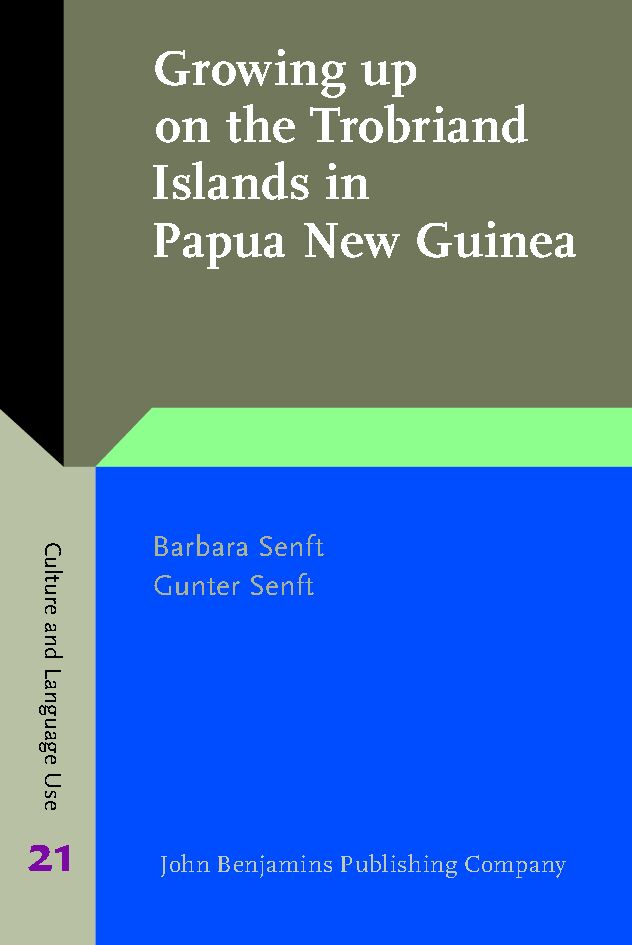
Growing up on the Trobriand Islands in Papua New Guinea : childhood and educational ideologies in Tauwema
This volume deals with the children’s socialization on the Trobriands. After a survey of ethnographic studies on childhood, the book zooms in on indigenous ideas of conception and birth-giving, the children’s early development, their integration into playgroups, their games and their education within their `own little community’ until they reach the age of seven years. During this time children enjoy much autonomy and independence. Attempts of parental education are confined to a minimum. However, parents use subtle means to raise their children. Educational ideologies are manifest in narratives and in speeches addressed to children. They provide guidelines for their integration into the Trobrianders’ “balanced society” which is characterized by cooperation and competition. It does not allow individual accumulation of wealth – surplus property gained has to be redistributed – but it values the fame acquired by individuals in competitive rituals. Fame is not regarded as threatening the balance of their society.
eBook

Differential coding of perception in the world’s languages
Is there a universal hierarchy of the senses, such that some senses (e.g., vision) are more accessible to consciousness and linguistic description than others (e.g., smell)? The long-standing presumption in Western thought has been that vision and audition are more objective than the other senses, serving as the basis of knowledge and understanding, whereas touch, taste, and smell are crude and of little value. This predicts that humans ought to be better at communicating about sight and hearing than the other senses, and decades of work based on English and related languages certainly suggests this is true. However, how well does this reflect the diversity of languages and communities worldwide? To test whether there is a universal hierarchy of the senses, stimuli from the five basic senses were used to elicit descriptions in 20 diverse languages, including 3 unrelated sign languages. We found that languages differ fundamentally in which sensory domains they linguistically code systematically, and how they do so. The tendency for better coding in some domains can be explained in part by cultural preoccupations. Although languages seem free to elaborate specific sensory domains, some general tendencies emerge: for example, with some exceptions, smell is poorly coded. The surprise is that, despite the gradual phylogenetic accumulation of the senses, and the imbalances in the neural tissue dedicated to them, no single hierarchy of the senses imposes itself upon language.
Journal Article

Tales from the Trobriand Islands of Papua New Guinea. Psycholinguistic and anthropological linguistic analyses of tales told by Trobriand children and adults
This volume presents 22 tales from the Trobriand Islands told by children (boys between the age of 5 and 9 years) and adults. The monograph is motivated not only by the anthropological linguistic aim to present a broad and quite unique collection of tales with the thematic approach to illustrate which topics and themes constitute the content of the stories, but also by the psycholinguistic and textlinguistic questions of how children acquire linearization and other narrative strategies, how they develop them and how they use them to structure these texts in an adult-like way. The tales are presented in morpheme-interlinear transcriptions with first textlinguistic analyses and cultural background information necessary to fully understand them. A summarizing comparative analysis of the texts from a psycholinguistic, anthropological linguistic and philological point of view discusses the underlying schemata of the stories, the means narrators use to structure them, their structural complexity and their cultural specificity.
eBook

The Tuma Underworld of Love. Erotic and other narrative songs of the Trobriand Islanders and their spirits of the dead
The Trobriand Islanders' eschatological belief system explains what happens when someone dies. Bronislaw Malinowski described essentials of this eschatology in his articles \"Baloma: the Spirits of the Dead in the Trobriand Islands\" and \"Myth in Primitive Psychology\". There he also presented the Trobrianders' belief that a \"baloma\" can be reborn; he claimed that Trobrianders are unaware of the father's role as genitor. This volume presents a critical review of Malinowski's ethnography of Trobriand eschatology – finally settling the \"virgin birth\" controversy. It also documents the ritualized and highly poetic \"wosi milamala\" – the harvest festival songs. They are sung in an archaic variety of Kilivila called \"biga baloma\" – the baloma language. Malinowski briefly refers to these songs but does not mention that they codify many aspects of Trobriand eschatology. The songs are still sung at specific occasions; however, they are now moribund. With these songs Trobriand eschatology will vanish.
eBook


Ritual communication
Ritual Communication examines how people create and express meaning through verbal and non-verbal ritual. Ritual communication extends beyond collective religious expression. It is an intrinsic part of everyday interactions, ceremonies, theatrical performances, shamanic chants, political demonstrations and rites of passage.
eBook

Imdeduya
This volume presents five variants of the Imdeduya myth: two versions of the actual myth, a short story, a song and John Kasaipwalova’s English poem “Sail the Midnight Sun”. This poem draws heavily on the Trobriand myth which introduces the protagonists Imdeduya and Yolina and reports on Yolina’s intention to marry the girl so famous for her beauty, on his long journey to Imdeduya’s village and on their tragic love story. The texts are compared with each other with a final focus on the clash between orality and scripturality. Contrary to Kasaipwalova’s fixed poetic text, the oral Imdeduya versions reveal the variability characteristic for oral tradition. This variability opens up questions about traditional stability and destabilization of oral literature, especially questions about the changing role of myth – and magic – in the Trobriand Islanders' society which gets more and more integrated into the by now “literal” nation of Papua New Guinea.
eBook

The Case: The Trobriand Islanders vs H. P. Grice. Kilivila and the Gricean Maxims of Quality and Manner
The Gricean maxim of Quality \"Try to make your contribution one that is true\" and his maxim of Manner \"Be perspicuous\" are not observed in Kilivila, the Austronesian language of the Trobriand Islanders of Papua New Guinea. Speakers of Kilivila metalinguistically differentiate registers of their language. One of these varieties is called \"biga sopa\". This label can be glossed as \"joking or lying speech, indirect speech, speech which is not vouched for.\" The \"biga sopa\" constitutes the default register of Trobriand discourse. This article describes the concept of sopa, presents its features, and discusses and illustrates its functions and use within Trobriand society. The article ends with a discussion of the relevance of Gricean maxims for the research of everyday verbal interaction in Kilivila and a general criticism of these maxims, especially from an anthropological linguistic perspective.
Journal Article

Semantic Typology and Spatial Conceptualization
This project collected linguistic data for spatial relations across a typologically and genetically varied set of languages. In the linguistic analysis, we focus on the ways in which propositions may be functionally equivalent across the linguistic communities while nonetheless representing semantically quite distinctive frames of reference. Running nonlinguistic experiments on subjects from these language communities, we find that a population's cognitive frame of reference correlates with the linguistic frame of reference within the same referential domain.
Journal Article