
Catalogue Search | MBRL


Are you sure you want to remove the book from the shelf?

{{itemTitle}}
56
result(s) for
"Serventi, Silvano"
Sort by:

Pasta : the story of a universal food / Silvano Serventi and Françoise Sabban ; translated by Antony Shugaar
Chronicles the history of pasta, describing its origins in China and Italy and examining its spread around the world and its evolution into its innumerable modern varieties.
eBook
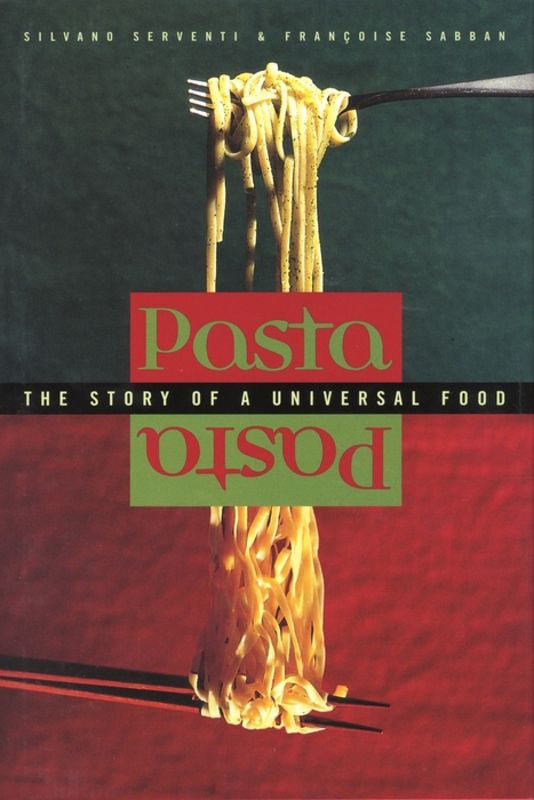
Pasta
Ranging from the imperial palaces of ancient China and the bakeries of fourteenth-century Genoa and Naples all the way to the restaurant kitchens of today, Pasta tells a story that will forever change the way you look at your next plate of vermicelli. Pasta has become a ubiquitous food, present in regional diets around the world and available in a host of shapes, sizes, textures, and tastes. Yet, although it has become a mass-produced commodity, it remains uniquely adaptable to innumerable recipes and individual creativity.Pasta: The Story of a Universal Foodshows that this enormously popular food has resulted from of a lengthy process of cultural construction and widely diverse knowledge, skills, and techniques.
Many myths are intertwined with the history of pasta, particularly the idea that Marco Polo brought pasta back from China and introduced it to Europe. That story, concocted in the early twentieth century by the trade magazineMacaroni Journal, is just one of many fictions umasked here. The true homelands of pasta have been China and Italy. Each gave rise to different but complementary culinary traditions that have spread throughout the world. From China has come pasta made with soft wheat flour, often served in broth with fresh vegetables, finely sliced meat, or chunks of fish or shellfish.Pastasciutta, the Italian style of pasta, is generally made with durum wheat semolina and presented in thick, tomato-based sauces. The history of these traditions, told here in fascinating detail, is interwoven with the legacies of expanding and contracting empires, the growth of mercantilist guilds and mass industrialization, and the rise of food as an art form.
Whether you are interested in the origins of lasagna, the strange genesis of the Chinese pasta bing or the mystique of the most magnificent pasta of all, thetimballo, this is the book for you. So dig in!
eBook
Pasta: the story of a universal food
This entertaining, comprehensive, readable book is full of fascinating tidbits. Exploding the myth that Marco Polo discovered pasta in China and brought it back to Italy, this volume shows that pasta has existed in various forms throughout Middle Eastern, Asian, and even North African culinary cultures long before its appearance in the West. Pasta is indeed the universal food. The book chronicles the infancy of lasagne, vermicelli and other forms of dried and fresh pasta, and the impact of rolling pins, hand presses, and pasta-making machines in the industrial age. Serventi and Sabban then relate the history of stuffed pastas and sauces. Equally important is the story of \"bing,\" the Chinese pasta with a rich history. The authors show that this enormously popular foodstuff is not merely a form of nourishment but the result of a lengthy process of cultural construction and the culmination of a wide array of knowledge, skills, and techniques.
eBook

The Industrial Age
The industrial era turned a new page in the history of pasta. The mastery of steam and then electricity triggered the mechanization of manufacturing and revolutionized working methods. The classic workshop described by Malouin, where workers silently and nimbly operated the brake, was transformed into a hubbub of cast-iron and steel machinery, where the clamor of pistons and flywheels rivaled the squeals of transmission belts. Engineers developed a generation of machines that could reproduce with ten times the power the precise actions of the laborers, who were therefore excluded—both their labor and their knowledge—from various operations in the
Book Chapter
The Words of Pasta
Over the centuries, the world of pasta has constructed a veritable museum of the imaginary, a repository of memories and dreams as well as reality, reflected in literature, folktales, and legends. From medieval chroniclers to contemporary novelists, from travel writers and adventurers to the forgotten glories of satirical burlesque poetry, countless authors have each contributed a stone to this edifice that forms part of Italy’s cultural identity. Here we offer a few texts that each, in its way, helps to tell the history of pasta.
Pasta was so common in medieval Italy that it lay at the heart of the
Book Chapter
From the Hand to the Extrusion Press
Medieval Italy, including the islands that formed part of its traditional territory, was the only region in the Mediterranean world that experienced the simultaneous development of the two types of pasta, dry and fresh. Both were cultivated and developed, giving Italy the position of leadership it still possesses in this field. It is no accident that Italian terminology soon came to dominate around the entire perimeter of the Mediterranean and even in northern France and England. The term “Italian macaroni,” which was later replaced by the more common “Italian pasta,” was used as early as the fifteenth century to define
Book Chapter
China
We begin this chapter on China with the “Ode toBing,” to which we will refer often. Its author is Shu Xi (264?–304?), a great scholar highly regarded by his contemporaries. He was entrusted in A.D. 281 with the compilation of theAnnals Written on Bamboo, the lost historical chronicle of the kingdom of Wei in Shanxi, fragments of which were rediscovered in a tomb in 279, that recounts events that took place between the third millennium B.C. and 299 B.C. Shu Xi also composed numerous odes devoted to themes as varied as the pleasure of reading, the art
Book Chapter
The Golden Age of the Pasta Manufactory
“In San Remo we saw a great many manufactories of macaroni and vermicelli! They are widely consumed in Provence and are beginning to become common in Paris.”¹ The French Dominican monk Jean-Baptiste Labat (1663–1738), who traveled through Italy at the turn of the eighteenth century, discovered a flourishing pasta industry there. The combination of the manual brake and the extrusion press, which began to spread in the second half of the sixteenth century, had revolutionized the production of pasta, considerably increasing output without in any way harming quality. Pasta made with the extrusion press was in many ways superior
Book Chapter