
Catalogue Search | MBRL


Are you sure you want to remove the book from the shelf?

{{itemTitle}}
6
result(s) for
"Shambaugh, David L., author"
Sort by:

China goes global : the partial power
Most are aware of the growth of the Chinese economy. Yet, while China watchers have shed much light on the country's internal dynamics, few have focused on how this increasingly powerful nation has become more active and assertive throughout the world. This book is an account of China's growing prominence on the international stage.
Book
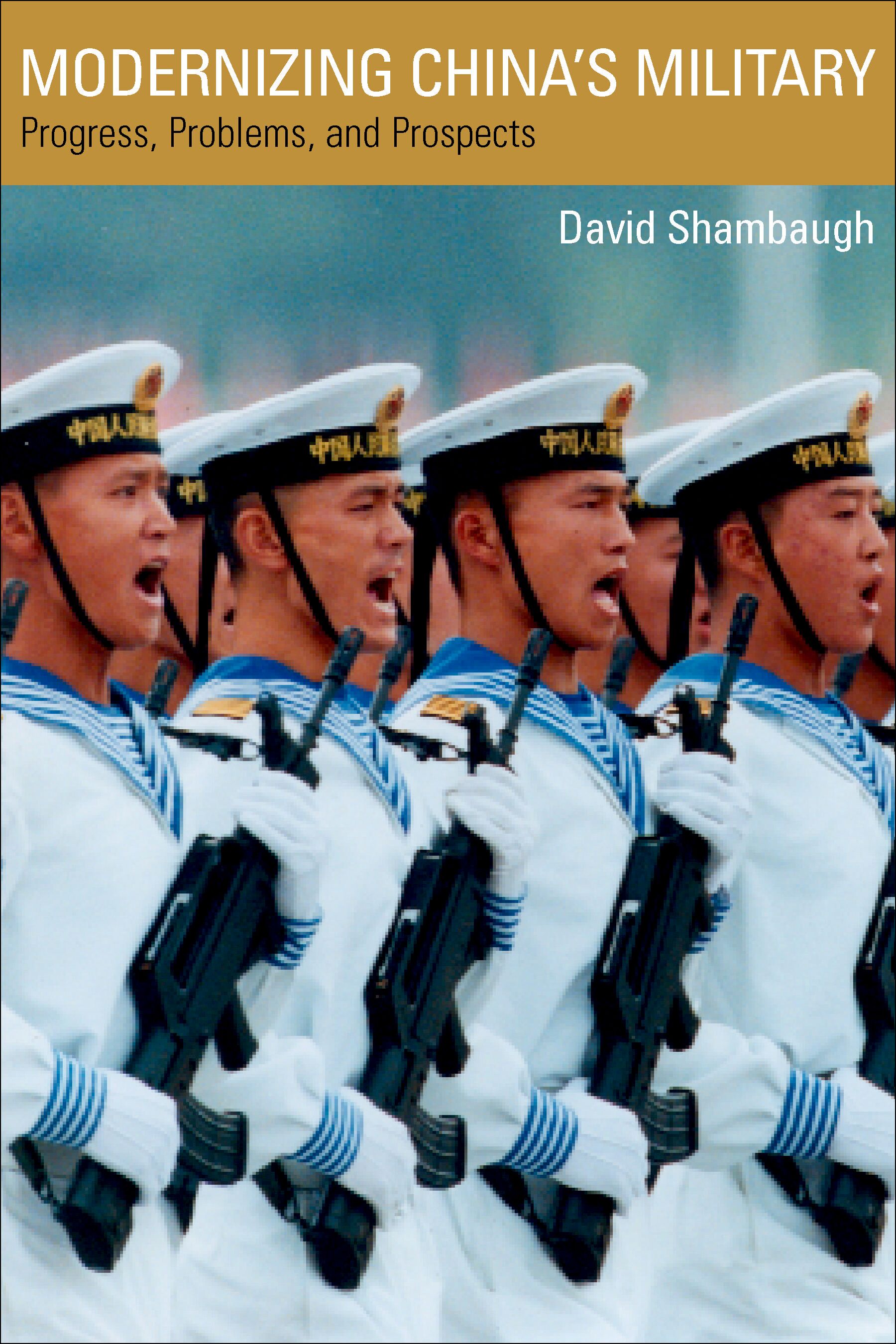
Modernizing China’s Military
David Shambaugh, a leading international authority on Chinese strategic and military affairs, offers the most comprehensive and insightful assessment to date of the Chinese military. The result of a decade's research, Modernizing China's Military comes at a crucial moment in history, one when international attention is increasingly focused on the rise of Chinese military power. Basing his analysis on an unprecedented use of Chinese military publications and interviews with People's Liberation Army (PLA) officers, Shambaugh addresses important questions about Chinese strategic intentions and military capabilities--questions that are of key concern for government policymakers as well as strategic analysts and a concerned public.
eBook

U.S. Relations with Southeast Asia in 2018
The United States maintains a comprehensive and robust presence throughout Southeast Asia that has grown dramatically since the 1980s. It includes the commercial, security, education and diplomatic, and other domains. America’s strengths and contributions to the region lie particularly in both hard and soft power, but the U.S. economic footprint is both broad and deep.
However, this presence is not very well appreciated or reported by regional media — whereas China’s presence and influence is pervasive. Most Southeast Asian governments are often reluctant to recognize or publicize the U.S. presence or contributions to regional security, stability, and growth.
America’s diplomatic engagement of ASEAN and the region has rightly been criticized for its episodic engagement, and Washington should substantially elevate Southeast Asia within its broader Asian and Indo-Pacific diplomatic priorities. Southeast Asia was made the highest priority ever for Washington during the Obama administration. While receding somewhat under the Trump administration, the region remains an important priority — but Washington must devote sustained attention to match the region’s importance to American national interests.
As U.S.–China competition escalates, Southeast Asia will become an epicentre of this competition. Southeast Asian states and societies may not realize the significance of the escalating U.S.–China competition for them, as most countries are internally preoccupied and buy into ASEAN’s rhetoric of inclusive engagement of external powers. Southeast Asian countries are likely to become increasing objects of this competition, and it will be become increasingly difficult for them to ignore it.
Meanwhile, Southeast Asian states and ASEAN must elevate their own emphasis and engagement with the United States. The U.S. brings many more strengths and benefits than does China and is a far more comprehensive actor in the region. In particular, it would be helpful if ASEAN and its member states would more publicly recognize the contributions and importance of the United States.
eBook

Is China Unstable?
Focuses on the potential for instability in China from political, economic, and historical perspectives. The book considers elite (national) and local politics, micro- and macro-economics, urban and rural conditions, attitudes among intellectuals, and minority areas. The high profile contributors include Thomas Bernstein, Pieter Bottelier, Bruce Dickson, June Dryer, Merle Goldman, Steven Jackson, Nicholas Lardy, H. Lyman Miller, David Shambaugh, and Dorothy Solinger.
eBook

Charting China's Future
Every day and everywhere, China figures prominently in global attention: companies and banks weigh billions in investments; hedge fund managers assess and speculate on downside risks; commodity traders and natural resource producers salivate over China's energy appetite; intelligence agencies carefully track China's growing global footprint; militaries monitor China's growing military capabilities; diplomats grapple with a new assertiveness in China's diplomatic posture; scholars try to understand the shifting dynamics and sources of China's behaviour; while journalists track the latest changes in China's economy, polity, and society.
Charting China's Future provides informed analysis on the complexities of today's China, and where these complexities may lead, from some of the world's leading Asia experts. The contributors have provided clear, intelligible, and forward-looking analyses, free of social science jargon and extensive footnotes. Probing into many of the key domestic and external issues facing China today from political, economic and social perspectives the book proffers a forward-looking analysis that will appeal to anyone with a professional, academic or personal interest in the big issues facing today's China and its interaction with the world. Readers will find much to contemplate about China's future in this volume, and will gain a clearer sense of the key variables and possible trajectories of one of the most consequential countries on the planet.
eBook

The China reader : rising power
The rise of China is the most important development in world affairs. During the past three decades China dramatically modernized its economy and taken a positon as one of the two major powers in the world. For all of its newfound prowess, China's rise has not been a smooth process. The China Reader chronicles and catalogues these complexities.
eBook