
Catalogue Search | MBRL


Are you sure you want to remove the book from the shelf?

{{itemTitle}}
492
result(s) for
"Shapiro, Larry"
Sort by:

Alanine-Glyoxylate Aminotransferase-Deficient Mice, a Model for Primary Hyperoxaluria That Responds to Adenoviral Gene Transfer
Mutations in the alanine-glyoxylate amino transferase gene (AGXT) are responsible for primary hyperoxaluria type I, a rare disease characterized by excessive hepatic oxalate production that leads to renal failure. We generated a null mutant mouse by targeted mutagenesis of the homologous gene, Agxt, in embryonic stem cells. Mutant mice developed normally, and they exhibited hyperoxaluria and crystalluria. Approximately half of the male mice in mixed genetic background developed calcium oxalate urinary stones. Severe nephrocalcinosis and renal failure developed after enhancement of oxalate production by ethylene glycol administration. Hepatic expression of human AGT1, the protein encoded by AGXT, by adenoviral vector-mediated gene transfer in$Agxt^{-/-}$mice normalized urinary oxalate excretion and prevented oxalate crystalluria. Subcellular fractionation and immunofluorescence studies revealed that, as in the human liver, the expressed wild-type human AGT1 was predominantly localized in mouse hepatocellular peroxisomes, whereas the most common mutant form of AGT1 (G170R) was localized predominantly in the mitochondria.
Journal Article
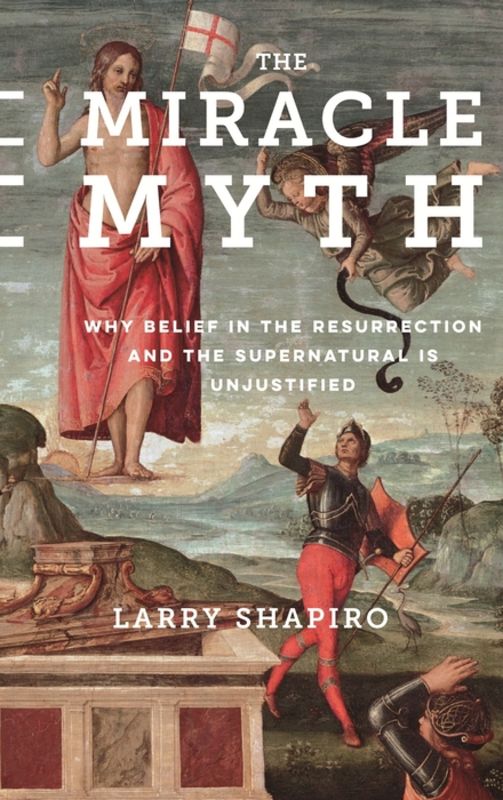
The miracle myth
There are many who believe Moses parted the Red Sea and Jesus came back from the dead. Others are certain that exorcisms occur, ghosts haunt attics, and the blessed can cure the terminally ill. Though miracles are immensely improbable, people have embraced them for millennia, seeing in them proof of a supernatural world that resists scientific explanation.
Helping us to think more critically about our belief in the improbable,The Miracle Mythcasts a skeptical eye on attempts to justify belief in the supernatural, laying bare the fallacies that such attempts commit. Through arguments and accessible analysis, Larry Shapiro sharpens our critical faculties so we become less susceptible to tales of myths and miracles and learn how, ultimately, to evaluate claims regarding vastly improbable events on our own. Shapiro acknowledges that belief in miracles could be harmless, but cautions against allowing such beliefs to guide how we live our lives. His investigation reminds us of the importance of evidence and rational thinking as we explore the unknown.
eBook

Against proportionality
A statement of the form 'C caused E' obeys the requirement of proportionality precisely when C says no more than what is necessary to bring about E. The thesis that causal statements must obey this requirement might be given a semantic or a pragmatic justification. We use the idea that causal claims are contrastive to criticize both.
Journal Article
JUSTIFIED AND UNJUSTIFIED BELIEF
LET’S START WITH A STORY THAT SHOULD PUT SOME COMMON ground under the feet of both believers in miracles and nonbelievers. In the chapters that follow, we’ll return now and then to the story. This way, if you find yourself disagreeing with the direction I take, you can retrace the path from our shared starting point to figure out where we began to diverge. This strategy, I hope, will help to sharpen our differences and might even lead you to clarify in your own mind why you believe in miracles if in fact you do.
So here’s the story. You’re
Book Chapter
JUSTIFYING BELIEF IN SUPERNATURAL CAUSES
IN THIS CHAPTER, I CONSTRUCT MY FIRST BIG ARGUMENT against the idea that we can have justified beliefs in miracles. The problem I focus on concerns the idea that miracles should arise as a result of supernatural and typically divine forces. I come to the conclusion that there is no way to justify beliefs about the supernatural origins of those events that are regarded as miracles, so there is no reason to be confident that what we are witnessing when wethinkwe’re seeing a miracle really is a miracle.
As I mentioned, this chapter contains thefirstbig argument
Book Chapter
EVIDENCE FOR MIRACLES
“ENOUGH ALREADY,” YOU MUTTER UNDER YOUR BREATH AS Jim drones on about that stupid Karnatakan frog and its miraculous doings. He’s relentless.
“And then there was the time that a pet owner showed up with her two-legged poodle,” Jim says. “The frog takes one look at the crippled canine, belches out a throaty croak, says something in Cantonese, and just like that,” Jim snaps his fingers, “the poodle’s back on all fours.”
What started as a pleasant evening of chatter with an agreeable stranger has taken a disastrous turn. You’re tempted to slide off your stool and be on your
Book Chapter
MIRACLES
WE SHOULD NOW BE FAMILIAR WITH THE DIFFERENCE between justified and unjustified beliefs. My aim so far has been the modest one of simply explaining the difference. Everyone—both believers and nonbelievers in miracles—should presumably be prepared to accept that some beliefs are justified and others not. This fact, whether we are conscious of it, is central to all of our lives. We rely on the difference between justified and unjustified belief when we choose to accept a doctor’s advice rather than a shaman’s or when we refuse to eat foods to which we have previously had an allergic
Book Chapter
SHOULD WE CARE THAT BELIEFS IN MIRACLES ARE UNJUSTIFIED?
THIS LAST CHAPTER IS BRIEF BECAUSE I TAKE MYSELF TO have completed my main task in the previous chapters. I have presented two convincing arguments against justified belief in miracles. After summarizing the main points of the preceding chapters, I want to consider another issue: Should you care if you can’t justify your belief in miracles? Should you be bothered if your belief that Moses parted the Red Sea or that Aaron turned his staff into a serpent-eating serpent or that Jesus rose from the dead is no more justified than a belief you form on the basis of an
Book Chapter