
Catalogue Search | MBRL


Are you sure you want to remove the book from the shelf?

{{itemTitle}}
12
result(s) for
"Sharp, Isaac B"
Sort by:

The Barthian Revolt or the New Modernism: Karl Barth and the Limits of American Evangelical Theology
Throughout the twentieth century, U.S. American evangelicals engaged in an ongoing series of definitional debates over the contours and limits of a distinctly evangelical approach to theology. Developed as an explicit counter to theological liberalism—and often signaled by strict adherence to biblical inerrancy—American evangelical theology might conceivably have made common cause with Karl Barth, whose infamous rebellion against his liberal teachers became one of the founding events in the story of twentieth-century Christian theology. Despite Barth’s putative anti-liberalism, evangelical theologians never fully embraced Barthian theology, consistently vilifying it as un-evangelical and beyond the pale. In this essay, I recover the history of U.S. American evangelical theologians wrestling with Karl Barth and his legacy, highlighting how an enduring aversion to Barthianism became a key feature of evangelical theology.
Journal Article
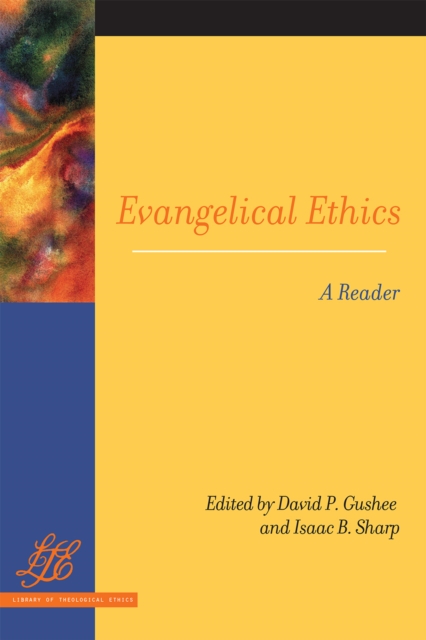
Evangelical Ethics
Introduction WHO ARE THE EVANGELICALS? Evangelicalism is notoriously difficult to define. Everything within the postmodern academy suffers from contestation ad nauseam, but evangelicalism has proven time and again a particularly thorny concept. Even if we choose to focus exclusively on evangelicalism within the United States, and almost entirely restrict the conversation to the post-World War II period, as we will do here, there is much to contest. Due to the multiplicities of meaning associated with the descriptor and the attempts, time and again, to offer a concise definition for a group that defies easy categorization, some scholars have suggested that we jettison the term evangelical altogether.1 Feeling that the broader cultural association of the term with a particularly narrow political agenda--an anti-gay and anti-abortion agenda-- has left the label unredeemable, some within the evangelical community itself are today choosing to self-disassociate with evangelicalism and are using terms like \"post-evangelical\" or even \"ex-evangelical.\"2 In this sense a particular social-political theological ethic within a sector of evangelicalism is undercutting evangelicalism itself. But that gets ahead of our story. If no one can agree on anything else about evangelicalism there is, at least, a consensus among those who know it best that evangelicalism is a slippery term. Some scholars approach the study of evangelicalism through a sociological lens and then disagree about who counts as an evangelical. Others define the movement in terms of religious history and then disagree about when and from whence it came. Still others view evangelicalism in terms of theological beliefs: a lens most often chosen by those \"on the inside\" and frequently deployed in times of hottest disagreement in order to decide who is still in and, more importantly,
who is now out. Evangelicals, in part due to a distinctive historical journey we are about to describe, do an awful lot of arguing about who counts as an evangelical and who does not. In another attempt at enumerating evangelical theological characteristics, evangelical historian George Marsden includes the five following \"essential evangelical beliefs\": 1. Harkening ever back to the Protestant Reformation, evangelicals maintain the \"final authority of the Bible\"; 2. the belief that Scripture records the real historical narrative of \"God''s saving work\"; 3. redemption through the salvific work of Jesus Christ and yielding eternal life; 4. \"the importance of evangelism and missions\"; 5. the necessity \"of a spiritually transformed life.\"4 Union Seminary professor Gary Dorrien, contra Donald Dayton''s suggestion that the term evangelical has lost its usefulness, instead agrees with Marsden and further quips about his \"favorite definition of an evangelical, which is ''anyone who likes Billy Graham.''\"5 This quip is revelatory of a sociological reality about evangelicalism; it has often produced hugely visible and charismatic figures ranging from Aimee Semple Macpherson to Billy Sunday to Billy Graham to Jerry Falwell to Rick Warren to John Piper to Jim Wallis to Rob Bell to . . . whoever comes next. An \"evangelical\" in this sense would be someone who knows who these evangelical icons are and who takes as authoritative one, some, or all of them. Noting the importance of the denominational and confessional diversity of evangelicalism, evangelical church historian Timothy Weber sees evangelicalism as \"a large extended family\" with four main branches including: 1. classical: loyalists to the Reformation, with a tendency toward creedalism and away from the value of religious experience 2. pietistic: also within the Reformation stream but including
an emphasis on religious experience and including both pietism and Puritanism; 3. fundamentalist: defined as opposing \"liberal, critical, and evolutionary teaching\" but also including \"their ''neo-evangelical'' offspring\"; 4. progressive: including those who attempt to reconcile modernity with a variety of evangelical beliefs.6 This sophisticated and helpful definition points already at sociological diversities within evangelicalism. Or we could just go back to the etymological origins of the word evangelical, which at least are clear. The English word evangelical and associated words like evangelism come from the Greek word εύαγγέλιον (euangelion). Every definition of these terms must, therefore, reckon with their original meaning: \"good news.\"7 (Evangelicals themselves will sometimes argue about which versions of our faith still represent \"good news\" to a suffering and unjust world and thus still merit the term \"evangelical.\") And as traced by Mark Noll--who is evangelicalism''s foremost historian--the use of the term evangelical as an adjective dates back at least to the Middle Ages, when writers used it to describe the prophet Isaiah or the followers of St. Francis.8 More history helps us gain some clarity. The term evangelical began taking on its modern shape during the sixteenth century with the advent of the Protestant Reformation, at which point it began to be used as a synonym for Protestant--as is still the case in Germany today, where Evangelische means Protestant and especially Lutheran.9 The movement that would become what we are describing when we say evangelicalism, however, offers a particular fl of Christian faith that neither includes all Protestants nor is limited solely to Reformation-descended Protestantism. As we will see, though, the reformist impulse, implanted at its birth, continues to impact evangelicalism even
now. This impulse has at times focused on doctrine and therefore on renewing theological seriousness or offering resistance to theological (or ethical) liberalism. Some of evangelicalism''s greatest contributions to Christianity, however, have been about the renewal of passion in moribund Christianity and the drive to move people back toward devout \"biblical\" Christianity. The first \"modern\" evangelicals were born when some newly minted Protestants were insultingly called \"evangelicals\" and chose to accept the label. The ensuing religious foment of sixteenththrough eighteenth-century Europe and the fledgling American colonies then gave rise to several more movements varyingly described as evangelical including Puritanism, Pietism, and the revival movements of the first American \"Great Awakening.\" Formed for a variety of activist and evangelistic goals, evangelical \"associations\" then began taking root in the fertile, more disestablished religious soil of nineteenth-century North America.10 Evangelicalism as a movement was always multi-denominational and multi-confessional, including Calvinists (but also Arminians), Wesleyans, Anabaptists, Baptists, Methodists, Presbyterians, Holiness, and eventually charismatics, Pentecostals, and others. There are even evangelical Episcopalians, now often called Anglicans in the U.S. setting, and some speak of evangelical Catholics. The historic black churches are almost all evangelical by any theological definition, though they have often not been institutionally close to predominantly white evangelical bodies due to the tortured history of race in America. Evangelicalism has never been confined to official denominational structures--sometimes evangelicals are a minority within a broader denomination while at other times they dominate a particular denomination--thus there are self-identified evangelicals in
the mainline Presbyterian and Methodist denominations while the Southern Baptist Convention as a whole is normally viewed as evangelical. Meanwhile, evangelicals have tended to produce a lush crop of parachurch organizations for various mission and activist purposes. So evangelicals include groups ranging from the Salvation Army to the Vineyard churches to the World Relief and World Vision social ministries. In some ways the leaders of these groups act as each era''s current evangelical gatekeepers, an unofficial house of bishops for a decentralized evangelicalism attempting to retain its vitality and identity. These evangelical institutions--some old and some new, including churches, colleges, publishing houses, and parachurch groups--continue to help define and shape the evangelical subculture. If you know Wheaton, Gordon, and Azusa Pacific universities; if you have heard of Books & Culture, Relevant, and Charisma magazines; if you read books published by Thomas Nelson, Baker, and Zondervan publishing houses; if you participated in Campus Crusade, RUF, or Intervarsity Christian Fellowship while in college; if you sang worship songs from Hillsong or have attended the Passion conference held in Atlanta each year--you probably are, or were, an evangelical. Each nation with a strong evangelical presence could tell its own version of the same story; meanwhile, there are institutions of global evangelicalism, such as the World Evangelical Fellowship and the Lausanne Movement. AMERICAN EVANGELICALISM AND ITS SOCIAL ETHICS But now let us focus more tightly on the trajectory of American evangelicalism and its social ethics. The waves of religious and cultural change cresting around the turn of the twentieth century left an indelible imprint on all aspects of American Christianity, including what became American evangelicalism. American Christian
approaches.
eBook

The Other Evangelicals: The Marginalization of Liberal-Modernist, Barthian, Black, Feminist, Progressive, Arminian- Wesleyan-Pietist, and Gay Evangelicals and the Shaping of 20th Century U.S. American Evangelicalism
By focusing almost exclusively on the most prominent evangelical institutions and best-known evangelical groups, conventional narratives of American evangelical history consistently tell the story of 20th century evangelicalism from one main viewpoint: the perspective of its most powerful figureheads and famous mainstream leaders. In this dissertation I offer an alternative reading of 20th century evangelical history. By recovering the stories of some of evangelicalism’s least well-known groups, long neglected movements, and widely overlooked figures, in this dissertation I tell the story from an entirely different perspective: the point of view of the various kinds of 20th century evangelicals who struggled to make their way in the evangelical world only to be driven to its margins and thereby forgotten by the historical record. In so doing, I suggest that the story of the other evangelicals—those who, for one reason or another, were often viewed as insufficiently evangelical, or who spent their lives and careers as lonely voices of dissent among an evangelical culture that often treated them as pariahs—sheds new light on how it is that contemporary evangelical identity took on its most distinguishing characteristics.
Dissertation


Hierarchical inference as a source of human biases
The finding that human decision-making is systematically biased continues to have an immense impact on both research and policymaking. Prevailing views ascribe biases to limited computational resources, which require humans to resort to less costly resource-rational heuristics. Here, we propose that many biases in fact arise due to a computationally costly way of coping with uncertainty—namely, hierarchical inference—which by nature incorporates information that can seem irrelevant. We show how, in uncertain situations, Bayesian inference may avail of the environment’s hierarchical structure to reduce uncertainty at the cost of introducing bias. We illustrate how this account can explain a range of familiar biases, focusing in detail on the halo effect and on the neglect of base rates. In each case, we show how a hierarchical-inference account takes the characterization of a bias beyond phenomenological description by revealing the computations and assumptions it might reflect. Furthermore, we highlight new predictions entailed by our account concerning factors that could mitigate or exacerbate bias, some of which have already garnered empirical support. We conclude that a hierarchical inference account may inform scientists and policy makers with a richer understanding of the adaptive and maladaptive aspects of human decision-making.
Journal Article

Genetic mapping of 66 new microsatellite (SSR) loci in bread wheat
In hexaploid bread wheat ( Triticum aestivum L. em. Thell), ten members of the IWMMN ( International Wheat Microsatellites Mapping Network) collaborated in extending the microsatellite (SSR = simple sequence repeat) genetic map. Among a much larger number of microsatellite primer pairs developed as a part of the WMC ( Wheat Microsatellite Consortium), 58 out of 176 primer pairs tested were found to be polymorphic between the parents of the ITMI ( International Triticeae Mapping Initiative) mapping population W7984 x Opata 85 (ITMI pop). This population was used earlier for the construction of RFLP ( Restriction Fragment Length Polymorphism) maps in bread wheat (ITMI map). Using the ITMI pop and a framework map (having 266 anchor markers) prepared for this purpose, a total of 66 microsatellite loci were mapped, which were distributed on 20 of the 21 chromosomes (no marker on chromosome 6D). These 66 mapped microsatellite (SSR) loci add to the existing 384 microsatellite loci earlier mapped in bread wheat.
Journal Article

Does Local Government Matter?
Employing policy feedback theory to a series of local government programs, Elaine B. Sharp shows that these programs do have consequences with respect to citizens’ political participation. With this clear-eyed analysis, Sharp finds that local governments’ social program activities actually dampen participation of the have-nots, while cities’ development programs reinforce the political involvement of already-privileged business interests. _x000B_
eBook