
Catalogue Search | MBRL


Are you sure you want to remove the book from the shelf?

{{itemTitle}}
504
result(s) for
"Shaw, Jo"
Sort by:

Knitting stitches step-by-step
Whatever your knitting ability, this guide will help you master a huge range of techniques and patterns, including colourwork, textural patterns, and openwork and lace knitting. Find inspiration for your next knitting project, or adapt a design you know and love with tips on incorporating different stitches into your work. Every stitch is accompanied by full instructions, with the trickiest stitches illustrated with clear photographs and annotations so that you can follow the methods with ease, while the Tools chapter will help you get to grips with the right needles, yarn, and other tools you'll need to recreate each technique.
Book

The Art of Being Dangerous
Sign up to be notified when the book becomes available
>
\"A major inspiration for the project was the tendency by
some in the media to describe particular women as 'the most
dangerous woman in' Scotland, or the UK, or the world.\", Jo Shaw,
editor 'The Art of Being Dangerous'
Browse a preview of the book >
Unique and kaleidoscopic collection of feminist visual and
literary art
The idea that women are dangerous - individually or collectively
- runs throughout history and across cultures. Behind this label
lies a significant set of questions about the dynamics, conflicts,
identities and power relations with which women live today.
The Art of Being Dangerous offers many different images
of women, some humorous, some challenging, some well-known, some
forgotten, but all unique. In a dazzling variety of creative forms,
artists and writers of diverse identities explore what it means to
be a dangerous woman.
With almost 100 evocative images, this collection showcases an
array of contemporary art that highlights the staggering breadth of
talent among today's female artists. It offers an unparalleled
gallery of feminist creativity, ranging from emerging visual
artists from the UK to multi-award-winning writers and translators
from the Global South.
Contributors: Margie Orford, Meredith Bergmann, K.E. Carver,
Sasha de Buyl-Pisco, Mary Paulson-Ellis, Melissa Álvaro Mutolo,
Kerri Turner, Heshani Sothiraj Eddleston, Joanie Conwell, Dilys
Rose, Alison Jones, Sim Bajwa, Hilaire, Tara Pixley, Leonie Mhari,
Kate Feld, Millie Earle-Wright, Helen Boden, Elif Sezen, Rebecca
Vedavathy, Irene Hossack, SE Craythorne, Roisin Kelly, Nkateko
Masinga, Elaine Gallagher, Ildiko Nova, Rachel Roberts, susan c.
dessel, Savanna Scott Leslie, Heather Pearson, Eva Moreda
Rodriguez, Tanya Krzywinska, Siris Gallinat, Clare Archibald, Maya
Mackrandilal, Zuhal Feraidon, Anna Brazier, Shirley Day, Treasa
Nealon, Satdeep Grewal, Lucy Walters, Priyanthini Guns, Kate
Schneider, Alana Tyson, Jayde Kirchert, Boris Eldagsen, Brenda
Rosete, Victoria Duckett, Patricia Allmer, JL Williams, Carly
Brown, Sotiria Grek, Sepideh Jodeyri, Brooke Bolander, Maria
Stoian, Maria Fusco, Claire Askew and Marianne Boruch.
This book emerges from the Dangerous Women Project. For
more information, visit
dangerouswomenproject.org
eBook


‘Shunning’ and ‘seeking’ membership: Rethinking citizenship regimes in the European constitutional space
This article explores parallels between the ‘shunning’ and ‘seeking’ of membership of the EU in the context of Brexit and stalled enlargement in south-east Europe, via a focus on the partial, fragmentary and contested governance of citizenship. The case studies place Union citizenship into a wider political and socio-economic context, demonstrating its central importance as an enabler of personal freedom. At the same time, they highlight how the denial or removal of Union citizenship can engender individual strategies to recover lost or denied benefits. From the analysis, parallels emerge between Union citizenship and national citizenship; both offer a promise of equality, but a reality of differentiation and inequality. At the same time, by delving deep into the case studies, it proves possible to illuminate the complex and often ‘messy’ constitutional edifice of the European Union, involving sometimes contradictory processes of Europeanisation and de-Europeanisation affecting citizenship regimes at all levels.
Journal Article
Contested compliance of obligations under international law: A take from Global Constitutionalism
Taking Global Constitutionalism as an agora, a platform for international interdisciplinary discussions this article asks a question about the state we are in with regard to the international order as an order that is not just a ‘rule-based order’ but also more substantially, a ‘legal order’ based on the rule of law. The topic is illustrated with reference to examples of ‘contested compliance’ i.e. objections to implementing international law and/or international rulings by international actors on behalf of signatories of states parties of a treaty. Three questions guide this discussion. The first is a question of normative change: are we facing a change regarding United Nations member states’ respect for and handling of the rule of law, or is a larger change of international law itself imminent? The second is a question about the effects of the shift from ‘normal’ contestations of norms to ‘deep’ contestations of the international order itself. And the third is a question about pluralism and diversity: are the UN Charter Order’s institutions, conventions and organisations sufficiently equipped to respond to an ever more diverse range of internationally, transnationally, and sub-nationally raised justice-claims? The article elaborates on each of the three themes in light of the current situation of contested compliance with obligations under international law.
Journal Article
Climate change and the challenge to liberalism
In this editorial, we consider the ways in which liberal constitutionalism is challenged by and presents challenges to the climate crisis facing the world. Over recent decades, efforts to mitigate the climate crisis have generated a new set of norms for states and non-state actors, including regulatory norms (emission standards, carbon regulations), organising principles (common but differentiated responsibility) and fundamental norms (climate justice, intergenerational rights, human rights). However, like all norms, these remain contested. Particularly in light of their global reach, their specific behavioural implications and interpretations and the related obligations to act remain debatable and the overwhelming institutionalization of the neoliberal market economy makes clear and effective responses to climate change virtually impossible within liberal societies.
Journal Article
Private law, private international law and public interest litigation
Private actors and institutions, and by extension private law itself, are increasingly being forced to reckon with a multiplicity of challenges that extend beyond the domain of private law as it is traditionally conceived. They reflect threats to the global constitutional order and liberal constitutionalism, and threats to individual and collective fundamental rights and constitutional values. As a result, the role of private law in framing and facilitating the development of the global economy and globalization often does not fall within the direct purview of public international lawyers. This editorial aims to examine the role of private law in the litigation and enforcement of public interests against the background of the public/private divide. This is done in light of the increasing role adopted by private actors, including corporations, beyond the private realm.
Journal Article
The pendulum swings back: New authoritarian threats to liberal democratic constitutionalism
For the past decade, the most salient form of this has been internal crisis.3 As we observed following Trump, Brexit, and a general resurgence of far-right parties across the diverse polities, ‘far right populist authoritarianism’ poses an immediate threat to LDC.4 Yet, a year after Trump’s defeat and with the EU having survived Brexit in part because states central to its integrity, such as France, have – so far – resisted far right populist leadership, the norms of constitutionalism have shown a measure of robustness.5 The possibility that LDC might ultimately be extinguished by far-right populism remains, but so far it has survived a number of traumatic political events internal to its established champions. The authoritarian weaponization of the values of global constitutionalism Weaponization of the values of LDC against constitutional democracies has taken three significant forms: exploiting crises of migration, which raise tensions for the commitment to human rights; claims that ethnic collective self-determination grants autocratic regimes the right to annex or co-opt all or part of democratic regimes; and manipulating constitutionalism’s commitment to speech and discourse rights to surreptitiously meddle (through new technology) in popular self-determination. Given the commitment of LDC to recognizing the intrinsic value of persons and the subsequent universality of rights, managing refugee migration – crudely stated, excluding migrants from entry into polities – raises a fundamental tension: philosophically, national origin is arbitrary, and differentiating persons on its basis contravenes liberalism’s Kantian inclinations.10 The presence of migration has been exploited domestically by far-right ethnonationalists within constitutionalist regimes. Western officials have suggested that the authoritarian president of Belarus, Aleksandr Lukashenko, has deliberately admitted refugees from war-torn and economically deprived areas into Belarus and then funnelled them to the Polish border11 as a reprisal for Western condemnation of his allegedly fraudulent electoral victory in the 2020 and subsequent Western sanctions.12 The particular scenario is reminiscent of President Tayyip Erdogan’s deployment of migration policy as a bargaining chip with the European Union when Western governments reacted to his expansion of his executive powers in Turkey.13 However, the Belarus–Poland crisis presents additional layers: according to Western powers, Lukashenko is acting as a proxy for Russia in his efforts to undermine the European Union, a constitutional arrangement forged in cosmopolitan ethnopluralism rather than autocratic ethnonationalism; and the engagement with Poland in particular targets a state that faces concerns of far-right democratic backsliding based in ethnonationalism – precisely the type of drift rightward driven by anti-immigrant xenophobia.
Journal Article

Citizenship and COVID-19: Syndemic Effects
This article begins the task of outlining the impacts of the COVID-19 pandemic in relation to matters of citizenship, using what is termed a “syndemic analysis.” This type of analysis places both the pandemic and citizenship in their wider contexts. The synergistic or intersectional thinking encouraged by the characterization of the pandemic as a syndemic, which links together health, socio-economic issues, and political questions, is useful for highlighting how much more vulnerable to many of the negative impacts of the pandemic in the sphere of citizenship are those who are also more vulnerable both to catching and suffering more seriously from the virus and to experiencing negatively the externalities of the measures taken to restrict social contact by shutting down economies. While the scope of the review is relatively broad and encompasses many different domains of “pandemic life,” what emerges from the analysis are important insights into how many of the impacts of the pandemic in fact operate at the intersection of citizenship and constitutional law and thus play out in the form of changes in relation to constitutional citizenship, both as ideal and as practice. The article takes an important step towards developing the use of constitutional citizenship as a framing device for understanding citizenship as putative full membership in a given society.
Journal Article
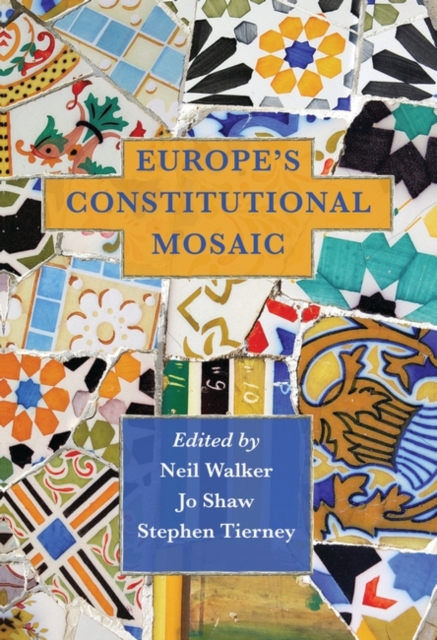
Europe’s Constitutional Mosaic
This book emerged from an extended seminar series held in Edinburgh Law School which sought to explore the complex constitutional arrangements of the European legal space as an inter-connected mosaic. There has been much recent debate concerning the constitutional future of Europe, focusing almost exclusively upon the EU in the context of the (failed) Constitutional Treaty of 2003-5 and the subsequent Treatyof Lisbon. The premise of the book is that this focus, while indispensable, offers only a partial vision of the complex constitutional terrain of contemporary Europe. In addition, it is essential to explore other threads of normative authority within and across states, embracing internal challenges to state-level constitutional regimes; the growing jurisprudential assertiveness of the Council of Europe regime through the ECHR and various democracy-building measures; as well as Europe’s ever thicker relations, both with its border regions and with broader international institutions, especially those of the United Nations. Together these developments create increasingly dense networks of constitutional authority within the European space. This fluid and multi-dimensional dynamic is difficult to classify, and indeed may seem in many ways impenetrable, but that makes the explanatory challenge all the more important and pressing. Without this fuller picture it becomes impossible to understand the legal context of Europe today or the prospects of ongoing changes. The book brings together a range of experts in law, legal theory and political science from across Europe in order to address these complex issues and to supply illustrative case-studies in the topical areas of the constitutionalisation of European labour law and European criminal law.
eBook