
Catalogue Search | MBRL


Are you sure you want to remove the book from the shelf?

{{itemTitle}}
83
result(s) for
"Sherington, Geoffrey"
Sort by:

British academics, liberalism, and the First World War
Purpose
The purpose of this paper is to examine the impact of the War on two prominent academic liberal historians.
Design/methodology/approach
The research is based on a narrative of their lives and careers before and during the War.
Findings
The findings include an analysis of how the War engaged these academic liberals in the pursuit of the War effort.
Originality/value
By the end of the War, both sought to reaffirm much of their earlier academic liberalism despite the political and social changes in the post-war world.
Journal Article

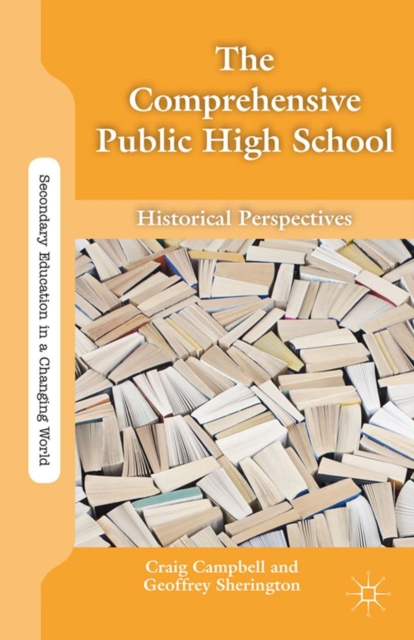
The comprehensive public high school : historical perspectives
This book traces the decline of the public comprehensive high school. New educational markets emphasized school diversity and parental choice rather than social equity through common schooling, and they were criticized for declining standards. The book also considers government education policies and their regional manifestations.
eBook
Empire, state and public purpose in the founding of universities and colleges in the antipodes
From the mid-nineteenth to the early twentieth century universities and colleges were founded throughout Australia and New Zealand in the context of the expanding British Empire. This article provides an analytical framework to understand the engagement between changing ideas of higher education at the centre of Empire and within the settler societies in the Antipodes. Imperial influences remained significant, but so was locality in association with the role of the emerging state, while the idea of the public purpose of higher education helped to widen social access forming and sustaining the basis of middle class professions.
Journal Article

The Comprehensive Public High School
This book traces the decline of the public comprehensive high school. New educational markets emphasized school diversity and parental choice rather than social equity through common schooling, and they were criticized for declining standards. The book also considers government education policies and their regional manifestations.
eBook
Pam Hirsch and Mark McBeth, Teacher training at Cambridge. The initiatives of Oscar Browning and Elizabeth Hughes, London, Woburn Press, 2004. XXXI + 254 pp. Rezension
Rezension von: Hirsch, Pam: Teacher training at Cambridge; McBeth, Mark: Teacher training at Cambridge.
Journal Article


Public Commitment and Private Choice in Australian Secondary Education
The history of education in Australia presents an apparent contradiction. During the nineteenth century, and for much of the twentieth century, the role of the state was crucial in creating a highly centralised 'public' education system, albeit one founded on clear social divisions of not only class and gender but also race and ethnicity.
1
Writing in the early 1980s, Bob Connell and his coauthors suggested that in Australia 'the ruling class and its schools are articulated mainly through a market, while the working class and its schools are articulated mainly through a bureaucracy (or to put it very strictly through the state via a bureaucracy)'.
2
In more recent decades, with the moves towards 'markets' and 'school choice' throughout much of the English-speaking world, it has been argued that Australia has developed one of the strongest commitments to 'private schools', while even the former public sector in Australia is seen as being increasingly privatised. The provision of education as a 'public good' for the foundation of a liberal-democratic society, it is suggested, has been replaced by education as 'a positional good' serving private advantage.
3
Book Chapter