
Catalogue Search | MBRL


Are you sure you want to remove the book from the shelf?

{{itemTitle}}
10
result(s) for
"Shewfelt, Robert L"
Sort by:

Becoming a food scientist : to graduate school and beyond
\"Becoming a Food Scientist is designed as a reservoir of ideas for those beginning a graduate education in food science or beginning a professional career in the field. Although at times it may read as a how-to manual for success in graduate school, it is meant to encourage each reader to study the research process, to challenge conventional wisdom, and to develop a career path that maximizes the probability of success both in school and beyond. The author has viewed food science graduate programs through the lenses of programs at four universities and service in numerous activities with the Institute of Food Technologists. This book is thus focused on the field of food science, but it may have relevance to other scientific disciplines. The book introduces the concept of research as process in the first chapter. Subsequent chapters focus on individual unit operations of research: idea generation, problem definition, critical evaluation of the literature, method selection, experimental design, data collection, processing and analysis, and knowledge dissemination. Successful graduate students in food science must master each of these operations. The final section of the book pushes the reader beyond graduate school into its practice in the real world. Topics covered in the maturation of a food scientist include the scientific meeting, critical thinking, science and philosophy, ethics, finding and managing the literature, planning, grantsmanship, laboratory setup and management, and career development. This book should be a meaningful companion for any graduate student in the field and those transitioning from graduate school to the food science profession.\"--Page [4] of cover.
BOOK

Postharvest handling: a systems approach
Postharvest Handling: A Systems Approach introduces a new concept in the handling of fresh fruits and vegetable.Traditional treatments have been either physiologically based with an emphasis on biological tissue or technologically based with an emphasis on storage and handling.
eBook
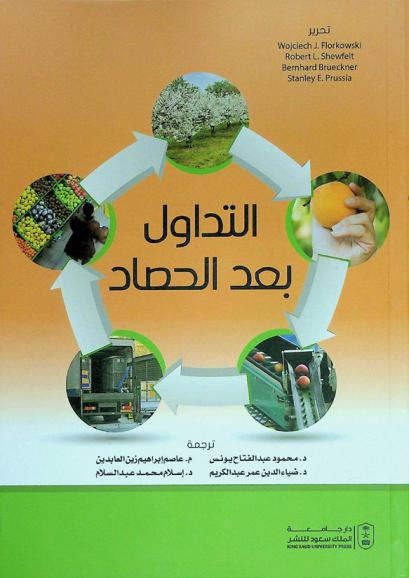
التداول بعد الحصاد
يتناول الكتاب أهمية معاملات ما بعد الحصاد في تحسين جودة المنتجات البستانية وضمان سلامتها. يركز على تقنيات ما قبل التخزين للحد من التلف وتقليل الفاقد، ويستعرض الطرق الحديثة للكشف عن الكائنات الدقيقة المسببة للفساد والأمراض. يهدف إلى دعم الأمن الغذائي ورفع كفاءة التداول، مما يسهم في توفير غذاء آمن للمستهلك وتعزيز القدرة التصديرية للأسواق العالمية. يقدم مرجعا متكاملا للمهتمين بأنظمة ما بعد الحصاد والابتكار في سلاسل الإمداد الزراعي.
BOOK

Physical and Sensory Attributes of a trans-Free Spread Formulated with a Blend Containing a Structured Lipid, Palm Mid-Fraction, and Cottonseed Oil
Physical and sensory attributes of an experimental
trans
-free margarine spread (MG-X) and two commercial margarine spreads (MG-A and MG-B) were studied. The
trans
-free margarine spread was formulated with a blend containing a structured lipid (SL) synthesized by reacting canola oil with 40% stearic acid (w/w), palm mid-fraction (PMF), and cottonseed oil (CTO). No
trans
fatty acids were detected in MG-X, whereas the
trans
fatty acid contents of MG-A and MG-B were 0.3 and 3.7% (w/w), respectively. MG-X was considerably firmer than MG-A and MG-B, less cohesive, and its adhesiveness was intermediate between those of MG-A and MG-B. MG-X’s stability to syneresis was also intermediate between those of MG-A and MG-B. Sensory evaluation showed that MG-X was comparable to MG-A in terms of spreadability and texture only, but was significantly different from MG-B in all attributes.
Journal Article

