
Catalogue Search | MBRL


Are you sure you want to remove the book from the shelf?

{{itemTitle}}
55
result(s) for
"Shiel, Mark"
Sort by:

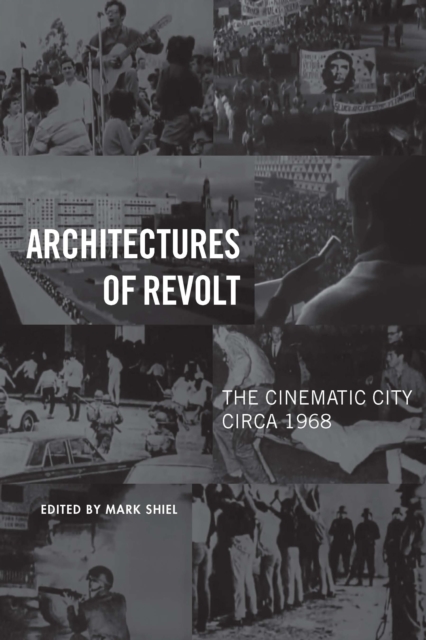
Architectures of Revolt
Coinciding with the fiftieth anniversary of the worldwide mass protest movements of 1968—against war, imperialism, racism, poverty, misogyny, and homophobia—the exciting anthology Architectures of Revolt explores the degree to which the real events of political revolt in the urban landscape in 1968 drove change in the attitudes and practices of filmmakers and architects alike.
In and around 1968, as activists and filmmakers took to the streets, commandeering public space, buildings, and media attention, they sought to re-make the urban landscape as an expression of utopian longing or as a dystopian critique of the established order. In Architectures of Revolt, the editor and contributors chronicle city-specific case studies from Paris, Berlin, Milan, and Chicago to New York, Los Angeles, Mexico City, and Tokyo. The films discussed range from avant-garde and agitprop shorts to mainstream narrative feature films. All of them share a focus on the city and, often, particular streets and buildings as places of political contestation and sometimes violence, which the medium of cinema was uniquely equipped to capture.
Contributors include: Stephen Barber, Stanley Corkin, Jesse Lerner, Jon Lewis, Gaetana Marrone, Jennifer Stob, Andrew Webber, and the editor.
eBook

Architectures of revolt : the cinematic city circa 1968
\"Architectures of Revolt explores the intertwined stories of cinema and the city in 1968, a year which witnessed political revolutions and a revolutionary cinematic engagement, both of which relied upon interacting with and using the city in new ways. Includes case studies from cities around the world\"-- Provided by publisher.
Book

Hollywood cinema and the real Los Angeles
i For many people the epithet 'City of Angels' evokes sunshine and golden beaches, glamorous movie stars and the promise of fame - the reality is of course very different. And, paradoxically, the city's reality is as much the record of Los Angeles on film as it is the Los Angeles of highways and suburban neighbourhoods, of people and shops, police and parking lots. This is because Los Angeles is first and foremost a city of cinema - it is where so many major movies are made, and where its locations and studio re-creations are recorded and re-presented on film.This book explores Los Angeles from the invention of motion pictures in the 1890s to the decline of the studio system in the 1950s, describing the ever-changing cinematic image of the city, and the ways in which its representations reflected and manipulated its physical geography. It shows how the construction of big studios helped to change the shape of Los Angeles, and how Hollywood not only contributed to, but also complicated, the city's economic, political, social and cultural life. The incredibly popular films that were produced during this time, from the early slapstick comedies to film noir, and the histories of Los Angeles and its film industry cannot be understood in isolation from each other. Shiel provides a close analysis of narrative, mise en scene, cinematography, editing and other elements of film-making and style, concentrating on the ways in which directors and others engaged with the architecture of the city both within the studios and on location in California.Written by an expert in the history and theory of cinema and the city, this book is a must-read for anyone interested in Hollywood movies, or the history and architecture of Los Angeles. As well as being illustrated with many previously unpublished photographs, the book offers an in-depth view of a city that has never really been seen before.
eBook

A Regional Geography of Film Noir
In the heyday of film noir, from the mid-1940s to the mid-1950s, the utopian aspirations that had driven the foundation and meteoric rise of the Hollywood studio system since World War I suddenly seemed fragile and liable to collapse. For the American Right, which had never much liked Hollywood on moral and political grounds, it came to appear as a Communist command post on American soil; for workers, it was a desperately insecure and often hostile place in which to try to make a living; and for the Hollywood moguls it was a dream they once had that was now
Book Chapter
Hollywood, the New Left, and FTA
The effects of the anti-Communist witch hunts of the late 1940s and 1950s were profound. As Larry Ceplair and Steven Englund have explained, politically engaged directors, writers, and actors on the left of the political spectrum found that “opportunities for political activism virtually ceased to exist in the ‘new era.’”¹ Leftist organizations in Hollywood such as the Independent Citizens Committee of the Arts, Sciences, and Professions and the local chapters of the U.S. Communist Party disintegrated. Many leftists were jailed or forced into exile or into lives of quiet compliance guaranteed by the continuing watchful eyes of the FBI. After
Book Chapter

Art Direction and Production Design
How is the look of a film achieved? In Art Direction and Production Design, six outstanding scholars survey the careers of notable art directors, the influence of specific design styles, the key roles played by particular studios and films in shaping the field, the effect of technological changes on production design, and the shifts in industrial modes of organization.
eBook

Banal and Magnificent Space in \Electra Glide in Blue\ (1973), or an Allegory of the Nixon Era
Emphasizing the political meanings of cinematic space, this essay examines the representation of the American West in the unjustly neglected road movie Electra Glide in Blue (1973)for its telling allegory of the social divisions of the Nixon era and the temporary infiltration of Hollywood cinema by the 1960s counterculture.
Journal Article