
Catalogue Search | MBRL


Are you sure you want to remove the book from the shelf?

{{itemTitle}}
75
result(s) for
"Shildrick, Margrit"
Sort by:


Dangerous discourses of disability, subjectivity and sexuality
This innovative and adventurous work, now in paperback, uses broadly feminist and postmodernist modes of analysis to explore what motivates damaging attitudes and practices towards disability. The book argues for the significance of the psycho-social imaginary and suggests a way forward in disability's queering of normative paradigms.
eBook

Disability, digital technologies and the ambivalent allure of posthumanist/transhumanist futures
Technologies, both simple and sophisticated, have always played a major role in the negotiation of a range of disabilities that are assumed to impede the expression of autonomous selfhood. Whether deployed as mechanical aides to ideally normalise physical differences, as organic—and often internal—supplements to bolster the performance of body and mind, or as digital enhancements that override the supposed shortcomings of neurodiversity, the widely accepted claim is that such technologies have a clear therapeutic value. It conjures the illusion of an unproblematised sequence of more complex technologies leading to increasingly enhanced function and the advent of superior selfhood. Those who identify as having disabilities, either physical or cognitive, are assured of a better future in which anomalies are sufficiently offset to the extent that they no longer attract disvalue.My paper offers a less conventional perspective that leaves behind the desire for individual autonomy and opens up the question of the transhuman and the posthuman. Rather than focusing on the bounded self at the centre of humanist thought, I ask what is at stake when human embodiment becomes intricately entangled with non-human materialities and digital coding. It is likely that the major developments in such ‘prosthetic’ technologies will strongly impact the field of disability. Beyond a merely functional usage, which is likely to dominate in the short term, urgent questions arise about the extent to which the category of the human can or should be sustained as the anchor of continuing life. In exploring the practical, philosophical and bioethical implications of newly emerging technologies, I distinguish between the motivation of transhumanism, which focuses on self-perfectibility and mastery, and a posthumanism that in seeking to radically decentre the very notion of human privilege and hierarchical distinctions offers an optimistic view of disability futures.
Journal Article
Hauntological dimensions of heart transplantation: the onto-epistemologies of deceased donation
The practice of human organ transplantation studies is shot through with questions concerning the concepts of selfhood and identity that continually reach out towards transmigration, displacement and haunting. In particular, heart transplantation is the site at which the parameters of human life and death are tested to their limits, not simply for the recipient but for the donor too. In conventional biomedicine, the definition and therefore the moment of death is a matter of ongoing and disturbing dispute between two major channels of thought. Should we understand life to end at the point of cessation of cardiac function, or alternatively that of the brainstem? That whole logic is predicated, however, on the familiar binary of life/death that fails to address urgent concerns in three arenas: social-cultural imaginaries, postmodernist philosophy and increasingly exploratory bioscience. If there is always something about death that is uncanny, that exceeds rationalist thought, then we need to queer the concept and ask whether there are more sensitive ways of thinking the process of dying. The very concept of extended life for the recipient is no simple outcome, and the question of whose life has been prolonged is far from clear. My contribution touches on the idea of thinking transplantation in the mode of parasitism but will suggest an alternative Deleuzian way forward.
Journal Article

living on; not getting better
The contemporary emergence of the concept 'debility', which pertains to a broad swathe of humanity whose ordinary lives simply persist without ever getting better, shares a time span with an acute critique of neo-liberal biopolitics. Where capital has historically relied on a population that through its labour necessarily becomes debilitated, the newer model of understanding references the intrinsic profitability of debility itself. The two dimensions overlap and co-exist, but what I shall pursue here are the implications of recognising that, at the most fundamental level, it is in the interests of neo-liberalism to produce and sustain bodies as debilitated and therefore susceptible to a range of market commodities that hold out the promise of therapeutic interventions into the relative failures of physical, cognitive and affective embodiment. In previous work, I have argued strongly for the inherent vulnerability of all bodies, but in considering here a more overtly politicised context, it becomes possible to readdress the questions posed by Jasbir Puar: 'which bodies are made to pay for \"progress\"? Which debilitated bodies can be reinvigorated for neoliberalism, and which cannot?' And at the present moment, writing at a time of imposed austerity, I would add, what, if anything, is lost in the deployment of the term debility instead of disability?
Journal Article

The Temporalities and Spatialities of Death, Dying, and Heart Donation
Contemporary biomedical technologies surrounding deceased organ transplantation raise urgent issues regarding the temporalities of the living and the dead, the disturbance of distinctions between self and other, and the question of absence and presence. There is no simple and stable futurity, but rather a host of ontological, epistemological, and ethical issues that trouble both organ recipients and donor proxies. My claim is that heart transplantation in particular marks a fluid assemblage and intertwining of self and other at both the biological and ontological level, where personal identities and the conventional limits of life and death are deeply problematized. Nonetheless, those disturbing and inescapable challenges to conventional binaries are rarely explored within the authorized narrative of the clinic.
Journal Article

\Why Should Our Bodies End at the Skin?\: Embodiment, Boundaries, and Somatechnics
Donna Haraway's enduring question—\"Why should our bodies end at the skin?\" (Haraway 1990, 220)—is ever more relevant in the postmodern era, where issues of bodies, boundaries, and technologies increasingly challenge not only the normative performance of the human subject, but also the very understanding of what counts as human. Critical Disability Studies has taken up the problematic of technology, particularly in relation to the deployment of prostheses by people with disabilities. Yet rehabilitation to normative practice or appearance is no longer the point; instead, the lived experience of disability generates its own specific possibilities that both limit and extend the performativity of the embodied self. I look at what is at stake in the challenge to the Western logos that comes specifically from the capacities of the disabled body, understood not as a less than perfect form of the normative, but as figuring difference in a nonbinary sense. Feminist theory has long contested the isomorphism of the logos, but I go beyond simply setting out the grounds for revaluing multiple variant forms. The feminist turn to Jacques Derrida and Gilles Deleuze opens up the problematic to a celebratory positioning of difference and transcorporeality as the very conditions of life.
Journal Article
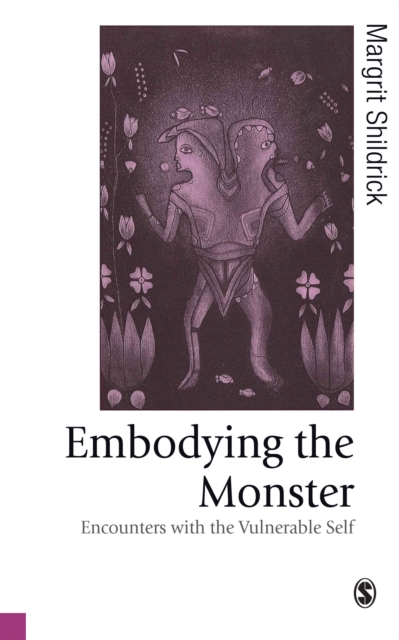
Embodying the monster : encounters with the vulnerable self
Embodying the Monster explores ideas of bodily: { monstrosity { vulnerablity { normality { perfection The book examines the ideologies surrounding these perceptions and considers what this tells us about ourselves. Margrit Shildrick argues that the response to the monstrous body has always been ambivalent. In trying to look at it from the basis of what is normal, we create the impossibility of realizing a fully developed, invulnerable self. Shildrick calls upon us to rethink the monstrous, not as an abnormal category, but as a condition of attractiveness. She demonstrates how this involves an exploration of relationships between bodies and embodied selves, and a revising the phenomenology of the body.
eBook
