
Catalogue Search | MBRL


Are you sure you want to remove the book from the shelf?

{{itemTitle}}
126
result(s) for
"Shryock, Andrew"
Sort by:

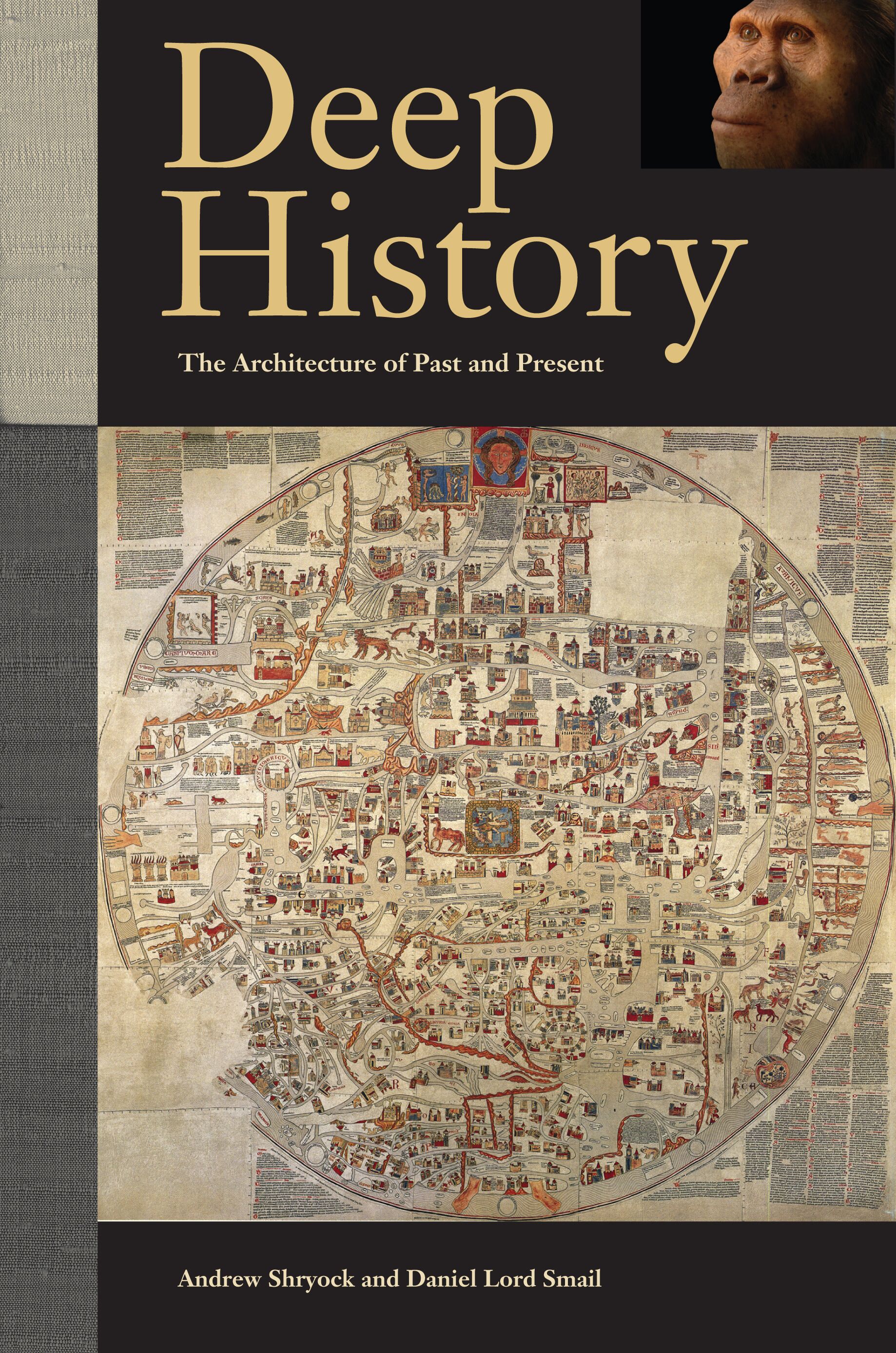
Deep history
Humans have always been interested in their origins, but historians have been reluctant to write about the long stretches of time before the invention of writing. In fact, the deep past was left out of most historical writing almost as soon as it was discovered. This breakthrough book, as important for readers interested in the present as in the past,brings science into history to offer a dazzling new vision of humanity across time. Team-written by leading experts in a variety of fields, it maps events, cultures, and eras across millions of years to present a new scale for understanding the human body, energy and ecosystems, language, food, kinship, migration, and more. Combining cutting-edge social and evolutionary theory with the latest discoveries about human genes, brains, and material culture, Deep History invites scholars and general readers alike to explore the dynamic of connectedness that spans all of human history. With Timothy Earle, Gillian Feeley-Harnik, Felipe Fernández-Armesto, Clive Gamble, April McMahon, John C. Mitani, Hendrik Poinar, Mary C. Stiner, and Thomas R. Trautmann
eBook


Breaking hospitality apart: bad hosts, bad guests, and the problem of sovereignty
Talk of hospitality often turns to the problem of bad guests and bad hosts. This trend holds whether the speakers are Balga Bedouin in Jordan or political theorists in Europe, and it would seem that bad hospitality accumulates in the gaps created by shifts in scale, as houses absorb other houses, or nation-states and their citizens compete to control the concepts and practices that define house, host, and guest. Moving from Bedouin history to metropolitan political theory, I show how bad hosts and guests break hospitality apart, revealing its component parts and how they work. Quand on parle d'hospitalité, que ce soit avec des Bédouins Balga en Jordanie ou avec des politologues européens, le débat s'oriente souvent vers le problème des mauvais hôtes et des mauvais invités. C'est à croire que la mauvaise hospitalité s'accumule dans les vides créés par les changements d'échelle, lorsque les maisons absorbent d'autres maisons, lorsque les États-nations et leurs citoyens se font concurrence pour contrôler les concepts et les pratiques qui définissent la maison, l'hôte et l'invité. Passant de l'histoire des Bédouins à la théorie politique métropolitaine, je montrerai ici comment les mauvais hôtes et les mauvais invités déconstruisent l'hospitalité, révélant ses composantes et leur manière de fonctionner.
Journal Article


History and the \Pre\
Smail and Shryock explore a type of historical argument, common in recent writing about the past, that invokes the \"pre.\" The \"pre,\" they say, is vital to certain kinds of arguments; it can be used to justify claims of revolution, accelerating change, or the invention of agency. Evocation of the \"pre\" can give clarity to the \"post\" including the postcolonial, postmodern, and postindustrial--but it also renders deep time invisible. They offer a model for crafting deep historical arguments that don't depend on the invocation of \"pre\" or \"post.\" They question the centrality of agency and contingency to the construction of modern(ist) historical accounts, showing how these ideas draw history away from the deep past and ever closer to the present. Finally, using the shell bead as a simple example, they suggest other ways of imagining and writing about deep history.
Journal Article


Islamophobia/Islamophilia : beyond the politics of enemy and friend
Islamophobia is a term that has been widely applied to anti-Muslim
ideas and actions, especially since 9/11. The contributors to this provocative
volume explore and critique the usefulness of the concept for understanding contexts
ranging from the Middle Ages to the modern day. Moving beyond familiar explanations
such as good Muslim/bad Muslim stereotypes or the clash of civilizations, they
describe Islamophobia's counterpart, Islamophilia, which deploys similar oppositions
in the interest of fostering public acceptance of Islam. Contributors address topics
such as conflicts over Islam outside and within Muslim communities in North America,
Europe, the Middle East, and South Asia; the cultural politics of literature, humor,
and urban renewal; and religious conversion to Islam.
eBook


Tribal Priorities
In the oral traditions of Jordan's Balga tribes, one event occurs many times: local shaykhs are invited to a feast by the Turks, and at this feast the shaykhs are attacked, arrested, or killed. Sometimes it is the Ottomans who are betrayed by their bedouin hosts. Either way, they should have seen it coming—that is usually the narrator's conclusion—but the lure of hospitality was strong. Something about these encounters was worth the risk of ending up in manacles, or dead.
Journal Article