
Catalogue Search | MBRL


Are you sure you want to remove the book from the shelf?

{{itemTitle}}
23
result(s) for
"Shugaar, Antony, translator"
Sort by:

The Catholic school
\"A semiautobiographical coming-of-age story, framed by the harrowing 1975 Circeo massacre\"-- Provided by publisher.
Book
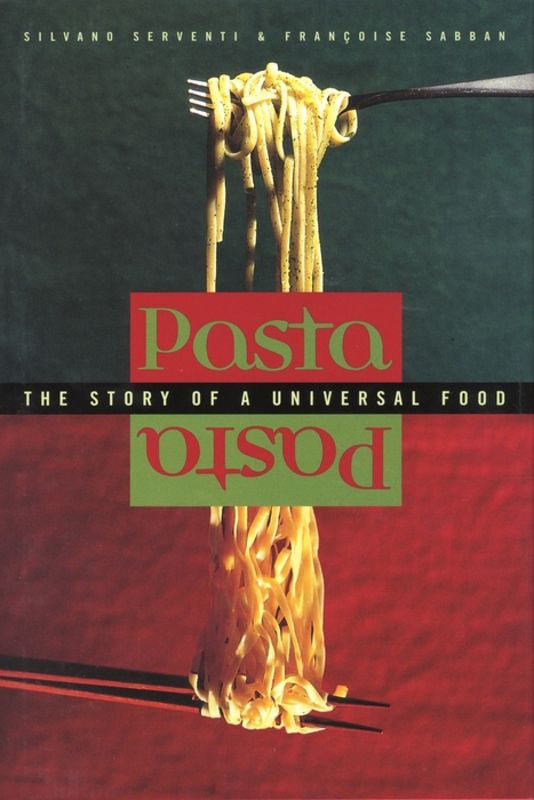
Pasta
Ranging from the imperial palaces of ancient China and the bakeries of fourteenth-century Genoa and Naples all the way to the restaurant kitchens of today, Pasta tells a story that will forever change the way you look at your next plate of vermicelli. Pasta has become a ubiquitous food, present in regional diets around the world and available in a host of shapes, sizes, textures, and tastes. Yet, although it has become a mass-produced commodity, it remains uniquely adaptable to innumerable recipes and individual creativity.Pasta: The Story of a Universal Foodshows that this enormously popular food has resulted from of a lengthy process of cultural construction and widely diverse knowledge, skills, and techniques.
Many myths are intertwined with the history of pasta, particularly the idea that Marco Polo brought pasta back from China and introduced it to Europe. That story, concocted in the early twentieth century by the trade magazineMacaroni Journal, is just one of many fictions umasked here. The true homelands of pasta have been China and Italy. Each gave rise to different but complementary culinary traditions that have spread throughout the world. From China has come pasta made with soft wheat flour, often served in broth with fresh vegetables, finely sliced meat, or chunks of fish or shellfish.Pastasciutta, the Italian style of pasta, is generally made with durum wheat semolina and presented in thick, tomato-based sauces. The history of these traditions, told here in fascinating detail, is interwoven with the legacies of expanding and contracting empires, the growth of mercantilist guilds and mass industrialization, and the rise of food as an art form.
Whether you are interested in the origins of lasagna, the strange genesis of the Chinese pasta bing or the mystique of the most magnificent pasta of all, thetimballo, this is the book for you. So dig in!
eBook

The Athenian women
The Athenian Women presents a powerful vision of class struggle, the subjugation of women under a patriarchal system, and the courage needed to change the course of history. Athens, 411 BC. In the countryside, Trasillo and Polemone, two veterans of the infamous battle of Mantinea, now live in adjacent cottages as humble farmers. They are determined to improve their lot by finding influential husbands for their daughters, Glicera and Charis. However, sensing that a violent political scheme is secretly afoot, the two friends agree that first they must defend Athens from oligarchs who are plotting to reinstate tyrannical rule. Charis and Glicera are convinced their fathers are being paranoid and, impatient, set about finding suitors themselves. Cimone, the rich and arrogant son of their neighbor Eubulo, soon becomes the object of their desire. When the men travel to Athens to see Aristophanes' latest comedy, the girls, far from their fathers' watchful eyes, break social order and accept an invitation to Cimone's house. While this romantic drama plays out in the countryside, from the stage, the Athenian Lysistrata and the Spartan Lampito raise their voices in protest against misogyny and war, calling into question the status quo that Athenians have accepted for centuries. Alessandro Barbero captures an Athens that feels extraordinarily contemporary, where citizens concerned about their freedoms choose to act and create change.
Book


The Pope's daughter
\"Lucrezia Borgia is one of the most vilified figures in modern history. The daughter of a notorious pope, she was twice betrothed before the age of eleven and thrice married--one husband was forced to declare himself impotent and thereby unfit and another was murdered by Lucrezia's own brother, Cesar Borgia. She is cast in the role of murderess, temptress, incestuous lover, loose woman, femme fatale par excellence. But there is always more than one version of a story. Lucrezia Borgia is the only woman in history to serve as the head of the Catholic Church. She successfully administered several of the Renaissance Italy's most thriving cities, founded one of the world's first credit unions, and was a generous patron of the arts. She was mother to a prince and to a cardinal. She was a devoted wife to the Prince of Ferrara, and the lover of the poet Pietro Bembo. She was a child of the renaissance and in many ways the world's first modern woman.\"--Jacket flap.
Book


We'll sleep when we're old
\"Like Fellini's classic film 8 1/2 and mixed with Elmore Leonard's Get Shorty, a gorgeously wrought novel that explores the complicated life of a controversial Italian film producer who vanishes after a fire destroys his home. Rome, present day: an extravagant, opulent world of fashionable parties, fancy cars, and powerful men and women in a constant dance of excess and intrigue. Oscar Martello, president of a film production company, is a self-made man: despite his humble origins, he has managed to achieve unbelievable fame and success. He is also a cutthroat and ruthless visionary. Andrea Serrano, his best friend, is a scriptwriter who explores the themes of love and murder in his work. The beautiful actress Jacaranda Rizzi, Oscar's muse, has a secret that has been tormenting her for many years. Pulsing with ambition, all three represent the apex of Rome's complex and privileged network of glamorous yet troubled aristocrats. When a fire devastates Oscar's villa in one of the city's most fashionable neighborhoods and he goes missing, all of Rome is left to wonder about his fate. The evidence points to Jacaranda, but could she have orchestrated something so sinister? More important, could she have done it alone, or has Andrea played some role in the debacle? In this archly funny, immersive, and gripping novel, Pino Corrias does for Rome what Elena Ferrante did for Naples, delivering a powerful story about the high stakes world of entertainment in today's Rome, where celebrity rules all and the grande bellezza of a more gracious age has given way to something much darker\"-- Provided by publisher.
Book


Spring cleaning : a novel
\"Rocco is still reeling from the death of his best friend's girlfriend, who was murdered as she slept in his bed. There's no doubt that she was in the wrong place at the wrong time and paid the ultimate price. With the identity of the hitman still unknown, a cloud lingers over Rocco, dulling his judgment and leaving this anti-hero exposed to other threats. For Rocco has stepped on one too many people's toes over the years, namely the mafia that is still being rooted out in Aosta. To complicate matters, the kidnapped teenager that Rocco saved has not fully recovered. But all is not as it appears with that family. Her mother, father, and boyfriend are all running some sort of farce that Rocco can't easily crack. And now he must grapple between these two parallel investigations and find answers once and for all ... before one too many skeletons come after him\"-- Provided by publisher.
Book

For all the gold in the world
A robbery goes wrong and ends with a brutal murder. The police investigation turns up nothing. Two years later, Marco Buratti, alias 'the Alligator,' is asked to look into the crime and find out who was responsible. Buratti's employer is young, the youngest client he has ever had; he is only 12 years old, the son of one of the victims. The Alligator senses right from the start that the truth is cloaked, twisted and shocking. Together with his trusted associates he will find himself mixed up in a story of contraband gold and blood vendettas between criminal gangs.
Book